Amun Ra vs Ra: Who Was the Most Powerful Egyptian God?

Introduction
>In the grand landscape of ancient Egyptian mythology, the question of who holds ultimate power—Amun, Ra, or perhaps another primordial force—is less a contest of strength and more a study of the tradition’s evolving spiritual and political ecology. When people search for the most powerful Egyptian god, they are searching for a definition of cosmic authority that was anything but fixed. The true significance of this tradition lies in understanding how power was conceptualized: not as a monolithic, eternal might, but as a dynamic, often regional, and conditional balance maintained through the foundational principle of Ma’at. > >The relationship between Ra, the sun god, and Amun, the god of Thebes, exemplifies this complexity. Both are monumental figures, but examining their respective roles reveals that divine supremacy in the Egyptian worldview was heavily influenced by historical shifts and the functional requirements of the cosmos.
The Cosmic Architecture: Ra and the Principle of Ma’at
>To understand the tension between Amun and Ra, one must first appreciate the core tenets of Egyptian cosmic order. Ra, the sun god, serves as one of the most essential figures in this system 1. He is traditionally credited with creating the universe out of primordial chaos and embodies the constant, life-giving cycle of the sun. Ra’s journey through the underworld is a critical narrative, symbolizing the daily struggle to maintain Ma’at—the principle of order, truth, and universal balance—against the forces of darkness 1. > >However, the concept of power in Egypt extends beyond a single, all-encompassing deity. Ma’at itself acts as the foundational force for law, governance, and moral conduct within Egyptian society 1. While not always categorized as a supreme “god,” Ma’at is the active concept that structures the relationship between the divine and the mortal. In this sense, Ra’s power is often defined not just by his creation, but by his dedication to upholding this necessary universal balance.
The Synthesis: Amun-Ra and the Weight of Empire
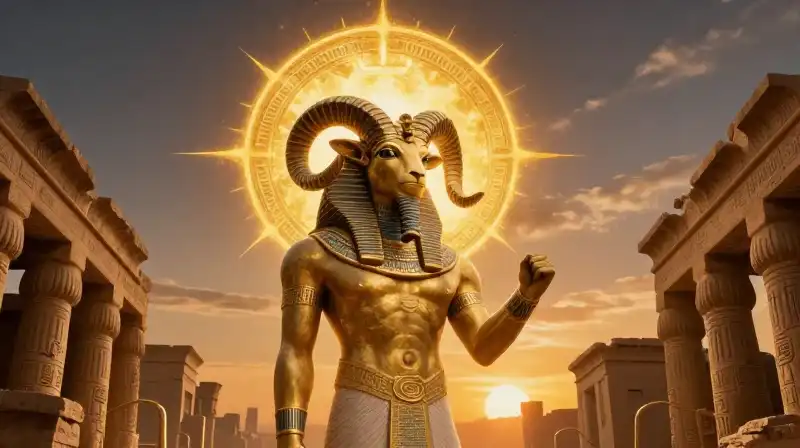
>The emergence of Amun-Ra speaks to the dynamic nature of ancient Egyptian religion, reflecting political centralization and regional reverence. Amun is held by some scholars to be among the most powerful deities 1. The theological discussion surrounding Amun and Ra centers precisely on why these two powerful figures eventually merged into a single, powerful entity: Amun-Ra (1, 2). > >When Amun merged with Ra, it created a potent, syncretic force. This union was not merely a title; it was a theological evolution that centralized power, particularly during periods when the city of Thebes flourished. Yet, the existence of both powerful entities, and the debate over who holds ultimate authority (1, 2), underscores the fact that the idea of a single, unchallenged supreme god is complex in polytheistic systems, shifting based on historical periods and regional sanctuary (1, 2). Amun-Ra represents a concentrated, synthesized power that drew heavily upon the solar divinity of Ra, while Amun himself brought the profound, localized strength of his cult.
Conditional Power and the Function of Deities
>Moving beyond the debate between Ra and Amun reveals a deeper truth: in Egyptian mythology, power was often defined by function, capability, or vulnerability rather than by sheer, brute strength. This is demonstrated vividly in the narratives of the female deities. > >Isis, the goddess of immense magical and feminine power, serves as an excellent example of conditional power. In one critical narrative, she is depicted as overcoming a Pharaoh Ra (a mortal form of the god) by using her magic to drain his poison and regain his name (1, 3). Scholars suggest that Isis did not inherently possess greater power, but rather she leveraged a specific vulnerability in Ra’s mortal form, which then allowed Ra to re-emerge, often even stronger 1. This highlights that divine authority could be achieved through cunning, support, or mastery of specific magical forces. > >Other figures further define the limits of power. Horus, associated with kingship and goodness, is a powerful protector, yet his ability to overcome chaotic figures like Set is often presented as dependent on the aid of his mother, Isis (2, 1). Meanwhile, Muut, possibly one of the oldest cosmic forces, is mentioned as a powerful goddess existing outside the standard hierarchy of deities like Apep 1. Even Sekhmet, the terrifying lioness embodying the sun’s destructive heat, is revered both as a force of destruction and as a powerful goddess of healing and protection 1.
The Domains of Time, Fate, and the Afterlife
>Certain deities define power not through solar cycles or martial force, but through the mastery of abstract concepts. Khonsu, for instance, is suggested by some tradition to possess powers over time and fate, including eternity and infinity 1. Another monumental figure is Osiris. Though strongly associated with the afterlife, his importance skyrocketed because of his resurrection, establishing him as the ultimate figure overseeing eternal life and the promise of rebirth 1. > >These figures—Osiris, Khonsu, and Ma’at—represent the enduring, systematic powers of the culture, giving meaning to the cosmic events. The ability of Osiris to grant eternal life, for example, is a far more practical and defining cultural power than Ra’s daily journey through the sun, as it dictates the ultimate fate of the individual.
Understanding Divine Hierarchy: A Nuanced View
>To conclude the search for the “most powerful” Egyptian god, one must discard the notion of a single, fixed apex. The complexity of the Egyptian pantheon, and the differing regional focus, makes the question unanswerable in a universal sense (1, 2). > >The “most powerful” deity shifts depending on the observer’s perspective: > >
>- If you value universal order and creation: Ra is central to the cycle. >- If you focus on political power and concentrated worship: Amun-Ra represents the pinnacle of Theban imperial influence. >- If you value cosmic stability: Ma’at provides the essential framework. >- If you seek ultimate transcendence: Figures like Khonsu or Osiris define eternity. >
> >The tradition does not offer a clear, definitional hierarchy. Instead, it offers a vast, interlocking tapestry of forces where power is negotiated, leveraged, and maintained through balance. A genuine understanding of this heritage requires appreciating not just the definition of the gods, but how they function as living metaphors for the spiritual and social architecture of the ancient Egyptian world.
References
Footnotes
Frequently Asked Questions
Who is more powerful, Amun or Ra?
The article states that the relationship between the two gods culminated in their union into the powerful, syncretic force of Amun-Ra. Ultimately, the article concludes that a single, universal hierarchy cannot be assigned, as divine authority shifts depending on whether one values universal order (Ra) or political power and concentrated worship (Amun-Ra).
Related Articles