The Strongest God in Egyptian Mythology: Who Was the Most Powerful?

Introduction
For a reader interested in the profound narratives of ancient Egyptian mythology, the question of who wielded the most power among the divine is perhaps the most intriguing, yet most nuanced, query. While modern interest often seeks a definitive answer, such as identifying the “strongest god” in Egyptian mythology, the reality of the Egyptian tradition reveals a far more complex picture. The pantheon was not a static, tiered hierarchy; rather, divine strength was fluid, shifting based on geopolitical realities, the specific city of worship, and the central narrative of cosmic maintenance. To seek a single “most powerful” figure is, in part, to misread the fundamental nature of Egyptian religious thought, which emphasized balance, order, and the shifting relationship between forces rather than absolute dominance.
The idea of a supreme deity was constantly debated among cultural scholars and within the community of believers, reflecting a belief that even within the heavens, different aspects of power were required—creation, chaos, kingship, and ultimate order. Instead of a single “King of Gods,” the pantheon functioned as a dynamic web of relationships, where a god’s power was often defined by their function and their role in the cosmic struggle to maintain the universe.
The Concept of Cosmic Order: The Role of Ma’at
To understand divine power in ancient Egypt, one must first grasp the critical concept of Ma’at. Ma’at is not a personified god in the traditional sense, but the very essence of cosmic order, truth, justice, and balance. This principle is perhaps the most crucial element for understanding the limits and nature of power. In the Egyptian worldview, the gods themselves were subject to moral codes and the necessity of maintaining Ma’at, ensuring that the universe did not succumb to entropy or chaos. Therefore, the most powerful figure was often not the most aggressive, but the one who best guaranteed the stability and perpetuation of the cycle of existence.
This focus on order explains why figures like Ma’at hold such a central, albeit non-aggressive, position in the divine structure. They represent the ethical and structural ceiling of the cosmos; without balance, even the most omnipotent creator would find their existence meaningless. Consequently, when we look for the “strongest god,” we are often looking for the deity who best enforces this vital, life-sustaining balance.
Amun-Ra: Power Defined by Regional Supremacy
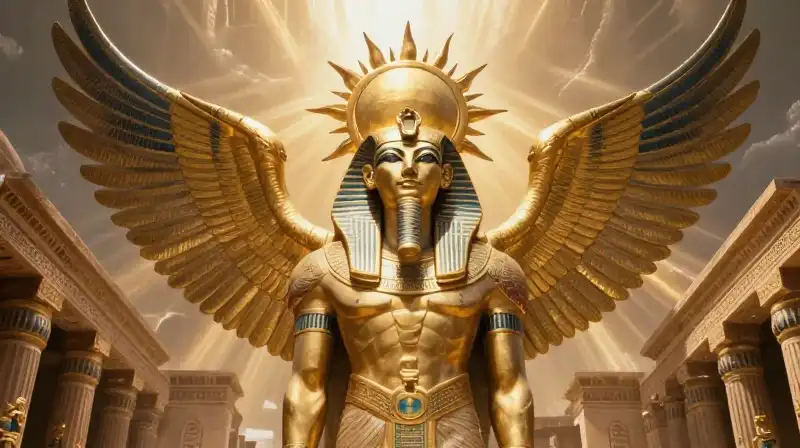
For centuries, Amun-Ra holds a preeminent position as the ultimate manifestation of imperial power and divine kingship, especially during the powerful New Kingdom period. Amun, who later merged with Ra, served as the paramount deity and the patron of the city of Thebes. This fusion created Amun-Ra, recognized as the supreme, omnipotent figure in this specific regional and chronological context 1. The rise of Amun-Ra reflects a powerful political reality: his authority was deeply intertwined with the political success and military expansion of the empire, cementing his status as the “King of Gods.”
However, it is vital to acknowledge that this supremacy was not universal. Cultural scholars emphasize that Egyptian religious authority was not monolithic. The perceived strength of a deity shifted depending on the time period and the specific city of worship, demonstrating that power was localized and political as much as it was mythical (2, 3). Therefore, while Amun-Ra reigned supreme in Thebes, the claim to universal omnipotence remained a subject of debate, with other figures holding massive sway elsewhere.
The Eternal Struggle: Creation, Ra, and Isis
At the earliest layers of creation, figures like Atum are associated with the foundational act of bringing existence into being. These figures reflect a complex understanding of primeval existence, suggesting multiple approaches to “ultimate power,” where power is defined by the genesis of the world 1. Ra, the solar deity, holds a particularly powerful and ancient claim. As the sun god, he is credited with being the primary creator, the being who initiated all life and whose nightly journey through the underworld was a perpetual battle against chaos. This narrative positioning gives Ra a deep, foundational authority over the physical world and the cycle of rebirth (3, 2).
The narrative around the struggle between the deities often illuminates the true nature of power. For instance, the interactions between Isis and Ra are telling. Isis, a figure known for her cunning and formidable magical abilities, is sometimes credited with successfully influencing or “tricking” Ra into ceding authority, reflecting the powerful role that intelligence and divine magic could play in the celestial politics 1. This dynamic suggests that power was not merely brute force, but also involved strategy, bloodlines, and divine manipulation.
The Necessity of Duality: Seth and the Embrace of Chaos
The Egyptian pantheon makes a critical distinction between destructive chaos and chaotic necessity. Seth, the god of storms, the desert, and war, represents the untamed, volatile forces of the universe. While he embodies chaos and often acts as a challenger to Ma’at and order, he is far from a villain. In the context of the tradition, he is also a necessary protector. He serves as a powerful guardian of the pharaoh and the harsh realities of the desert realm (3, 2). His strength lies in his capacity for unpredictable, raw force—the power to break stagnation and keep the balance from becoming stagnant.
This duality is essential to the “living culture” of Egyptian belief. The most powerful forces are those that understand that existence requires both absolute order (Ma’at) and the perpetual threat of chaos (Seth) to maintain equilibrium. The gods did not simply defeat chaos; they held it in check, a relationship that defines their power more than any simple act of victory.
Understanding Diverse Claims: Time, Fate, and Kingship
Beyond the dominant figures, other deities occupy specialized spheres of power that are often relevant to contemporary discussions about ultimate influence. Horus, the embodiment of divine kingship and pharaonic rule, represents a critical form of power linked directly to the terrestrial throne and divine mandate 1. Modern interpretations, however, sometimes highlight that even the power of the king could be dependent on the influence and favor of other entities, such as Isis, whose magical aid was essential to his survival and legitimacy 1.
Furthermore, figures like Khonsu or Muut are cited in discussions regarding ultimate power due to their association with controlling fate and the flow of time itself 1. In this perspective, the power to dictate the boundaries of time represents a kind of ultimate, conceptual sovereignty. These examples demonstrate that “power” in the Egyptian context could be measured by ability to govern a moment, a kingdom, or the very span of existence.
Synthesizing Divine Strength: A Cultural Reflection
In conclusion, the search for the “strongest god in Egyptian mythology” reveals less about a single supreme powerhouse and more about the profound complexity of the ancient Egyptian cosmology. The question of who was most powerful requires moving beyond the definition of a “top god” and instead understanding how the Egyptian tradition conceptualized power: as a fluid, necessary balance of forces. Amun-Ra’s reign demonstrates the political and regional peak of authority; Ra demonstrates foundational, cosmic creation; Seth demonstrates necessary, chaotic force; and Ma’at provides the moral and cosmic framework. To genuinely appreciate this tradition, one must accept that the power of the gods was a narrative of intricate relationships and strategic negotiations, not a simple hierarchy of might.
The enduring lesson from this rich heritage is that absolute power is not static. It is a constantly negotiated equilibrium between order and change, creation and destruction—a theme that continues to resonate throughout the artistic, philosophical, and spiritual life of the culture.
References
Footnotes
Related Articles