Búri: The Primordial Father of the Æsir in Norse Mythology

Introduction
In the rich tapestry of global heritage, certain traditions serve not merely as stories, but as conceptual blueprints for how the world came to be. Among the scholars of Norse heritage, few figures command as much primordial importance as Búri. He is a foundational deity—a “first god”—and the genealogical source of the great Æsir. Búri’s presence in Norse mythology is less about a specific historical figure and more about the concept of origination: the act of being powerfully brought into existence. He represents the deep, initial state of power from which the entire structure of the later, more recognized pantheon unfolds (1, 2).
The Myth of Primordial Emergence
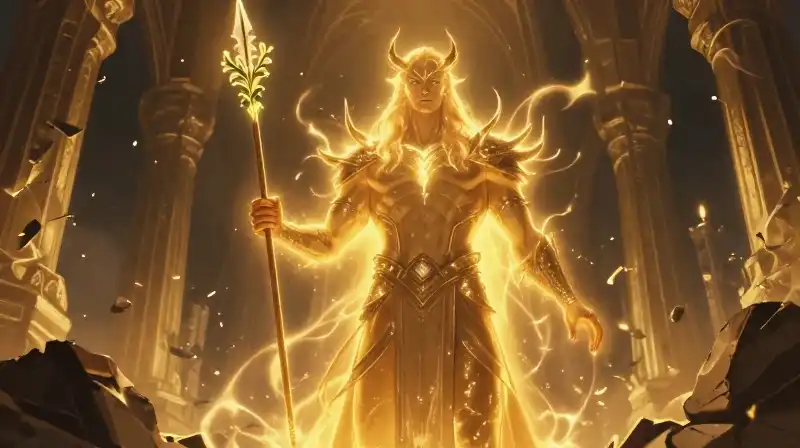
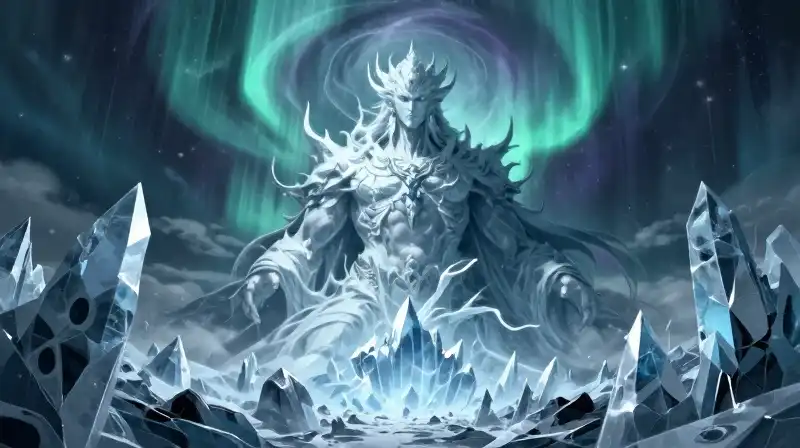
The creation narrative surrounding Búri is inherently rooted in the physical act of emergence, a process that marks him as fundamentally tied to the physical realm and its raw, untamed materials. He does not arise through a grand divine decree, but through a sustained, elemental transformation involving the primeval cow, Auðumbla. According to the preservation found in the *Prose Edda*, Búri’s genesis occurs when Auðumbla licks him free from salt rime stones that have encased him over a period of three days (3, 1, 2). This licking process is so vital to his becoming that the *Gylfaginning* details a precise, incremental physical revelation (3, 2). On the first day, the result of this licking is merely a man’s hair; on the second day, a complete head appears; and by the completion of the third day, the entire, magnificent figure of Búri is unveiled (3, 2). This story establishes Búri as a being born from the earth and primal elements, lending him an untamed, initial power. Despite his powerful description as “fair of feature, great and mighty,” his very birth suggests a state preceding settled order (3, 2).
The Linguistic and Lineage Foundations
To understand Búri’s place in the cosmology, one must look closely at the linguistic root of his name. Scholarly analysis traces the Old Norse name *Búri* back to the Proto-Germanic term *buriz*, a word translated as meaning “begotten, father” 3. This linguistic association is central to his identity, positioning him as the primary progenitor in the Old Norse worldview 3. While the narrative definitively states that Búri fathered Borr, the specific mechanics of this conception are deliberately left ambiguous (3, 1). There is no explanation provided regarding whether he created Borr through self-generation, or if the concept of sexual reproduction applies to this primordial figure (3, 1). This narrative gap suggests Búri occupies a domain of existence where conventional biology does not apply—he is more of a conceptual force of “being begotten” than a biological ancestor. His line, however, is crucial, as it leads directly to his grandsons, Óðinn, Vili, and Vé, who form the cornerstone of the principal Æsir pantheon 3.
Navigating Textual Variations
The documentation of Norse mythology is scattered across several complex, often conflicting, sources, and Búri’s presence reflects this variability. While the *Prose Edda* (specifically through the *Skáldskaparmál*) offers detailed descriptions of his emergence and his role as the father of Borr, Búri is notably absent from the *Poetic Edda* (3, 2). This absence suggests that the figure of Búri may have held different roles or existed within different strata of the oral tradition that eventually became written (3, 2). For the modern reader exploring the tradition, this difference is significant; it indicates that Búri is not a universally attested figure across all Old Norse writings, but rather a vital element preserved in the texts focused on detailed narrative and genealogy.
What Búri Represents in the Norse Conceptual Worldview
If the main Æsir gods are the “present” state of order and structure in the Norse cosmos, Búri represents the necessary chaotic power that existed *before* that order. His status as the “first god” places him at the beginning of the recorded mythological timeline, establishing him as the earliest figure described within the known Norse creation narrative (1, 2). In a cultural sense, Búri’s narrative emphasizes the theme of origination. His physical description as “great and mighty” coupled with his name meaning “begotten” highlights a powerful moment of genesis—a being rising out of the cold, salt, and frozen stillness of the cosmos (3, 2). His story serves as a cultural bridge between the unshaped, primeval forces and the complex, social pantheon that follows.
For those attempting to understand “who made the Norse gods,” Búri functions as the ancestral link. He is the primordial source of that lineage, representing the initial burst of power required to seed the divine community 3.
Búri in Contemporary Scholarship
Modern scholarship on the Æsir and Old Norse religion recognizes Búri’s position as the earliest documented ancestor, which shifts how we view the evolution of the pantheon. Instead of seeing a sudden creation, the tradition suggests a process of emergence—first the foundational, powerful, ambiguous father (Búri), followed by the recognizable line of descendants (3, 2). This focus on Búri’s early emergence prevents a reductive view of the gods as being “finished” at their creation. Instead, it allows for a deeper appreciation of the gradual development of cultural and mythological identity. He forces the observer to consider the journey from the cosmic void to the structured divine community that we know through the later myths of Mjölnir and Odin.
Understanding the Origins of the Æsir
In the broader context of Norse mythology, Búri is not merely a parent; he is a conceptual point of reference. He is the proof that the great Æsir gods, while we see them in later narratives, have a documented lineage reaching back to the primal state of “begotten” existence. His role highlights the transition from mythic archetype to detailed mythological history preserved in the surviving texts 3. He establishes the initial “source” from which all subsequent power flows, making him a foundational element of Norse heritage and a critical component in understanding the scope of their world view.
References
Footnotes
How Búri Emerges from the Primeval State
The Encasing
Búri is encased in salt rime stones by the primeval cow, Auðumbla.
First Day of Transformation
Through the licking process, the result reveals only a man's hair.
Second Day of Transformation
The licking progresses, and a complete head of Búri appears.
Third Day of Transformation
The licking is completed, and the entire, magnificent figure of Búri is fully unveiled.
Related Articles