Understanding the Falcon Head: Horus, Ra, and Egyptian Deity Roles

Introduction
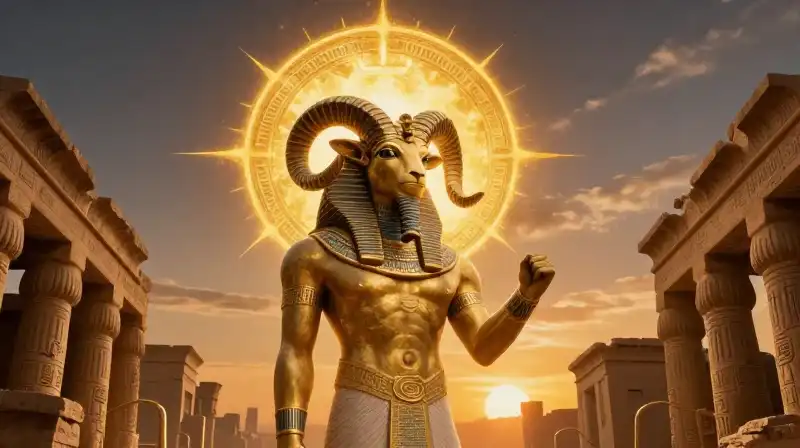
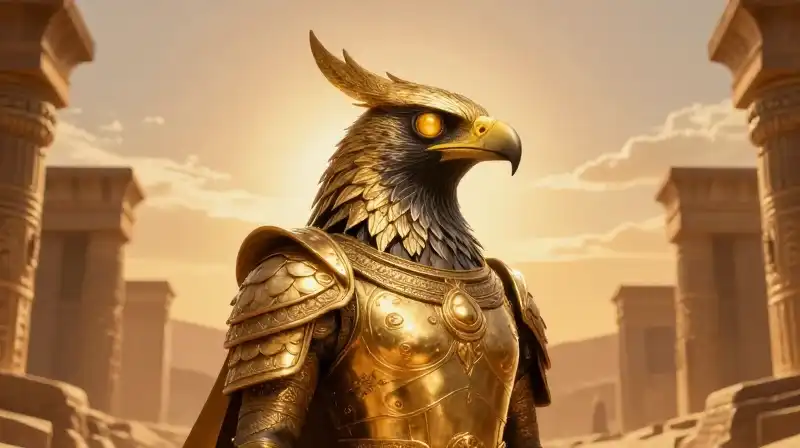
The image of a human figure crowned with a falcon’s head has long been central to the visual language of Ancient Egypt. For those navigating the vast landscape of Egyptian theology, the falcon head might initially suggest a simple stylistic choice, yet it is far more complex: it is a visual representation of ultimate divine order, celestial authority, and fierce protection. The figure wearing this attribute—most famously the god Horus, and occasionally the solar deity Ra—serves as a bridge between the earthly realm of kingship and the immense power of the heavens. To truly understand the living culture of Egypt, one must look beyond the decorative nature of the divine forms and see them as functioning as cosmic principles.
Horus: The Embodiment of Order and Kingship
Horus is arguably the most narrative and relatable of the falcon-headed deities. According to 1 and 2, he was a multifaceted god encompassing roles from sky deity to protector, and even healer. His primary narrative provides a profound insight into the Egyptian worldview: the struggle for rightful dominion. This foundational myth details how his uncle, Set, murdered his father, Osiris, scattering his body to destabilize the divine order (1, 2, 3). Horus’s subsequent quest to reclaim the throne is not merely a family feud; it is the cosmic battle between order and chaos. In this cultural context, the pharaoh was believed to be the earthly embodiment and direct representative of Horus (1, 3). By linking the human ruler to this divine champion, the entire system of governance—the divine kingship—was justified. The pharaoh, therefore, was seen as holding the keys to the cosmic structure, leveraging Horus’s inherent divine dominion to manage the world (1, 3).
Ra and the Celestial Ascent: The Sun’s Divine Form
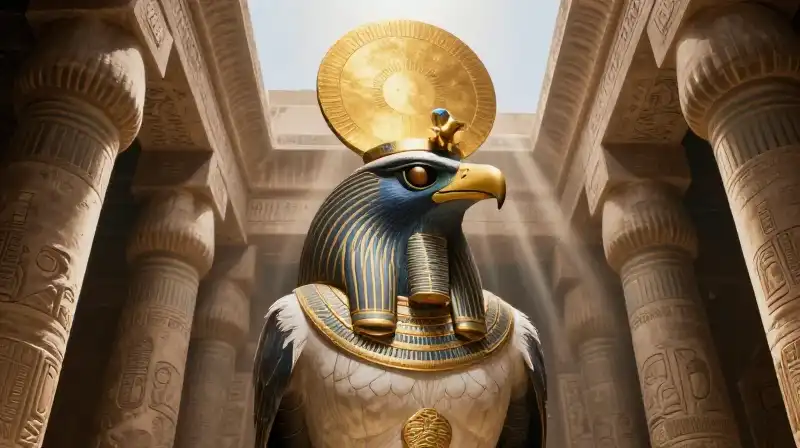
While Horus governs the narrative of rightful rule, the connection between the falcon head and the solar cycle is seen in the depiction of Ra. Ra, the primordial sun god, was sometimes shown as a man possessing a falcon head 1. This visual linkage is rooted in cosmology: Egyptians saw the god’s flight across the daytime sky as the Sun itself. Furthermore, the concept of Horus as the sky deity is often tied to the dual paths of the cosmos. One perspective suggests that the god’s flight in the sky represented the movement of the Sun via his right eye, while the Moon was observed via his left (1, 3). This connection illustrates a crucial point in Egyptian belief: the celestial bodies and the deities were not separate entities but various manifestations of the same divine energy, linked to cycles of life, death, and rebirth (1, 2).
The Eye of Horus (Wedjat): A Symbol of Practical Protection
The abstract concept of cosmic order translates into concrete protective measures through the “Eye of Horus,” also known as the *wedjat* (1, 2). This powerful symbol represents royal power and divine wholeness. Beyond being a powerful symbol of the divine order maintained by Horus, the eye held immense practical significance for the community. It was utilized in funerary amulets, intended to ensure protection in the afterlife, and was also employed by travelers, particularly sailors, seeking safe passage on the unpredictable seas (1, 2). The *wedjat* thus demonstrates how abstract theological concepts—the restoration of balance after chaos—could be simplified into a talisman of guaranteed safety and wholeness in daily life. This served as a potent form of reassurance in a society where the natural world was often seen as a volatile reflection of divine whim.
The Multi-layered Divine: Understanding Facets vs. Entities
A common point of confusion for those studying the “Egyptian god falcon head” is the perceived distinction between Horus, Ra, and various other forms. It is vital to understand that scholars suggest these variations are less about representing separate gods and more about a multi-layered deity or system 1. Horus’s origins, for instance, describe a mystical cycle: his birth was achieved through the intervention of Isis, who resurrected Osiris and subsequently conceived their son (1, 2). This allows the divine system to be fluid and adaptable. Horus embodies the triumph of the righteous order (Ma’at) over anarchy. Whether depicted as the falcon itself or as a man, he consistently represents the intersection of heavenly power and legitimate earthly authority, whether that authority is claimed by a Pharaoh or invoked through a powerful protective amulet.
Conclusion: The Living Legacy of Divine Authority
To encounter the falcon-headed gods of Egypt is to encounter a powerful theological statement on the necessity of balance. These traditions taught that even the most devastating acts of violence—the murder of Osiris by Set—do not result in irreversible chaos, but rather initiate a sacred quest for rightful restoration. The falcon, in its majesty, stands as the guardian of that quest. Understanding the *wedjat*, the pharaoh’s identity as Horus, and the solar cycles associated with Ra provides the framework for grasping the fundamental Egyptian belief that even when the world seems out of control, the divine principle of Order (*Ma’at*) remains perpetually engaged in a relentless, beautiful, and purposeful struggle to maintain stability.
References
Footnotes
Frequently Asked Questions
Why does Ra have a falcon head?
The falcon head visually represented Ras function as the primordial sun god, as Egyptians viewed the gods flight across the daytime sky as the Sun itself. This visual linkage is rooted in cosmology to illustrate Ras celestial nature.
Related Articles