Aker: The Egyptian God of the Horizon and Underworld

Introduction
Aker, a central figure in the intricate tapestry of ancient Egyptian cosmology, was more than merely a deity; he was a potent personification of transition, marking the liminal space between worlds. Often identified as an earth god and a protector of the underworld, Aker presided over the profound boundaries of existence, guarding both the eastern threshold (Bakhu) and the western boundary (Manu) (1, 2). For the ancient Egyptians, the horizon was not just a geographical feature but a sacred, fluid space—a place where creation met its end and where the cycle of solar rebirth was guaranteed. Understanding Aker means examining the ancient Egyptian worldview through the lens of boundaries, guardianship, and the relentless journey through the cosmos.
Iconography and the Evolution of Form
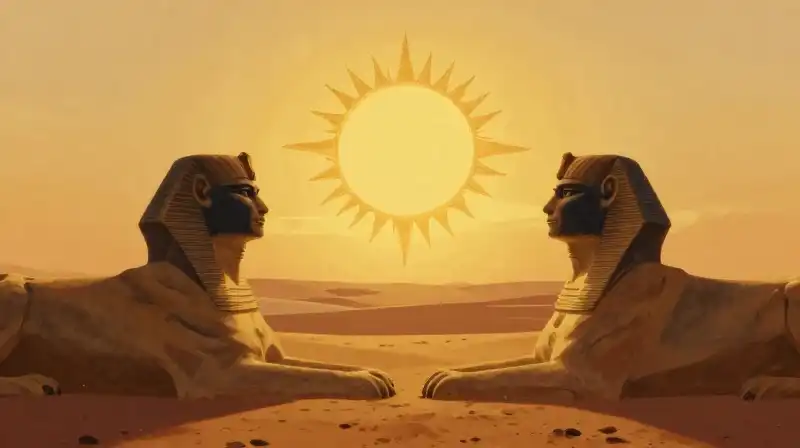
The visual depiction of Aker reflects the dynamic conceptual shift he embodied, evolving from a simple natural feature into a complex mythological entity. Originally, the deity was associated with “the two lions,” a powerful metaphor for guardianship, though the name Aker itself translates to something close to “(one) who bends” (2, 1). Over time, Egyptian artistic conventions transformed this conceptual duality into tangible forms. From the Middle Kingdom onward, the image of the two merged lions became highly prominent (2, 1). As theological concepts matured, Aker’s representation became increasingly anthropomorphic or sphinx-like. In later depictions, he transitioned from representing a narrow strip of land to embodying a recumbent lion torso. Eventually, he settled into the dual-form of twin lions, Duaj (“tomorrow”) and Sefe (“yesterday”) (1, 2). These later forms further elaborated upon his role, sometimes depicting two merged torsos of recumbent sphinxes, occasionally featuring human heads, signifying the blend of human intellect and fierce, primordial power 1. These varied forms serve as a visual shorthand for his overarching function: the necessary intermediary between states of being.
Aker’s Essential Role in the Cycle of Rebirth
The core significance of Aker lies in his function as a facilitator of rebirth and a protector of the divine and mortal realms. Cultically, while the primary sanctuary for Aker’s worship remains archaeologically elusive, his mythological duties are described with striking clarity in the earliest sacred texts, such as the Pyramid Texts of King Teti 1. His most crucial role was often intertwined with the sun god Ra. Aker was understood to defend Ra during his perilous nocturnal journey through the underworld caverns. He actively carried Ra’s barque through these subterranean realms, functioning as a guide (2, 1). This role is solidified in the Coffin Texts of the Middle Kingdom, where Aker is given the specific title of the “ferryman of Ra in his nocturnal barque,” marking him as the vital agent of rebirth 1. Furthermore, Aker holds a role in the genesis of new solar power; the Book of the Dead credits him with giving birth to Khepri, the sun god who represents the rising scarab and the morning sun 1.
Guard of the Threshold: Aker as Protector and Boundary Setter
The presence of Aker was intrinsically linked to protection and the establishment of boundaries. In ancient practice, twin lion statues representing Aker were frequently placed at the entrances of both palaces and tombs. These placements were not mere decoration but served a profound function as protective barriers, intended to ward off malevolent forces and evil spirits 1. As the celestial boundary-keeper, Aker’s protective powers extended to shielding the deceased Pharaoh from existential threats. Specifically, he was recorded as a powerful force that shielded the king from three powerful demonic snakes: Hemtet, Iqeru, and Jagw 1. His link to the protective god Geb further underscores his status as a pillar of cosmic order. In some of the most complex funerary narratives, Aker transcended the role of a mere boundary-marker; he came to represent the underworld itself, acting as the ultimate recipient of the enemy, Apophis 1. His body was even depicted in certain inscriptions as creating a mythological bridge, physically connecting the North and West horizons 1.
Nuances and the Akeru: The Many Faces of the Underworld
The tradition surrounding Aker is rich with nuance, suggesting that the concept was not monolithic but adapted depending on the specific narrative or era. While he was generally perceived as a benevolent protector, the divine forces associated with him could also be aggressive. The plural form, the Akeru, appears in the Pyramid Texts and suggests a more formidable and dangerous aspect of the earth gods, differing from the benevolent guide described elsewhere 1. Furthermore, scholarly analysis has introduced a connection between Aker and the wind deity Seth, a link that complicates his classification, suggesting that his earthly nature might be inextricably interwoven with the powerful, unpredictable forces of the air and chaos 1. These connections emphasize that Aker exists at the intersection of several fundamental cosmological forces: the solid earth, the solar cycle, the chaotic underbelly of the cosmos, and the shifting boundaries between life and death.
Synthesis of Meaning: The Weight of the Horizon
Aker remains a powerful example of how ancient traditions translate abstract philosophical concepts—like change, protection, and mortality—into tangible, sacred figures. He is the ultimate figure of the “in-between,” the deity whose very existence acknowledges that life, death, and rebirth are inseparable parts of a single, cyclical journey. Whether manifesting as twin lions guarding a tomb, or as the ferryman guiding the sun god Ra, Aker represents the necessary, powerful order found within transition. For the contemporary reader engaging with this tradition, Aker teaches the deep cultural value placed on boundaries and guides—the essential, often overlooked figures who make the voyage through darkness possible.
References
Footnotes
Related Articles