Heru: The Egyptian God of Kingship and the Sky

Introduction
In the vast tapestry of Ancient Egyptian belief, few figures exert the profound and enduring influence of Heru, or Horus. Known by various epithets including Har and Her, this sky deity is far more than a simple god of the heavens; he is the living embodiment of cosmic order, legitimate kingship, and protective power. To understand Horus is to understand the foundational structure of the Egyptian state itself. For the ancient Egyptians, the god was inextricably linked to the role of the pharaoh, representing the divine authority that maintained balance between the earthly realm and the celestial cycles.
The tradition surrounding Heru is rich with narrative—a drama of cosmic struggle, divine succession, and the eternal interplay between light and darkness. This is not merely a mythological story, but a cultural framework that defined how power, protection, and the very idea of a legitimate ruler functioned within Egyptian society, from the late prehistoric eras through the Ptolemaic Kingdom.
The Divine Nexus: Horus and the Pharaoh
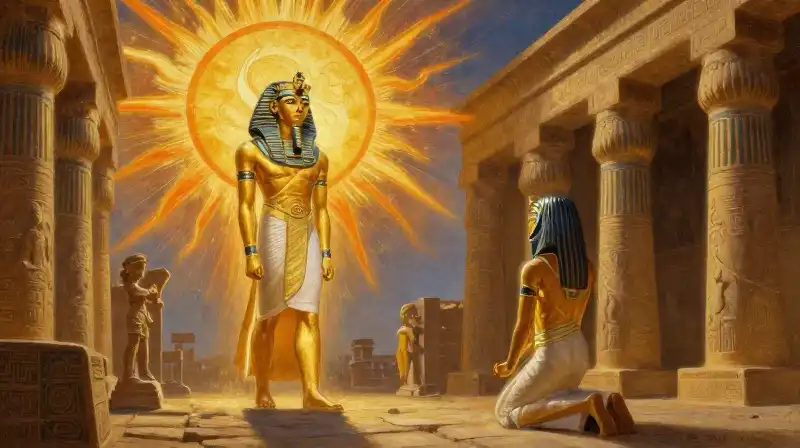
The relationship between Horus and the ruler of Egypt is perhaps the most critical element of his theology. Culturally, the pharaoh was not just a leader but was seen as being identified with Horus during his life. This concept elevated the pharaoh from a mortal king to a divine intermediary, a protector whose authority was sanctioned by the god himself 1. Horus, therefore, did not just watch over the king; he *represented* the king’s divine mandate, acting as the ultimate guarantor of the ruling power and the stability of the land 1.
As a protector and king-symbol, Horus’s responsibilities were expansive. He presided over kingship, healing, and the vast expanse of the sky. This breadth of influence allowed him to serve as one of the most significant and enduring deities across Egyptian history 1. Unlike gods who might specialize in one craft, Horus’s divinity was tied to the very order (Ma’at) that kept Egypt functioning.
Cosmic Conflict and the Triumph of Order
The Osirian myth provides the primary narrative through which Horus’s central place is established. In this profound ancient tradition, Horus is the son of the great deities Isis and Osiris. His narrative purpose is defined by his role as Osiris’s heir and his primary rival to the unpredictable god Set 1. This conflict is understood cosmically, not merely as a dynastic squabble. The battle between Horus and Set is the quintessential cosmic struggle for Egypt itself—a contest between order and chaos. Horus’s eventual victory solidified his position as the supreme victor, bringing stability and rightful rule back to the land (1, 2).
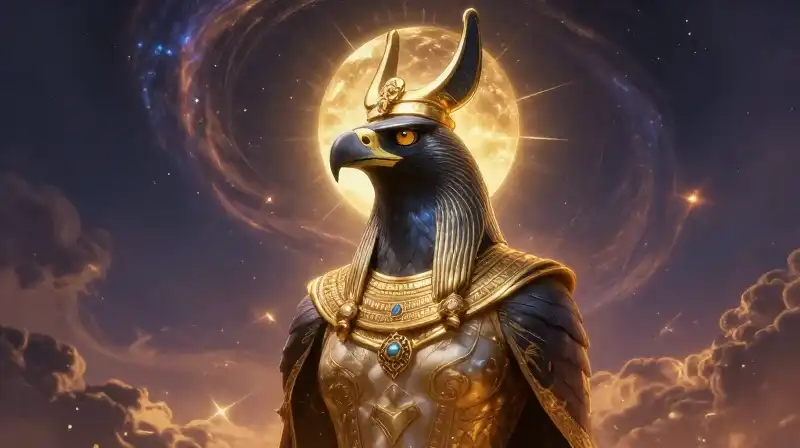
Symbolically, his divine anatomy reinforces his role as the traverser of the celestial realm. Tradition holds that he contains the Sun in his right eye and the Moon in his left eye, allowing him to move across the sky as a protective, vigilant falcon 1. This iconography demonstrates that his protection is not localized, but universal—reaching across the entire cosmos he inhabits.
Iconography: The Falcon and the Protective Eye
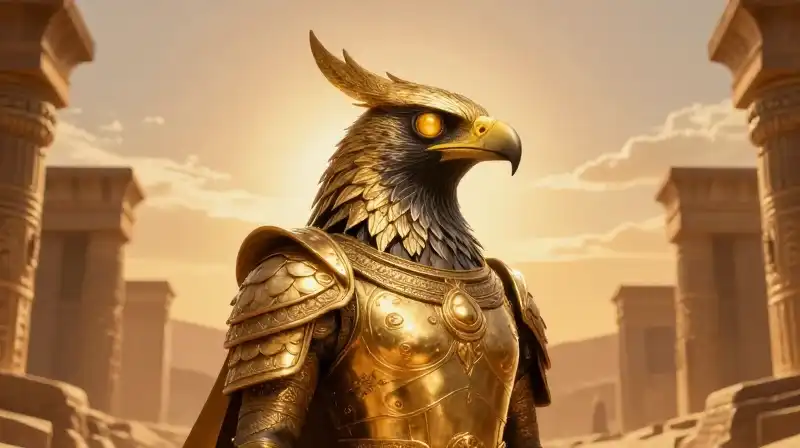
To the eye of the ancient people, Heru was often depicted in powerful and distinct forms, conveying his specific roles. The most recognizable form is the falcon, typically identified as a lanner or peregrine falcon 1. When depicted in his human form, he is often shown with the striking falcon head. However, the tradition also accounts for a youthful representation known as “Good Horus” (*nfr ḥr.w*), which sometimes shows him as a naked boy 1. These various forms reflect the different facets of his personality and power.
From his divine form, the powerful concept of the Wedjat—the Eye of Horus—was derived. This ancient symbol is far more than a decorative motif; it is a powerful mark of royal power and, crucially, protection. It appears frequently in funerary amulets, signifying that the divine gaze of Horus continues to safeguard the deceased even in the afterlife 1.
Regional Nuances and Ancient Origins
While tradition commonly links Horus to the delta and Lower Egypt, the development of his cult reveals a more complex regional history. The earliest known manifestation of Horus began as a tutelary deity specific to Nekhen in Upper Egypt. It was only through the gradual absorption of local regional gods that the Horus cult evolved into the first truly national god of the unified kingdom (1, 2). This suggests that the journey of Heru was one of assimilation and expansion, growing from a localized sacred presence to a universal divine authority.
Furthermore, Egyptian scholarship distinguishes between different forms of the deity, such as Heru-ur, known as “Horus the Elder” (1, 2). These variations show that the interpretation of the deity adapted to the needs and beliefs of different eras and communities, ensuring his relevance across millennia.
Addressing the Spiritual Inquiry: Heru and Other Concepts
As the tradition of Egyptian belief engages with external concepts, questions arise about the nature of its deities. It is important to maintain the clear distinction within the specific framework of the ancient Egyptian pantheon. While the mythology of Heru is vast and rich, his role is distinctly defined within the cultural context of the Nile Valley. Scholars maintain the importance of understanding the specific theological boundaries of Egyptian belief, such as clarifying his relationship to other major gods like Ra (the sun god) or Osiris (the god of the afterlife) (1, 2). The search for connections to figures outside this specific cultural tradition requires careful contextualization, as Egyptian deities operated within a unique cosmic schema.
The Enduring Meaning of Heru
Heru stands as a monument to the cultural sophistication of ancient Egypt. He represents the enduring belief that the human world and the divine world are intrinsically linked; the stability of the pharaoh is the stability of the cosmos. His narrative—the struggle against chaos, the triumph of divine succession, and the continuous protection of the land—provides a profound lens through which we can view the core values of the Egyptian tradition: order, vigilance, and the sacred necessity of leadership. Understanding Heru is understanding the blueprint of Egyptian culture itself.
References
Footnotes
Frequently Asked Questions
How was Heru born?
In the Osirian myth, Horus is the son of the great deities Isis and Osiris.
What is the connection between Heru and Jesus?
The provided article does not mention Jesus or describe any connection between Heru and him. It emphasizes maintaining the clear distinction within the specific framework of the ancient Egyptian pantheon.
Related Articles