
The Celtic Cross: Spiritual Meaning, Symbols, and Origins

Introduction
The Celtic Cross is far more than a simple fusion of two shapes; it is a complex historical document, a living emblem that embodies the intersection of ancient reverence and Christian adoption across the cultures of Ireland, Scotland, Wales, and Southwest England. Originating during the Middle Ages, this powerful design has transcended its religious roots to become a profound marker of cultural lineage and identity. It speaks not of rigid doctrine, but of a negotiation between pre-existing spiritual beliefs and the introduction of new faith, offering a visual language of spiritual unity and wholeness 1.
To understand the Celtic Cross is to look beyond a dictionary definition. It is to explore a tradition that carries the echoes of Celtic folklore, the ingenuity of ancient craftsmanship, and the sustained pride of communities tracing their ancestry back to the Celts. The cross serves as a visual narrative, documenting how people celebrated their worlds, structured their beliefs, and maintained their identity against changing historical tides.
The Historical Negotiation: From Sun Cycles to Sacred Symbols
The traditional history of the Celtic Cross is steeped in scholarly debate. While St. Patrick is often mentioned in the earliest narratives surrounding its origin, his role remains contested. One powerful theory suggests that the cross was not a sudden Christian imposition, but rather a sophisticated synthesis. It posits that earlier pagan sun circles were intentionally merged with the Christian cross during the era of conversion, serving as a unifying symbol to ease the transition to a new faith 1.
Other interpretations suggest the cross was deliberately employed to assert the dominance of Christian deities over previous pagan figures. Regardless of the precise intent, the resulting form became deeply embedded in the cultural landscape. Historically, some interpretations even view the cross’s structure as a symbolic nod to the revered trees integral to traditional pagan Celtic spirituality 1. The design itself evolved significantly, shifting from older versions where the arms were contained within the ring to modern interpretations featuring intricate geometric patterns and spirals derived from historic Celtic metalwork.
Layers of Meaning: Decoding the Geometry of the Soul
The power of the Celtic Cross lies in its layers of symbolism, where different traditions propose different, yet complementary, meanings. The integration of the circle and the arms does not yield a single, universally agreed-upon meaning; rather, it invites a dialogue between multiple forms of spiritual thought.
The Interpretation of the Circle
The prominent ring or circle at the center has been interpreted in several ways, each offering a distinct spiritual layer. It may be seen as a powerful derivation from the ancient Celtic sun symbol—sometimes specifically associated with the Roman sun god Invictus. Alternatively, the circle is frequently identified in Christian contexts as representing the halo of Jesus Christ. In some views, however, the circle takes on an even deeper, more abstract resonance, representing the cycle of eternity or the wheel of life 1.
The Meaning of the Four Arms
Similarly, the four arms of the cross carry various profound significances across different traditions. Some scholars suggest they represent the cardinal directions, symbolizing the cross’s reach into the world. Others propose a celestial or elemental interpretation, where the arms represent the four elements: earth, fire, wind, and air. A third, time-based interpretation suggests the arms track the passage of time, mirroring the transition from dawn through dusk 1.
These varied readings coalesce into a singular concept: wholeness. The cross acts as a holistic symbol, weaving the individual back into the greater cosmic and communal tapestry.
Forms and Functions Across the Landscape
In practice, the Celtic Cross is not monolithic. Its design and function are dictated by whether it is used in a sacred, public, or memorial context. Two primary forms demonstrate this functional diversity.
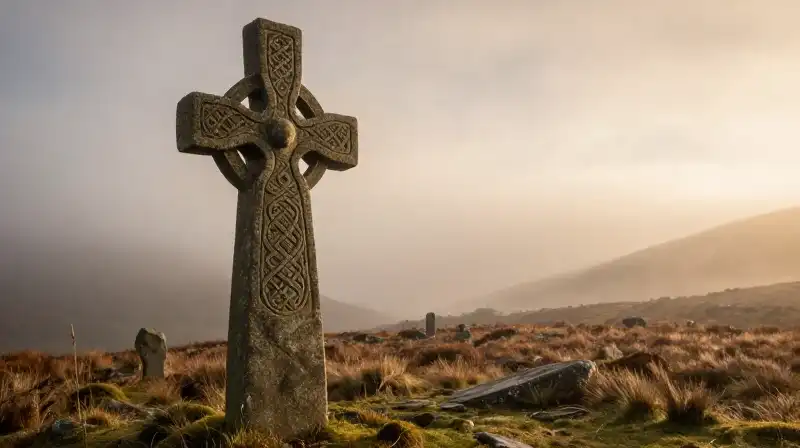
- The Ecclesiastical High Cross: Characterized by a long, prominent vertical beam, these are found primarily in ecclesiastical settings. They are often ornately carved and serve as markers of deep spiritual importance and narrative focus within religious communities 1.
- The Celtic Memorial Cross: These are specifically designed for funerary purposes. Their presence on grave markers often serves as a poignant reflection of a person’s connection to their heritage and their spiritual continuity.
Beyond the spiritual realm, there is a lesser-known theory suggesting a practical, architectural dimension. Some interpretations propose that the integrated circular design may have been an engineering choice, offering structural stability to the cross against harsh environmental erosion over centuries 1. Whether spiritual or structural, the enduring presence of the Celtic Cross speaks to its foundational importance in the regional landscape.
The Cross as Cultural Identity and Modern Heritage
The true flourishing of the Celtic Cross in modern life occurred during the mid-19th-century Celtic revival. This period saw the symbol become a powerful and emotive marker of national identity and heritage, particularly in the context of Irish independence and the reclaiming of ancient cultural roots 1. It moved from a strictly religious or architectural object to an icon of cultural defiance and collective pride.
Today, the meaning of the Celtic Cross is highly personal. For many, particularly those tracing their roots to Celtic cultures, it functions as an emblem of lineage. It is frequently adopted in jewelry, tattoos, and personal art, representing a connection to one’s ancestors and a commitment to cultural continuity. This modern usage elevates the cross from a historical relic to a dynamic, personal symbol of belonging and shared history.
Navigating Modern Practice: Belief and Personal Expression
The pervasive nature of the Celtic Cross often raises questions about its religious classification and proper usage. Because its history is rooted in a synthesis of pre-Christian and Christian traditions, its acceptance is broad, but not necessarily standardized across all modern faiths.
When considering whether to wear a Celtic Cross, it is essential to understand that its meaning is fluid. It functions as a powerful cultural, historical, or spiritual emblem for many, regardless of strict religious adherence. The symbol’s ability to incorporate themes of universal unity, harmony, and balance allows it to resonate with those who seek a sense of inner peace or a connection to a specific regional heritage. For those exploring Celtic spirituality, it serves as a direct link to the cultural narratives of the region. It is not strictly limited to a single denomination, but rather stands as a symbol of a broad cultural tapestry.
Cultural Synthesis: More Than a Definition
The enduring resonance of the Celtic Cross lies in its refusal to adhere to a single explanation. It exists at the powerful intersection of history, faith, and artistic expression. Whether it is understood as the path to the cardinal directions, the cycle of the sun, or the union of two disparate worldviews, the cross stands as a powerful reminder of human resilience and the beauty of cultural layering. It is a symbol that allows the past to speak directly to the present, reminding us that identity is rarely found in a single point, but in the wholeness of its components—the intersecting arms and the unifying circle.
References
Footnotes
Frequently Asked Questions
Should Christians wear a Celtic Cross?
Its acceptance is broad because its history is rooted in a synthesis of pre-Christian and Christian traditions, and its meaning is fluid and not strictly limited to a single denomination. The cross functions as a powerful cultural, historical, or spiritual emblem for many regardless of strict religious adherence.
What religion has a Celtic Cross?
The Celtic Cross emerged from a synthesis of pre-Christian and Christian traditions, but it is not strictly limited to a single denomination. It functions as a broad cultural, historical, or spiritual emblem for many, especially those exploring Celtic spirituality or regional heritage.
Related Articles