Japanese Creation Mythology: The Epic Story of Izanagi and Izanami

Introduction
The mythology of creation in Japan is not merely an ancient story of divine progenitors; it is the foundational text for the spiritual life of Shinto and the cultural identity of the Japanese people. This epic, chronicling the journey from primal chaos to the ordered archipelago, is primarily encapsulated in the foundational works, the *Kojiki* (712) and *Nihon Shoki* (720) 1. These texts together trace the origins of the *Kami* (gods) and the realm known as the Tenchi-kaibyaku. For the contemporary reader, understanding this narrative is key to grasping the deep connection between Japanese folklore, imperial lineage, and the living practice of ritual purity (*harai*).
The Political Roots of Myth: Establishing Order
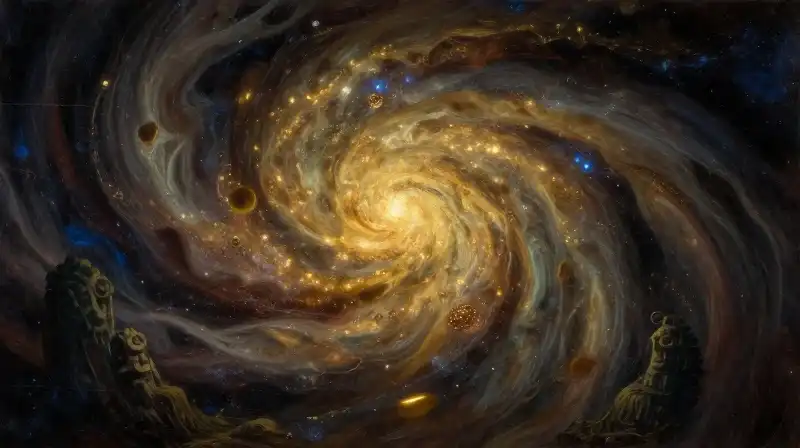
Before delving into the celestial drama, it is necessary to understand the historical and political context of these narratives. The compilation of the *Kojiki* and *Nihon Shoki* was not solely a spiritual exercise; it was a sophisticated act of statecraft 1. By meticulously tracing the lineage of the ruling class back through the creation myths to the primordial divine entities, the authorities sought to legitimize their rule and establish a sacred continuum between the present society and the ancient divine world. Cosmologically, the universe begins in a state of undifferentiated chaos—often described as a shapeless, primordial mass or “egg” 1. From this chaotic state, the elements of light and matter gradually separated, allowing for the gradual formation of the High Plain of Heaven, or *Takamagahara*, and the physical world of the Earth 1. The earliest divine entities, such as Takamimusubi, are referred to as the Three Creating Deities. They are viewed as spontaneous emanations of this nascent cosmos, existing prior to the birth of more human-like divine figures 1.
Izanagi and Izanami: The Act of Creation
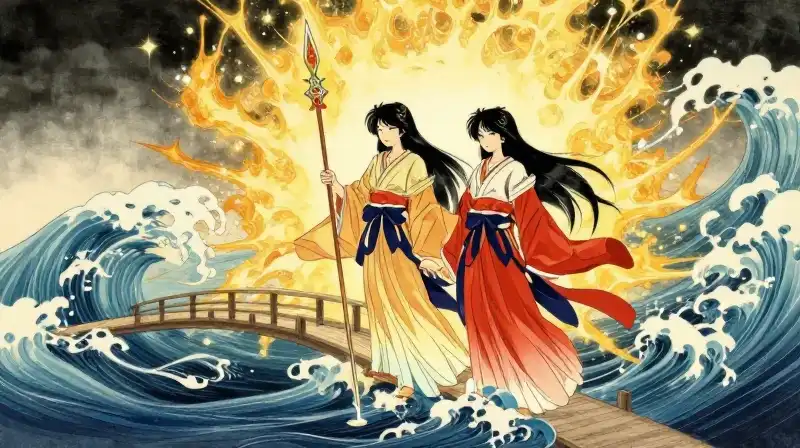
The main narrative gains momentum when celestial deities instruct Izanagi and Izanami, the eighth pair of gods to emerge, to begin the task of generating the physical world 1. They were given a jeweled spear, and together they ventured into the primeval ocean to create the land. Their method was simple yet profound: they stirred the sea with the spear, and from the resulting dripping matter, solid land coagulated into existence (1, 2). The creation of the various islands—including the later major masses of Honshu, Kyushu, Shikoku, and Oki—is attributed to Izanagi and Izanami. However, their initial attempts to procreate were fraught with ritual complication. According to both major sources, their first unsuccessful union resulted in a deformed child (1, 3). This error necessitated a correction: the divine couple began circling a Heavenly August Pillar. This ritual correction established a more orderly and proper rhythm to the act of creation (1, 3). Only after rectifying these initial mistakes did they successfully birth the various elements and, subsequently, the lesser gods who would govern the land, the mountains, and the seas (1, 3).
The Descent and the Birth of Harai
The story takes a dramatic and transformative turn with the birth of Kagutsuchi-no-Kami, the deity of fire. When this divine fire burned Izanami severely, she could not return to the Upper World. She descended to Yomi, the land of darkness and the dead 1. Izanagi followed, unable to bear the separation. His subsequent journey into Yomi and the encounter there became the crucible for the foundational spiritual practices of Japan. As Izanagi cleansed himself through a ritual purification bath in the sea, he became exposed to the essences of the underworld. From his purified body, key divine entities were born: Amaterasu, the Sun Goddess (born from his left eye); Tsukiyomi, the Moon God (born from his right eye); and Susanoo, the storm god (born from his nose) 1. This act of purification from the taint of the dead is widely regarded in Shinto as the foundational origin of *harai*—the sacred ritual practices designed to cleanse and restore spiritual order 1.
From Creation to Legacy: Understanding the Gods
The narrative does more than just explain how the world began; it sets the stage for the entire Shinto pantheon. By examining the consequences of Izanami’s descent and Izanagi’s cleansing, the mythology establishes a dual-natured cosmos: the brilliance and order of the Upper World (*Takamagahara*) and the necessary but dangerous power of the underworld (Yomi). This structure allowed the gods to evolve. While Amaterasu remains the most venerated and central figure—representing solar power and imperial lineage—the various lesser gods and elements derived from the creation and the purification process govern the day-to-day life of communities. This demonstrates a cultural understanding of balance: that creation requires both powerful forces (like the destructive fire of Kagutsuchi) and the profound necessity of renewal and purity.
People Also Ask: Myth vs. History
What is the main difference between the Kojiki and Nihon Shoki?
While both texts serve as the primary literary basis for Shinto mythology, the *Kojiki* is often seen as the more poetic and purely mythological record, focusing heavily on divine narrative. The *Nihon Shoki*, while also containing creation stories, is considered a more detailed and structured historical chronicle, blending genealogical records with the supernatural (1, 2).
Why are the myths so important today?
The myths are significant not just as historical relics, but as a living cultural touchstone. They explain the spiritual connection to the land, validate certain community traditions, and define the concept of *harai*—the ongoing cultural commitment to purification and order in daily life.
Are Izanagi and Izanami the same as Amaterasu?
No. Izanagi and Izanami are the primordial creators, responsible for forming the physical world and the early divine family. Amaterasu, the Sun Goddess, is a later, highly specific deity born from Izanagi’s purification, representing a specific aspect of cosmic order and light.
Cultural Significance: A Living Tradition
The Japanese creation mythology is a complex tapestry woven from deep spiritual beliefs and intricate social engineering. For the community, it is an ongoing story of cyclical renewal. The necessity of Izanagi bathing in the sea to achieve purity mirrors the ongoing spiritual discipline inherent in Shinto practice. The myths provide a framework for navigating dualities—life and death, order and chaos—teaching that even the most profound act of creation (and even the greatest transgression) requires subsequent purification to restore the balance of the community. It is not simply a history of gods, but a spiritual mandate for continuous harmony.
References
Footnotes
How the major deities were born through purification
Izanami's Descent
When the deity of fire, Kagutsuchi-no-Kami, burned Izanami, she could not return to the Upper World and descended to Yomi, the land of darkness and the dead.
Izanagi's Pursuit
Izanagi followed Izanami into Yomi, unable to bear the separation.
Ritual Purification
Izanagi cleansed himself through a ritual purification bath in the sea to counteract the taint of the underworld.
Spiritual Exposure
During his purification, Izanagi became exposed to the essences of the underworld.
Birth of Key Deities
Key divine entities were born from his purified body: Amaterasu, the Sun Goddess, from his left eye; Tsukiyomi, the Moon God, from his right eye; and Susanoo, the storm god, from his nose.
Related Articles