Hathor: The Egyptian Goddess of Love, Beauty, and the Stars

Introduction
Hathor stands as one of the most compelling and multifaceted deities in the tapestry of ancient Egyptian belief. More than a simple “Egyptian goddess of love and beauty,” she was a powerful celestial figure who functioned as a cultural nexus—a divine embodiment of the rhythms of life itself. To the ancient Egyptians, Hathor was the keeper of joy, the mother of gods, the consort of the heavens, and a potent symbol linking the cosmic order to the earthly power of the pharaoh 1. Understanding Hathor is not just about learning a mythological name; it is exploring a complex system where music, motherhood, beauty, and the cyclical journey of the sun were interwoven into the core fabric of their civilization 1.
The Multifaceted Divine Persona
Hathor’s spiritual significance derived from her ability to seamlessly transition between various roles. She was a cosmic force, often referred to as the “mistress of the stars,” dwelling in the heavens alongside the sun god, Ra 1. Her status as the biological mother of Ra each morning was a key element of her role, representing both creation and renewal. This divine duality was reflected in her interpersonal relationships. She served as a divine consort to Ra and as a mother to the gods, including Horus and Ra himself, thereby establishing a profound link between her and the earthly kingship embodied by the pharaoh 1. This positioning meant that her worship was deeply intertwined with the maintenance of cosmic harmony—a crucial goal in Egyptian life. Furthermore, while some of her functions were celestial and royal, she also represented the core aspects of Egyptian femininity, including love, sexuality, beauty, joy, and nurturing maternal care 1. She synthesized the human experiences of these traits and projected them into the divine realm.
Visualizing Hathor: Iconography and Transformation
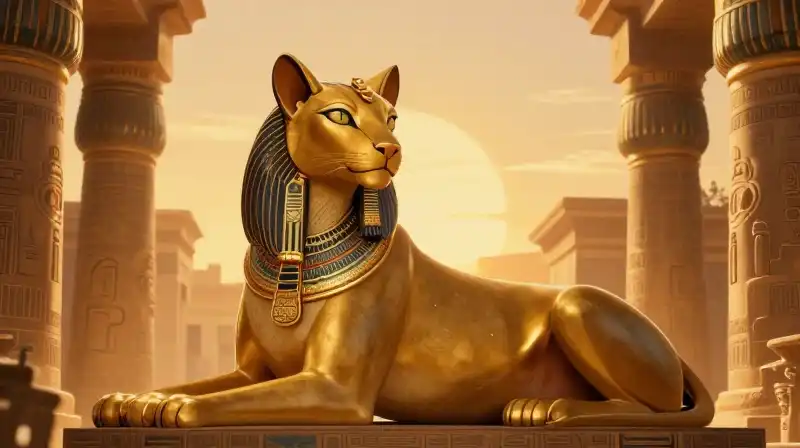
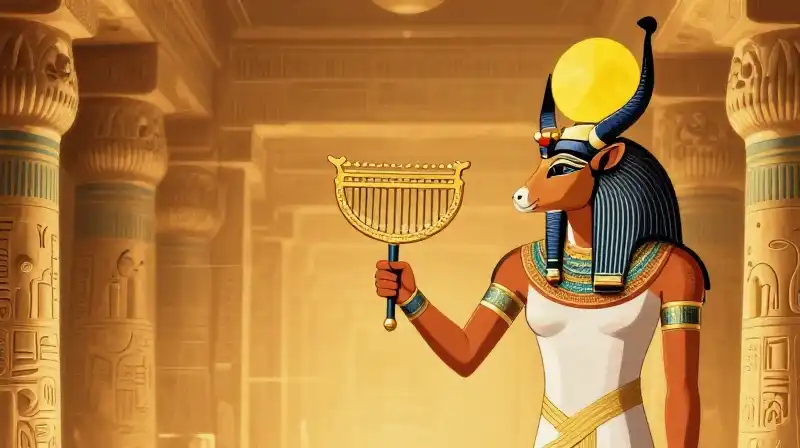
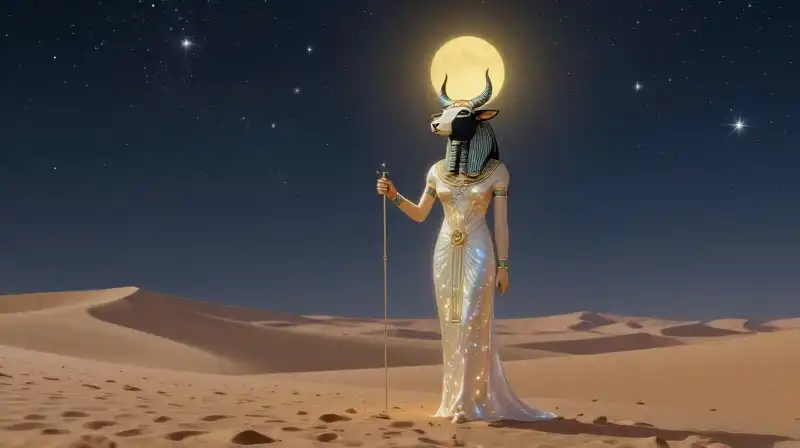
Iconography—the way a deity is visually represented—offers profound insight into Hathor’s complexity. The most recognizable depictions feature her as a beautiful woman adorned with a sun disk atop her head and the horns of a cow 1. This specific visual representation merges human beauty with the primal, maternal power suggested by the bovine form. However, her versatility meant she did not remain locked in this single form. Hathor took various other manifestations throughout Egyptian art and literature, including appearances as a lioness or a cobra 1. This ability to shift forms mirrored her ability to absorb and integrate the cult of other deities, effectively acting as a comprehensive type of goddess rather than a strictly singular entity 1. Even the depiction of the sky as a body of water, combined with her identity as a solar deity, linked her to the primordial waters from which the sun was believed to emerge 1.
Cultural Practice and Seeking Blessings
The influence of Hathor was not confined to grand temples reserved for the royalty; she held deep resonance within the private life of the community. Her importance to societal wellbeing was often reinforced through private worship 1. Among the Egyptian populace, Hathor was particularly sought out by women, who turned to her blessings for childbearing and family prosperity 1. As the “Eye of Ra,” she personified a feminine extension of the sun god’s power, and her presence was seen as vital to maintaining the smooth continuation of life throughout the land (1, 2). Her association with music and dance further cemented her position as a divine catalyst for human expression and joy 1. For the ancient Egyptians, recognizing and honoring such powerful deities was not merely a spiritual preference but a necessity for maintaining the overall harmony of existence.
The Legacy of Hathor: Evolution and Debate
Hathor’s rise to prominence, particularly during the Old Kingdom, was remarkable 1. She became a celebrated patron deity for many temples, with Dendera serving as one of her most prominent sacred sites 1. The evolution of her role also spurred scholarly debate regarding her earliest origins. Some researchers suggest that Hathor might have evolved from an earlier deity known as Bat, a figure visible on the Narmer Palette, while others maintain that the deity on that famous palette was already Hathor herself 1. Her position in the divine hierarchy was so substantial that she became a “type” deity, consolidating various divine functions into her broader, powerful presence 1.
Who is the Egyptian Equivalent of Aphrodite?
Many modern readers seek a direct comparative understanding of Hathor to other mythologies. Because Hathor encompassed so many roles—as mother, consort, beauty, and even a solar force—she does not have one single perfect equivalent. However, her multifaceted nature, which blends love, beauty, and divine origin, is why she is often compared to figures like Aphrodite in Greek tradition, though her primary connection is to the cosmic cycle and creation rather than solely to earthly romance.
The Concept of the Seven Hathors
The concept of “Seven Hathors” refers to various specific regional or contextual manifestations of the divine essence of Hathor. While she is often described as a unified “type” deity, different locales, temples, and social needs led to specialized aspects of her worship. These variations acknowledge the immense breadth of her divine functions—from nurturing motherhood to celestial power—and reflect the way a single powerful tradition can branch into regional or specialized practices.
Synthesizing the Divine Significance
Hathor’s legacy is a powerful lesson in how mythology functions not as a static list of attributes, but as a living cultural framework. She represents the synthesis of the domestic and the celestial, the passionate and the profound. She reminds us that in the Egyptian worldview, joy, the cycles of nature, and the power of love were not separate from the dictates of the gods. Her story illustrates how a divine figure can encompass the broadest spectrum of human experience, from the intimate blessing of a child to the daily, perpetual renewal of the sun itself. She remains a testament to the enduring power of beauty and harmony in maintaining a complex, ordered society.
References
Footnotes
Frequently Asked Questions
Who is the Egyptian equivalent of Aphrodite?
Hathor is often compared to figures like Aphrodite because her multifaceted nature blends love, beauty, and divine origin. Although she is linked to these traits, the article notes that her primary connection is to the cosmic cycle and creation rather than solely to earthly romance.
What are the seven hathors?
The Seven Hathors refer to various specific regional or contextual manifestations of the divine essence of Hathor. These variations acknowledge her immense breadth of divine functions and reflect how a single powerful tradition branches into specialized regional practices, temples, and social needs.
Related Articles