Norse Mythology: The Nine Worlds and What Connect Them All

Introduction
To explore Norse cosmology is to examine a worldview structured around a profound sense of balance and inherent tension. The concept of the Nine Worlds (Níu Heimar) is not merely a list of mythological locations; it is a comprehensive map of existence, a narrative framework through which the ancient people understood creation, mortality, and the forces at play in the universe. These realms serve as the setting for epic tales of gods, giants, and heroes, but their true significance lies in their interconnected nature. They represent a continuous tapestry of existence where disparate elemental forces—fire and ice, order and chaos—are perpetually intertwined.
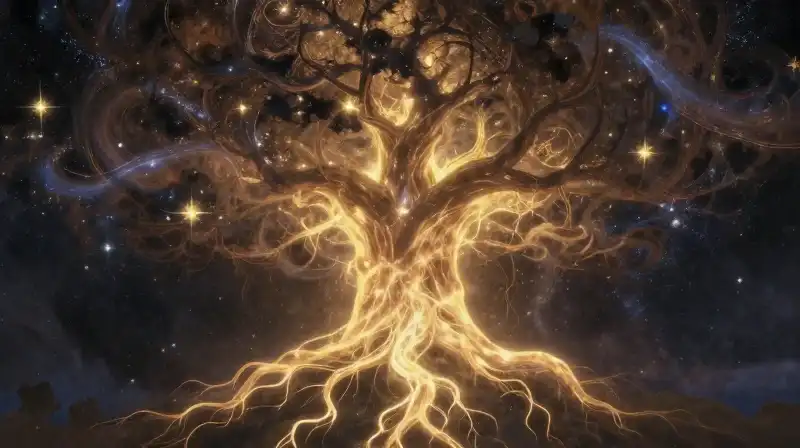
At the heart of this tradition, the nine distinct environments are held together by a single, colossal entity. For readers seeking to understand what connects all nine worlds, the answer is the cosmic infrastructure that defines the Norse imagination. This is the story of the cosmic tree, Yggdrasil, which anchors the entire physical and metaphysical integrity of the cosmos, weaving all its realms into a single, intricate life.
The Cosmic Nexus: Yggdrasil and the Interconnected Realms
The connective tissue of the Nine Worlds is Yggdrasil, the mighty ash tree of the gods. Its presence serves as the primary anchor for Norse cosmology, a literal structure that supports and interlinks all nine interconnected spheres (1, 2). The tree is so vast that its roots descend into three crucial wells, each holding deep symbolic and metaphysical significance within the tradition (1, 3).
These wells represent not just sources of water, but sources of wisdom, life, and destiny. Mímisbrunnr, the well of wisdom, is where knowledge can be gained, while Hvergelmir is often interpreted as a source of life and activity. Perhaps most poignant is Urðarbrunnr, the well of fate, which marks the culmination of destiny itself (1, 3). These wells act as conduits, allowing the various realms to draw sustenance or exert influence over one another, cementing the idea that no single realm exists in isolation. The system is fundamentally circular, bound by this central axis.
From Void to Structure: The Genesis of the Nine Worlds
The narrative of how these nine worlds came to be begins in the pre-cosmic emptiness known as Ginnungagap. The creation was a collision of fundamental forces: the oppressive ice and mist from Niflheim met the searing heat and energy originating in Muspelheim, the realm of fire (1, 2). This meeting of opposing dualities gave birth to the initial world and the subsequent creation of the realms.
Within this cosmogony, specific locations are designated by their function or the inhabitants they host. Midgard is defined as the central enclosure, the realm inhabited by mortals and humans. It is geographically precarious, protected by a dangerous, encircling ocean patrolled by the Midgard Serpent (1, 2). Hovering above this mortal realm is Asgard, the fortified domain of the Æsir, the gods. It functions as the ultimate seat of order, frequently analogized as the Norse version of Mount Olympus (1, 2). Below the surface, or perhaps contained within the cold domain of Niflheim, lies Helheim. This is the desolate underworld reserved for those who perish outside of glorious battle, ruled by the goddess Hel (1, 3, 2).
The Dynamics of the Nine Worlds: Order Versus Chaos
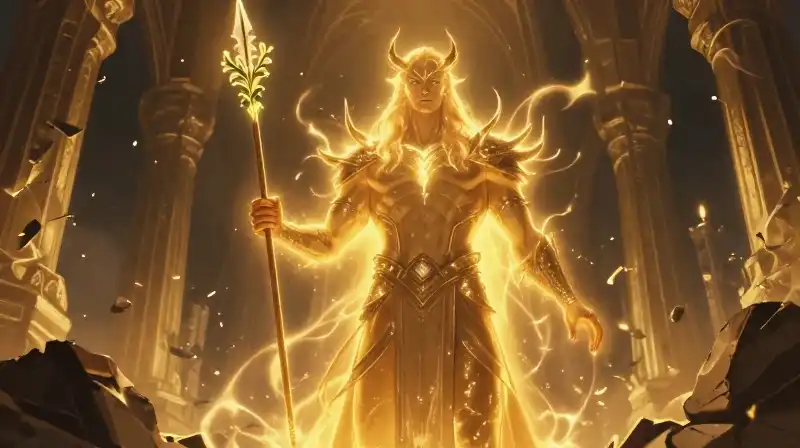
The Nine Worlds are defined not just by geography, but by the profound cultural conflict between two primary forces: ordered stability and primal chaos. This struggle is embodied by the rivalry between the Æsir in Asgard and the Jötnar (Giants) inhabiting Jötunheimr (1, 2). The giants represent chaotic, untamed nature, acting as the constant antithesis to the structured laws and traditions upheld by the gods.
Beyond the central conflict, the cosmology is rich with elemental boundaries. Muspelheim, characterized by its intense heat and volcanic fire, stands in stark opposition to Niflheim, the mist-covered realm of ice and frost (1, 2). This cultural duality—the constant tension between extreme heat and extreme cold—is a recurring motif in the tradition, symbolizing the eternal struggle between life and destructive forces. These elements dictate the spiritual and physical characteristics of the various realms, turning the cosmos into a perpetual theater of dynamic balance.
Navigating the Cosmos: Scholarly Debates on the Nine Worlds
While the concept of nine realms is central to the mythology, its precise architectural details remain a topic of scholarly discussion. It is important to understand that the Old Norse source texts do not always provide a rigidly fixed list or definite coordinates for every realm within the cosmos 1. Different researchers have debated the physical placement of realms like Niflheim, sometimes suggesting a northern location, while Muspelheim is placed toward the south 1. This indicates that the map of the Nine Worlds was perhaps more metaphorical than cartographical.
Furthermore, the cultural prominence of the number nine itself may be reflective of broader ancient Germanic cultural preferences for numbers three and its multiples. Because of this inherent flexibility, modern interpreters often build highly interpretive models, seeking to visualize the complexity of the tradition without claiming to perfectly replicate an ancient blueprint 1. This ambiguity allows the cosmology to remain a living, adaptable concept for communities and artists today.
Synthesis: The Meaning of the Nine Worlds Today
The Nine Worlds offer far more than an elaborate mythological backdrop; they provide a blueprint for a worldview where everything is connected, where conflict is inherent to existence, and where destiny is anchored in the deepest parts of creation. For those who engage with this tradition today, the cosmos is seen as a vibrant, precarious ecosystem. It is a system held together by fate (Urðarbrunnr) and bound by the ceaseless friction between opposing forces.
Understanding the Nine Worlds means accepting the tension between order and chaos, and recognizing that the “center”—Midgard—is surrounded by realms of both protection and peril. When studying Norse mythology, one is not just studying a definition of nine places, but a complex, richly detailed philosophical model of how everything lives, creates, and strives together in a universe defined by magnificent contradictions.
References
Footnotes
Frequently Asked Questions
What are the 9 worlds of Odin?
The nine worlds, or Níu Heimar, are described as a comprehensive map of existence and a continuous tapestry of intertwined elemental forces, with specific realms mentioned including Asgard, Midgard, Niflheim, Muspelheim, Helheim, and Jötunheimr.
What connects all 9 worlds in Norse mythology?
The Nine Worlds are held together by Yggdrasil, the mighty cosmic ash tree. This colossal entity anchors the entire physical and metaphysical integrity of the cosmos, weaving all the realms into a single, intricate life.
Related Articles