Ancient Greek Hermes: Roles, Myth, and Cultural Significance

Introduction
In the cultural landscape of Ancient Greece, few figures exhibit a complexity as profound or as multifaceted as Hermes. He is not simply a swift messenger, a stereotype of speed, but a god whose domain spans the wild outskirts of civilization and the highest halls of Olympus. He stands at the intersection of multiple worlds: the human realm, the world of trade and commerce, the divine hierarchy, and the threshold of death itself.
To understand Hermes is to understand a pivotal cultural role: the intermediary. According to the traditions explored in 1 and 2, he served as the psychopomp—the guide who conducted souls into the afterlife—while simultaneously acting as the herald and emissary for the gods. This duality is central to his meaning, establishing him as the master of boundaries and transitions. Whether traversing the sky as a swift runner or crossing the boundary of the grave, his essence lies in movement and connection. This article explores the deep roots of this tradition, tracing his evolution from a rustic protector to a divine diplomat.
The Cultural Function: A God of the Threshold
Hermes’s power was traditionally rooted in his ability to navigate the places where conventional rules ended. He was seen as a protector of those existing outside the social norms of the city-state, embodying a protective spirit over merchants, travelers, and even those on the fringes of law, such as thieves 1. This versatility reflects the diverse needs of a flourishing, trade-driven Greek society. He was the god of commerce, diplomacy, and the swift transmission of information—roles that required not just speed, but linguistic and social skill.
A significant physical manifestation of this role was the herma, a stone road-marker (1, 2). This marker was far more than a simple boundary delineator; it served as a small wayside shrine dedicated to him. For the traveler, the *herma* represented a sacred stopping point, a reassurance of guidance and protection while traversing the rugged terrain of ancient Greece. This physical artifact demonstrates how his cultural influence extended directly into the practical, daily life of the populace.
Evolution from Pan: The Roots of the Wild God
The origins of Hermes are not static, and scholars recognize his complex heritage, suggesting a lineage that predates later Hellenic myths. One prominent theory posits that Hermes emerged from a much older, more rustic divinity: the god Pan 1. Pan, originally tied to boundaries and the untamed elements, may have been absorbed into the nascent Hermes tradition as the god’s functions expanded. This suggests an evolution where the wild, nature-focused power of the forest god blended with the structured, intellectual functions of a messenger and diplomat.
His earliest records, however, point even further back. The earliest known appearance of his name in the region occurs in the Mycenaean Greek Linear B script, using the form hermāhās 1. Furthermore, some scholars suggest a connection to pre-Hellenic deities, proposing links to archetypes such as the Egyptian Thoth or the Mesopotamian snake-god Ningishzida 1. This historical complexity confirms that Hermes is a fusion of many ancient cultural streams, absorbing elements from various neighboring traditions to establish his unique position.
The Symbol of the Traveler: Art and Iconography
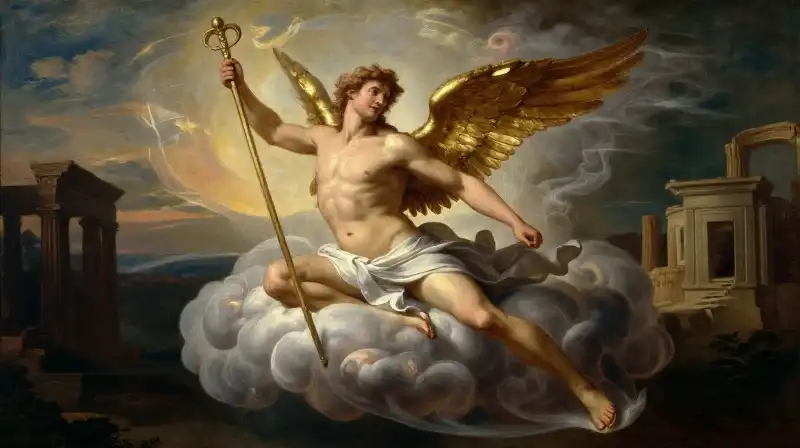
As the god of transition, Hermes’s visual representation changed dramatically over the centuries to reflect shifting cultural values. In the Archaic period, he was often depicted as a mature, bearded man, dressed in the attire of a traveler or shepherd 1. This depiction tied him closely to his earlier, pastoral roots—the god of herds and rustic travel 1. However, during the Classical and Hellenistic periods, his iconography underwent a noticeable shift. He was increasingly portrayed as a youthful, athletic, and beardless figure 1. This change emphasized his agility, speed, and skill in the realm of human endeavor and divine dispatch.
His traditional attributes serve as markers of his divine authority. The caduceus, a winged staff entwined with snakes, is perhaps his most recognizable symbol, representing his ability to mediate between the various powers of the world (1, 2). Paired with his winged sandals, the talaria, these symbols explicitly denote his capacity to transcend physical limits and traverse the boundaries between worlds—a perfect visual representation of the psychopomp’s function.
Trickster, Orator, and Herdsman: The Range of His Power
The mythology associated with Hermes reveals a god of great contrast. In the myths, he is celebrated for his immense skill in language and discourse, yet he is also famed for his disruptive, mischievous acts. Traditionally, he is noted as a highly skilled orator and speaker (2, 1). However, his earliest narratives, such as the tale of him stealing Apollo’s cattle as an infant and subsequently inventing the first lyre from a tortoise shell 1, establish his reputation as a divine trickster. He was closely associated with the practical life of the herds, tied to the ram, the hare, the crocus flower, and the strawberry-tree 1.
Despite the trickster element, his core powers are those of skilled mediation and guidance. He moves effortlessly between domains, possessing the wisdom to speak (diplomacy), the skill to guide (psychopomp), and the capacity to traverse any distance (speed). These narratives provide the cultural insight that his role in society was fundamentally about facilitating movement and connection—whether of souls, goods, or ideas.
Unpacking the Cultural Meaning: Meaning and Significance
When people ask about the meaning of Hermes, they are essentially asking about the concept of transition in the Greek worldview. He represents the necessary, often swift, and sometimes dangerous transition between states. He holds the “keys” to every doorway: the passage from the physical to the spiritual, from one kingdom to another, and from chaos to order (2, 1). His association with Arcadia, where he was known by other titles like Atlantiades or Cyllenius 1, further underscores this regional and adaptable cultural identity.
While he might be broadly categorized as the god of speed in modern terms, his deep cultural significance lies in his function as a cultural and spiritual broker. He is the god who allows the world to function—the diplomat who negotiates peace, the guide who ensures a soul finds rest, and the merchant who links disparate communities through trade. He is the embodiment of the fluid, dynamic nature of existence, moving beyond simple definitions to become a vital part of the Greek cultural understanding of movement and connection.
References
Footnotes
Related Articles