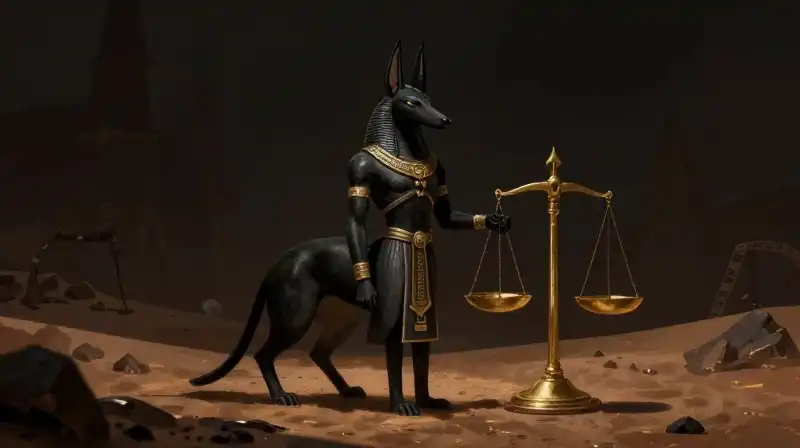

Anubis: The Ancient Egyptian God of the Dead and Funerary Rites

Introduction
In the vast landscape of ancient Egyptian belief, death was not an end, but a profound transition—a carefully orchestrated journey into a timeless realm. At the heart of this complex navigation stands Anubis, the powerful canine deity whose identity was forged in the dust of the cemeteries. While often simplified in modern media, Anubis represents far more than a mythological figure; he embodies the essential Egyptian concerns regarding purity, judgment, and the sacred process of transformation. He is the guardian at the threshold of the afterlife, a figure whose appearance and function reveal much about the society’s deep reverence for ritual and order.
The Pragmatic Origins: From Scavenger to Protector
The cultural elevation of the jackal into a protective god did not begin as a poetic myth; it emerged from necessity and observation. In the early days of the civilization, specifically during the First Dynasty, the jackals and wild dogs were pragmatic scavengers, naturally drawn to cemeteries to unearth bodies 1. This proximity to the rituals of death allowed the culture to recognize a deep connection between the creature and the deceased. Instead of fearing these animals, the Egyptians culturally harnessed them, choosing to “fight like with like” against the threats that lay against the souls entering the underworld 1. Thus, the jackal was transformed into a divine guardian.
This tradition maintained a clear distinction between the types of sacred animals. While the domestic house cat gave rise to revered goddesses such as Bastet, the jackal retained its specific, rugged association with death and the transition itself. Anubis was the primary form taken by deities of this nature, solidifying his identity as the canine figure of funerary rites 1.
The Custodian of the Transformation
Anubis’s most vital cultural function was tied directly to the preparation of the dead. His association with the mummification process established him as the patron god of embalmers. He oversaw the delicate, sacred work that preserved the physical form to allow the soul passage into the next world. Culturally, this required a figure of immense precision and knowledge, qualities embodied by the jackal god who guided the process 1.
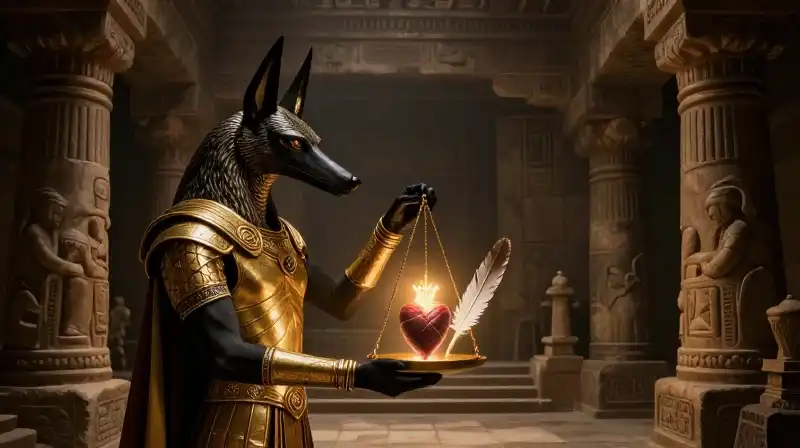
Beyond the physical preservation, Anubis played a crucial role in the spiritual journey. His role in the rites was not merely passive; he was actively involved in guiding souls through the underworld. This guidance was most acutely felt during the “Weighing of the Heart,” a critical moment where the soul’s moral balance was assessed to determine its eligibility for eternal life 1.
A Journey of Syncretism and Authority
The influence of Anubis evolved and expanded throughout Egyptian history. While he remained fundamentally a guide in the Egyptian context, his role eventually expanded through the powerful process of syncretism—the merging of different cultures and gods. During the Hellenistic period, Anubis absorbed traits from the Greek god Hermes, transforming into the complex deity Hermanubis 1. This fusion demonstrates the adaptability of Egyptian traditions, as their core beliefs found new spiritual outlets in the wider Mediterranean world.
In the Ptolemaic era, the importance of the canine-headed god was so central that entire cities were named after him. These Greek cities often translated to “city of dogs,” underscoring his entrenched central place in the religious landscape of the time 1. Furthermore, his authority was cemented by powerful epithets. He was revered as the “Foremost of the Westerners” and “Master of Secrets,” titles that acknowledged his power over the hidden workings of the dead 1. Ancient writers, including Plato, referenced oaths being sworn “by the dog of Egypt,” cementing his perception as a powerful arbiter of truth even beyond the physical grave 1.
Navigating the Pantheon: Hierarchy and Mystery
One of the most complex aspects of Anubis is how he was perceived among other gods. While he held immense, localized power over the transition and the judgment process, his function was often seen as highly specialized and subservient to the grander cosmic deities of the Egyptian pantheon. For instance, while he presided over the critical weighing of the heart, he worked within the larger framework of the divine order, serving the primary architects of the afterlife 1. He functioned as the vital guide, not the ultimate power.
The mythology of Anubis also presents a fascinating duality. On one hand, he is the careful guide of embalmers and the judge of souls. On the other, some narrative accounts give him the title “The Dog who Swallows Millions.” This epithet reflects a powerful cultural recognition of his ability to govern the overwhelming scale of life and death, balancing his meticulous guardianship with an awesome, unavoidable power over finality 1.
The Enduring Legacy of the Guardian
Anubis remains a profound example of how a practical, observed reality—a scavenger in a cemetery—can transform into a central pillar of spiritual tradition. He represents the human cultural attempt to bring order, definition, and guidance to the inevitable chaos of mortality. His life, as described in tradition, is one of tireless vigilance, ensuring that the sacred contract between the living and the dead is upheld. For the community that developed this tradition, Anubis was not merely a god of death, but a necessary guarantor of cosmic balance, confirming that passage into the eternal life was a process of divine justice, carefully managed by the steadfast canine guardian.
References
Footnotes
Frequently Asked Questions
Who is higher than Anubis?
Anubiss function was often seen as subservient to the grander cosmic deities of the Egyptian pantheon. He worked within the larger divine order, serving the primary architects of the afterlife.
Is Anubis a dog or a jackal?
Anubis is described as a powerful canine deity and solidifies his identity as the figure taken by deities of this nature. Culturally, he was identified as the jackal god, which allowed him to serve as the specific guide for funerary rites.
Related Articles