Aquarius: The Myth of the Water Bearer and Ancient Greek Gods


Introduction
For readers exploring the heritage of celestial traditions, the figure of Aquarius represents more than just a constellation on a star chart; it embodies ancient narratives of both colossal cleansing and vital replenishment. Within the rich tapestry of global folklore, the concept of the Water Bearer—the deity or figure tasked with pouring out great volumes of water—is a recurring, highly charged archetype. It speaks to the universal tension between destruction and creation, the sudden, overwhelming force of nature, and the ultimate necessity of renewal. When we examine the myths and astronomical observations surrounding this celestial placement, we find a powerful tradition that centers on divine intervention and the cyclical nature of existence, as found in Greek mythology and beyond.
The Archetype of the Water Bearer in Greek Tradition
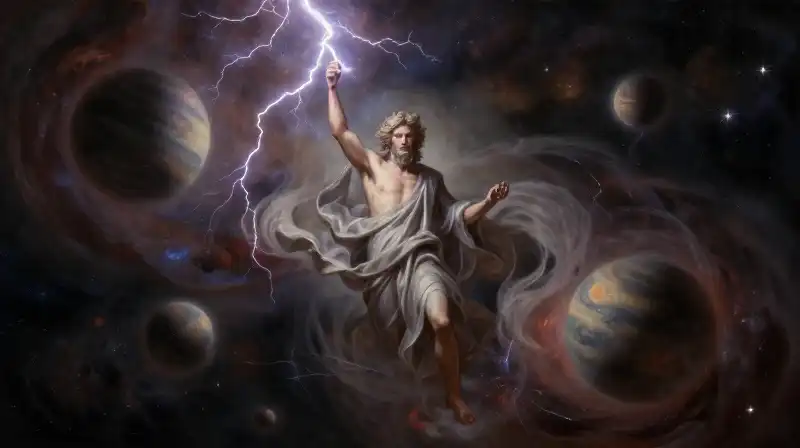
The Greek understanding of Aquarius is deeply rooted in stories of divine necessity and the management of cosmic forces. Most famously, the tradition recounts the legend of the Water Bearer, a figure dispatched by Zeus to pour forth heavenly waters during a great, devastating flood meant to purge humanity (1, 2). This narrative establishes the Water Bearer as a figure intrinsically linked to massive, purifying forces—a pivotal agent in cycles of destruction and subsequent rebirth (1, 2). Another prominent narrative associated with the same constellation involves Ganymede, a youthful cupbearer to Zeus (1, 2). His story introduces a different facet of the celestial realm: divine acquisition and the human-god connection. Ganymede was abducted by an eagle, a swift and powerful messenger, and transported to Mount Olympus, where he served the gods (1, 2). While the Water Bearer narrative focuses on the earth and the flood, the Ganymede myth speaks to the divine court and the movement of immortal beings through the cosmos.
Variations Across Ancient Cultures
The figure represented by Aquarius—a vessel carrying a powerful substance—is not limited to the Mediterranean basin; rather, its meaning shifts across diverse cultures, reflecting each civilization’s unique relationship with its environment and celestial bodies. In Mesopotamian tradition, Babylonian star catalogues identified the constellation GU.LA. This celestial grouping was interpreted as representing the god Ea, who is typically depicted in art holding an overflowing vase 1. This ties the cosmic symbol not merely to water, but to wisdom and the creative force represented by the overflowing vessel. Meanwhile, ancient Egyptian astronomy provided a distinct perspective on the celestial flow, tying the figure to the vital annual flood of the Nile. For the Egyptians, the presence of these waters symbolized the arrival of spring, marking the essential regenerative phase of the agricultural year 1. The nomenclature itself across different cultural groups reinforces this theme of the “carrier.” The Latin name *Aquarius* translates directly to “water-carrier” or “cup-carrier,” a designation that finds parallels in other traditions, such as the Hindu concept of the *kumbha*, a water-pitcher, which serves a similar function of carrying divine or essential waters 1.
Who Was Aquarius in Greek Mythology and Who Governed the Stars?
To understand the specific association of Aquarius within the Greek pantheon, one must navigate the varied interpretations of later classical scholars. For example, Western mythological texts such as Manilius’s *Astronomica* proposed connections, suggesting the constellation was attributed to the Greek goddess Hera, Zeus’s wife 1. However, other contemporary discussions within Greek mythology confirm the constellation’s connection to the Water Bearer myths of Deucalion and Ganymede (1, 2). The scholarly consensus and textual evidence often point to a degree of uncertainty regarding a single, definitive god or goddess behind the Water Bearer figure, beyond the widely known primary narratives 1. What remains consistent across traditions is the archetype: a powerful figure, often depicted negatively in terms of their impact (due to the destructive floods), yet serving a massive, pivotal role in the cosmic order (1, 2).
The Symbolism of Flow: Purification and Life
The constant thread running through these disparate traditions—from Babylonian gods to Egyptian floods—is the concept of cyclical flow. The Water Bearer is the embodiment of essential, overwhelming forces. In ancient cultures, water was not merely a resource; it was a transformative agent. The floods that require the Water Bearer’s intervention are universally recognized as being massive, yet they are also interpreted as a form of purification (1, 2). Just as the destructive floods in ancient stories ultimately give way to the promise of a renewed world, the celestial waters represent necessary transitions. The act of “pouring out” thus becomes a metaphor for the release of old structures and the emergence of new life, whether that life is the annual spring harvest in the Nile Valley or the rebirth of humanity following the cosmic deluge. This understanding elevates the constellation from a mere pattern of stars to a profound metaphor for change itself.
Understanding the Celestial Meaning of GU.LA
Beyond the Greek focus on “Zeus and the deluge,” the presence of the Babylonian figure Ea (GU.LA) provides a different cultural lens on the tradition. In the Mesopotamian view, the overflowing vessel does not necessarily represent destruction, but the creative and foundational wisdom of the divine. Ea, as a god associated with creation and the deep waters of the primordial earth, suggests that the Water Bearer archetype also holds meanings of fertile knowledge and the source of all life—an “overflow” of understanding rather than merely an overflow of destructive water. This distinction helps readers understand that the single figure of the Water Bearer can represent wildly different spiritual forces depending on the regional cultural context.
Conclusion: The Living Legacy of the Water Bearer
Ultimately, the story of Aquarius, as told through the myths and astronomical history of the ancient world, is a story of balance. It is a tradition that acknowledges the profound power of the forces of nature—the great floods, the seasonal cycles, and the movement of the gods—and seeks to understand their immense impact. Whether viewed as the agent of a purifying catastrophe, the bringer of life-giving floods, or the carrier of divine knowledge, the Water Bearer remains a powerful symbol for any culture grappling with the inevitable cycles of destruction, change, and renewal. It invites us to see the world not as static, but as a continuous, flowing process of divine and natural transition.
References
Footnotes
Frequently Asked Questions
Who was Aquarius in Greek mythology?
In Greek mythology, Aquarius is associated with the Water Bearer, a figure dispatched by Zeus to pour heavenly waters during a devastating flood, and Ganymede, a youthful cupbearer to Zeus. While contemporary discussions also confirm connections to the Water Bearer myths of Deucalion, some later classical scholars proposed links to the goddess Hera.
Related Articles