Egyptian Gods and Hieroglyphics: Deciphering the Ancient Pantheon

Introduction
To speak of the Ancient Egyptian pantheon is to acknowledge a civilization where the boundary between the human, the natural, and the divine was porous, fluid, and deeply practical. The Egyptian worldview was not merely a collection of myths, but a functional cosmology designed to maintain cosmic balance and harmony in a world defined by powerful elemental forces. Historically, accounts suggest that this belief system encompassed an immense pantheon of over 2,000 deities, each assigned a role—a function, a domain, or a facet of existence within their culture (1, 2).
These gods governed virtually every aspect of life, from abstract philosophical concepts and unpredictable natural phenomena to the most routine daily necessities. Because of this encompassing scope, the figures of Egyptian mythology are not simply gods in the sense of “supernatural beings”; they are forces of nature, societal principles, and cultural anchors, deeply intertwined with the rhythms of the Nile and the aspirations of the people.
The Functional Landscape: A Pantheon of Existence
The core of the Egyptian religious experience was the understanding that the world required constant maintenance. The deities existed to manage and stabilize this existence. Core gods often held primary associations with fundamental principles—the sun, the wind, the underworld—though the specific emphasis placed on any given god could shift as Egyptian society evolved 2. These divine roles were intensely practical.
Consider the elemental forces. Geb, the God of the Earth, held physical presence within the myths, his actions, such as his laughter, being mythologically linked to the creation of natural forces like earthquakes 2. Conversely, the vital flow of life itself was entrusted to figures like Sobek and associated deities, underscoring the critical, life-sustaining relationship between the Egyptian people and their unpredictable river 2. Even the realm of abstract beauty and emotional life was managed by figures like Hathor, revered for connections to love and motherhood, often depicted in majestic bovine forms or wearing headdresses featuring a sun disk surrounded by cow horns 2.
Furthermore, the scope extended to the most localized needs. The pantheon included countless minor deities who represented specific, regional natural elements, whether they were particular types of plants or unique local animals, as well as local deities representing specific towns within the vast kingdom 2.
Guardian and Journey: Gods of the Domestic and the Afterlife
The divine responsibility extended into the personal lives of the citizens, offering protection and guidance through both the mundane and the monumental challenges of death. For domestic harmony and daily protection, Bastet served as a paramount goddess, embodying home, fertility, and safety. Her strong connection to the sacred domestic cat was a central element of her worship, illustrating how divine protection could be sought in the intimate corners of home life 2.
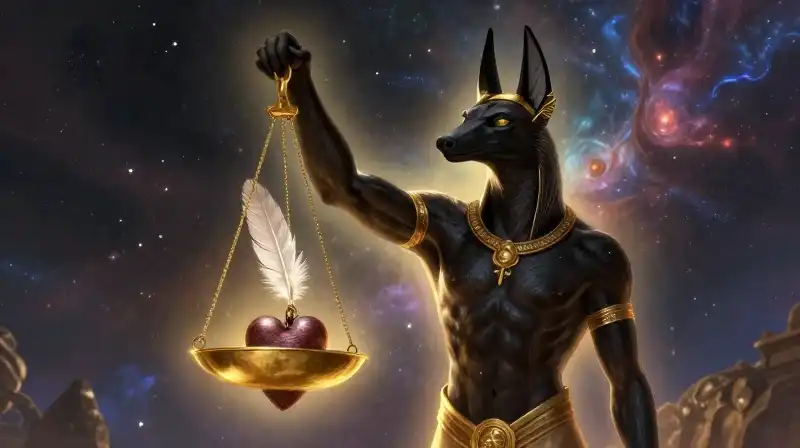
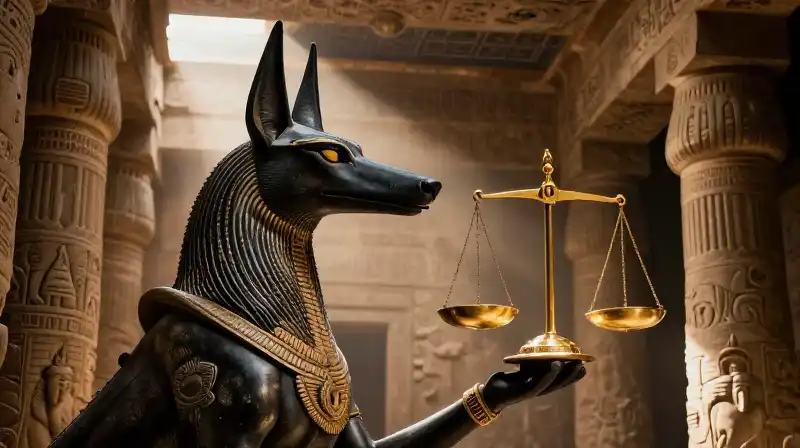
The transition from life to the afterlife was perhaps the most heavily managed aspect of their cosmology. This journey required divine oversight, which was provided by figures like Anubis. Anubis, associated with mummification and funerary rites, was essential in managing the crucial “Weighing of the Heart” ceremony—the process by which the deceased’s soul was judged (3, 1). These figures, both like Bastet and Anubis, held the cultural responsibility of protecting the populace against various threats, including evil spirits, diseases, and nightmares (3, 1).
The Divine Record: Hieroglyphics as Cultural Scripture
If the gods defined the spiritual architecture of Egyptian civilization, hieroglyphics provided the physical and narrative framework. This specialized written art was not merely a decorative system; it was the primary mechanism through which the visual and narrative understanding of the pantheon was preserved and communicated 2. The complex dynamics between these divine beings—such as early creation stories involving the separation of the Sky goddess Nut and the Earth god Geb—were meticulously recorded and conveyed through these sacred symbols 2.
Hieroglyphs functioned as a living cultural archive. They solidified the identities of the gods, preserved the intricate rites for the deceased, and articulated the mythological explanations for the chaotic world. Every carefully painted depiction of a god or every inscribed funerary text was a form of spiritual instruction and cultural continuity, grounding the complex web of beliefs in a tangible, enduring medium 2.
Shifting Crowns and Cosmic Power: The Evolution of Belief
The study of the Egyptian pantheon reveals that this was not a static tradition, but a dynamic one, adapting to political shifts and cosmic necessities. The very power of certain deities could evolve. A notable example is the transformation of Amun. Beginning as a local wind god associated with the city of Thebes, Amun gradually ascended to become a national figure. His eventual fusion with the sun god Ra, giving rise to Amun-Ra, highlights how the religious structure was intricately linked to the evolving political and cosmic power of the state 2.
This evolution demonstrates that the traditional understanding of the gods was constantly being refined, reflecting the growing complexity and power structures of the civilization itself. The shift was not merely theological; it was a reflection of the community’s needs and its desire for a unifying national deity capable of overseeing a growing empire.
Beyond the Monument: The Living Significance of the Pantheon
To genuinely understand the Ancient Egyptian tradition is to move past the simple idea of a list of gods. It is an understanding of a comprehensive system of meaning. The pantheon, expressed through its diverse divine functions and meticulously preserved in its hieroglyphic script, provided the cultural scaffolding for a society navigating vast natural cycles and political complexity. From the local protector of the home to the national god overseeing the sun’s journey, every deity addressed a core human concern—survival, order, and the promise of eternity.
The enduring importance of this tradition lies in its interconnectedness. The gods were not a concept separate from the land or the people; they were the embodiment of the land’s life force and the people’s fundamental drive for harmony. Hieroglyphics served as the sacred key, allowing these complex, functional beliefs to be passed down, ensuring that even when the culture changed, the foundational relationship between the community and the divine remained clear and respected.
References
Footnotes
Related Articles