Osiris: The God of Rebirth and the Ancient Egyptian Afterlife

Introduction
Osiris is not merely a deity of the Egyptian pantheon; he is a profound cultural touchstone, representing the foundational concepts of rebirth, agricultural cyclicality, and ultimate order (Ma’at). Long before the emergence of highly complex cosmological systems like the Heliopolitan Ennead, Osiris was already recognized as the sovereign of the subterranean realm and the Afterlife (1, 2). His story and worship provide a framework for understanding life, death, and the persistent Egyptian belief that even in the face of chaos, continuity and judgment reigned. Central to the ancient Egyptian community, Osiris transitioned through various roles—from a master who taught civilization and agriculture to the deceased, to the divine judge presiding over the Hall of Judgment. His enduring significance lies in the deep personal comfort his myth offered; it posited that death was not a final, passive void, but a complex negotiation with destiny 1. To understand Osiris is to understand the very architecture of ancient Egyptian society, which sought to mirror the predictable, life-giving cycles of the Nile itself.
The Narrative of Rebirth: Order from Chaos
The foundational story of Osiris is one of immense tragedy that ultimately leads to a triumph of regeneration. According to the narrative, the god’s life was challenged by his jealous brother, Set, who sought to usurp Osiris’s rightful place as the leader and bring about chaos (1, 3, 2). Set murdered Osiris and brutally dismembered his body, scattering the pieces across the land. This act of violence serves as a symbolic representation of the primordial forces of chaos that exist against the natural order. However, the myth gains its cultural power through the intervention of his sister and wife, Isis. Despite the severe fragmentation of his remains, Isis utilized powerful magic to gather and briefly reconstitute his form (1, 3, 2). Crucially, during this brief period of “un-death,” Isis was able to conceive Horus, thereby ensuring the continuation of the lineage and the eventual restoration of order 1. Osiris’s journey—death, scattering, and miraculous resurrection—became the perfect metaphor for the annual inundation of the Nile, illustrating the natural cycle of death and rebirth inherent in planting and harvesting 1.
Iconography and the Symbolism of Vitality
The visual representation of Osiris is rich with symbolic weight, deliberately connecting him to fertility, rebirth, and his dominion over the fertile Nile floodplain. He was frequently depicted in various forms, including pharaonic or mummified aspects (3, 2). His skin and garments often conveyed profound meaning:
- Black Skin: This alluded to the fertile soil of the Nile floodplain (3, 2), connecting him directly to the promise of new life.
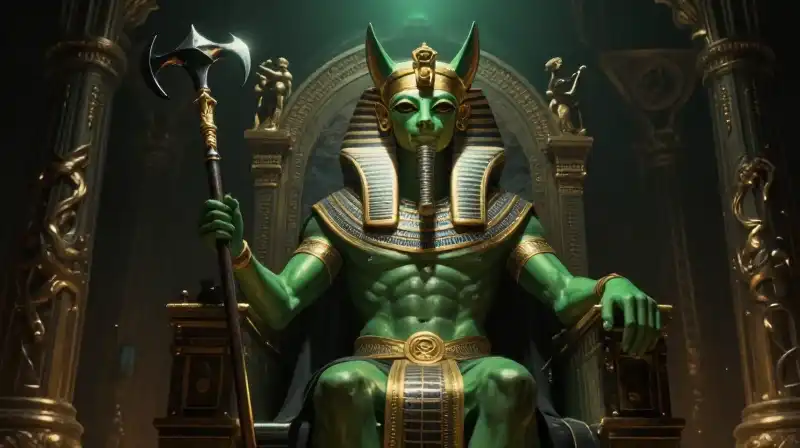
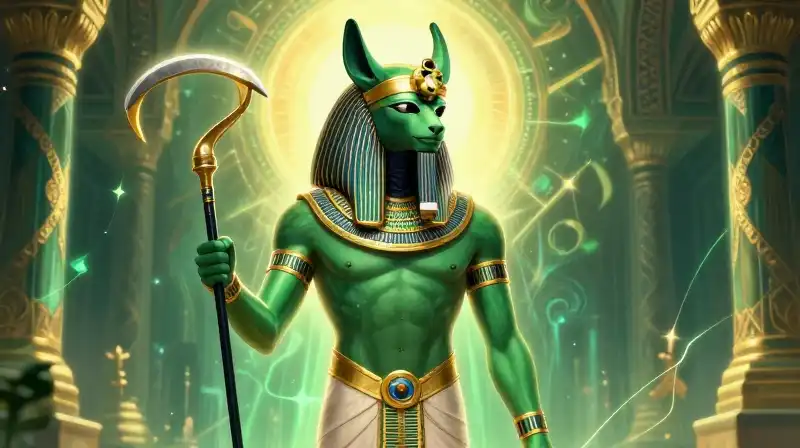
- Green Skin: Often associated with resurrection and vegetation (3, 2), representing the vitality that springs from the underworld.
As a divine ruler, Osiris was always depicted with specific regalia that solidified his authority: the crook and flail, symbols of his role in governance and bringing civilization to the deceased (3, 2). Most distinctive was the Atef crown, which was similar to the White Crown but adorned with two curling ostrich feathers, a potent sign of his divine sovereignty (3, 2). In some regional worship, such as the city of Mendes, his soul aspect, Banebdjedet, was occasionally worshipped in the form of a ram 1.
The Judgment: Negotiation and the Afterlife
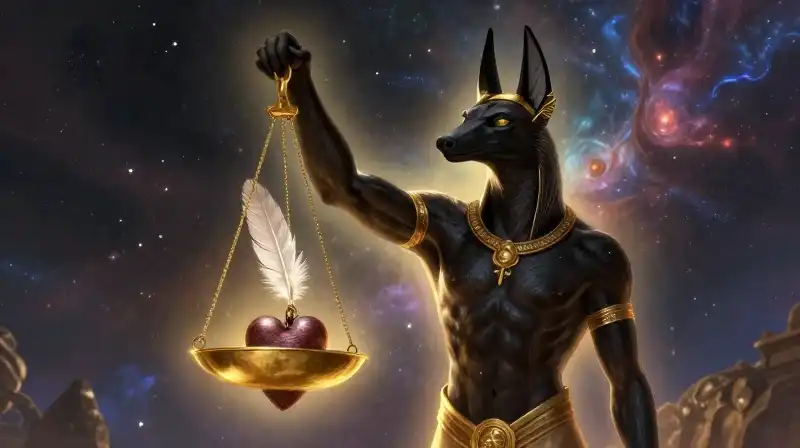
One of the most unique cultural contributions of the Osiris tradition is its emphasis on the “negotiation” of the afterlife. Unlike cultures where death is a passive fate to be endured, the Egyptian belief centered on the accountability of the individual. Osiris presided over the critical judgment of souls within the Hall of Judgment (1, 2). According to ancient texts, the deceased faced a process that was remarkably individualistic. The system utilized the “negative confession”—a declaration made by the soul that it had performed no wrongful acts during its earthly life 1. This mechanism allowed the ancient community to believe that the verdict upon death was not passively awaiting them, but was the result of their own moral actions and choices 1. This belief provided immense psychological comfort, grounding the abstract idea of the afterlife in a tangible system of ethical responsibility.
The Living Cult: Festivals and Cultural Evolution
While the myths of Osiris provided a framework for the spiritual life of the Egyptian community, the tradition was further maintained through active cultural practice. The god was central to numerous festivals, most notably those held during the fourth month of the season of Akhet, celebrating his eternal cycle of life and death 1. Over millennia, the role of Osiris, like all major ancient deities, underwent transformation. His domain gradually merged with the functions of other gods, a phenomenon known as syncretism (3, 2). He became associated with the Moon and eventually took on some aspects of the god Anubis (3, 2). These evolving associations reflect the dynamic and flexible nature of Egyptian religious life, which continuously reinterpreted ancient narratives to suit contemporary cultural needs. Furthermore, while some scholarly debates exist regarding the exact meaning of his name, “wsjr,” and various transliterations 1, the core essence of his role as a bringer of order remains constant across time.
Synthesis of Meaning: Ma’at and the Enduring Cycle
Osiris transcends the definition of a mere funerary god. At the heart of his tradition is the concept of Ma’at—the divine principle of balance, harmony, and order. His story suggests that even when existence descends into chaos (as represented by Set), there is an innate capacity for cyclical renewal. The belief in Osiris established a cultural blueprint for Egyptian civilization, providing a coherent narrative that linked the agricultural abundance of the Nile, the daily cycle of the sun, and the ultimate destination of the soul. His tradition offers a valuable lesson in the human capacity to find meaning not just in what we gain, but in how we manage the inevitable processes of decay and renewal. He remains, therefore, the embodiment of the eternal negotiation between life and death.
References
Footnotes
The Judgment Process in the Afterlife
Reach the Hall of Judgment
The deceased arrives at the Hall of Judgment to face the divine judge, Osiris.
Perform the Negative Confession
The individual soul utilizes a specific mechanism called the "negative confession" to detail its conduct.
Declare Lack of Wrongful Acts
The soul makes a declaration stating that it "had performed no wrongful acts during its earthly life" to determine its fate.
Related Articles