Lugh: More Than a Sun God — The Celtic Master of Skills

Introduction
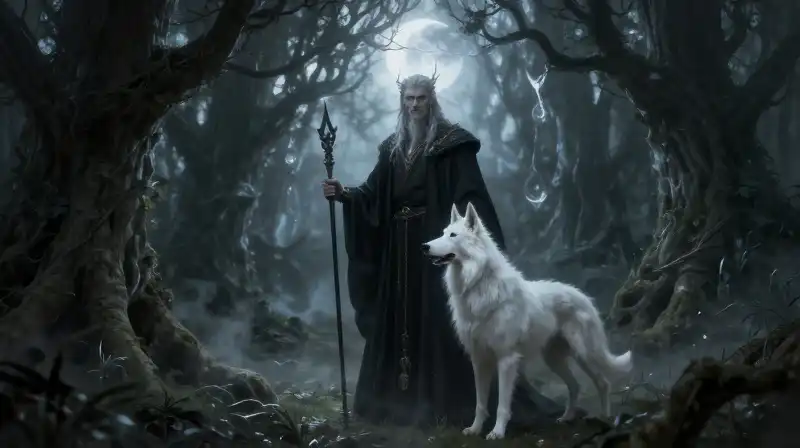
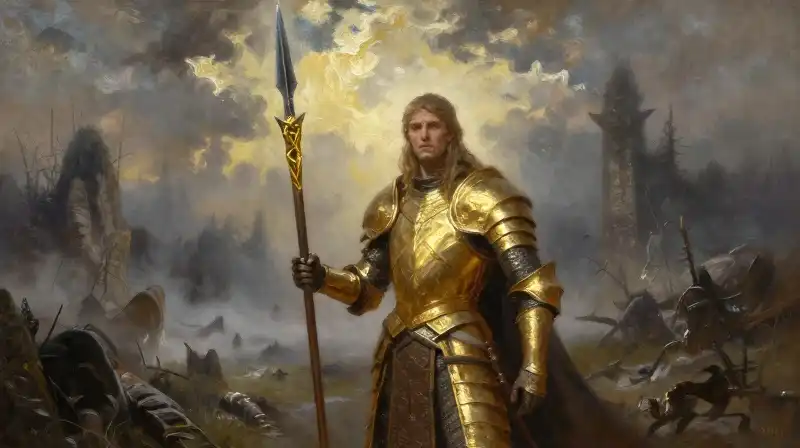
The figure of Lugh exists at the vibrant intersection of ancient Irish myth, pan-Celtic heritage, and the enduring human fascination with the multifaceted divine. To view him merely as the Celtic sun god is to miss the core of his cultural significance. Lugh is, fundamentally, the exemplar of human potential, a figure whose identity is forged not just by celestial radiance, but by profound competence. He is the master artisan, the formidable warrior, and the benevolent leader—a being who embodies the idea that a truly great community requires mastery across all necessary fields.
For those navigating the complex world of Celtic traditions, understanding Lugh requires looking beyond simple monotheistic labels. He is part of a complex tapestry of cultural roles, serving as a critical narrative tool in Irish mythology to explain the necessary balance between skill, warfare, and the cyclical promise of the harvest.
The Epithet of Samildánach: The All-Trades Master
The defining trait of Lugh, according to traditional lore, is his unparalleled versatility. His most potent epithet is Samildánach, which translates to “equally skilled in many arts” (1, 3). This is not a boast of mere talent, but a theological statement about necessary completeness. In a pre-modern agrarian and conflict-ridden world, a successful community relied on people who could bridge the gap between specialized roles.
Mythological accounts detail this proficiency: Lugh is described as a master weaver, a skilled smith, a healer, and a brilliant tactician in battle (1, 3). His mastery of diverse skills—ranging from the delicate arts of crafting to the brutal necessity of war—positions him as a figure of total competence. His lineage, born to Cian (a member of the Danann) and Ethniu (a Fomorian), further reinforces this duality, placing him as a vital bridge between the warring supernatural factions (1, 3).
Lughnasadh: The Cultural Nexus of Harvest and Competition
If Lugh is the cultural ideal of skill, Lughnasadh is the cultural celebration of that ideal. This major midsummer feast, celebrated annually on August 1st, is the primary living practice that anchors Lugh in community life (1, 3). Lughnasadh marks the pivotal moment of harvest in the traditional agricultural calendar, but it is also a festival of athletic excellence and social gathering.
The connection between the deity and the festival is direct and practical. Lugh represents the successful culmination of the year’s labor and the preparedness of the community. By celebrating the harvest and holding athletic contests, participants are, in a symbolic sense, aligning themselves with Lugh’s own ideal—the perfected application of skill to yield success. The festival is a reminder that true mastery is not just about personal genius, but about the collective ability to manage the elements, the labor, and the struggle for survival.
Beyond the Radiance: Sun, Light, and Dual Nature
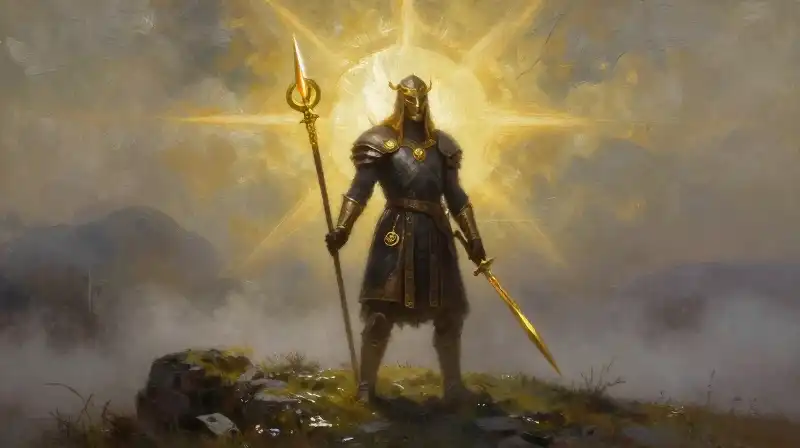
One of the most common questions surrounding the god is whether he is definitively a “sun god.” The historical tendency, particularly during the Victorian era, was to classify him as such due to descriptions of his radiant appearance (1, 2). However, modern specialists suggest a more nuanced interpretation (1, 2). While his brilliant, shining presence often links him visually to the solar power, the descriptor “shining” may be a general attribute of divine authority, rather than a specific limitation to solar association.
Lugh’s power is best understood through his dual nature. He embodies not just the glorious light of the sun, but also the grounded necessities of the earth—the practical requirements of rain, agriculture, and the successful completion of the harvest 1. This dual role reflects a cultural understanding of the divine that incorporates both the majestic, transcendent power (the light) and the tangible, sustaining labor of the earthly realm (the rain). His power is holistic, covering both the grand sweep of the cosmos and the granular detail of the forge.
Regional Echoes and the Pan-Celtic Influence
Lugh’s significance extends beyond the islands of Ireland. His archetype—the all-skilled divine figure—is a recurring motif throughout Indo-European traditions, cementing his status as an important pan-Celtic entity (1, 2). This widespread influence is often reflected in neighboring cultures through figures who hold similar attributes.
For example, his Welsh counterpart, Lleu Llaw Gyffes, mirrors the theme of divine mastery found in Celtic myth. Furthermore, the association of Lugh with the Roman god Mercury highlights the ancient shared cultural language regarding gods who represent cunning, swift action, and proficiency across various domains (1, 3). While specific details vary—such as the contested origins of his name, which some scholars suggest may derive from roots meaning “flashing light” or “to bind by oath”—the underlying concept of a complete, capable divine agent remains consistent across these cultural borders (1, 2).
Myth and Folklore: From Battle to Leprechaun
The narratives surrounding Lugh often place him at critical junctures of cultural conflict. In the great mythological struggle between the Danann and the Fomorians, Lugh plays a decisive role in the Battle of Mag Tuired, leading his people to victory by successfully challenging the tyrant Balor (1, 3). These tales establish Lugh as the ultimate agent of order and superior skill overcoming chaos.
Lugh’s figure has also undergone fascinating folkloric evolution. A later, distinct tradition in Irish lore describes Lugh as a small figure who, in a legendary act, buried pieces of the sun 1. This narrative transformation is key to one of the most widely known, albeit highly romanticized, creatures of Celtic tradition: the leprechaun. This shift demonstrates how a major deity can be filtered through time, localized, and reimagined to fit new cultural needs.
A Synthesis of Meaning and Practice
Lugh, then, is not simply a figure in a mythology book; he is a living cultural archetype. He represents the continuous tension and eventual harmony between disparate elements: light and rain, war and craft, chaos and competence. He teaches that the most powerful forces are often those that are balanced—those who can wield the hammer as skillfully as they wield the spear.
For those who engage with Lugh in a modern context, the focus shifts from devotional worship to the appreciation of skill and preparedness. He challenges the reader to understand that true cultural strength lies not in specialization alone, but in the cultivation of a broad and balanced mastery. He is the embodiment of the successful community, ready for the harvest and ready for the conflict, all through the disciplined application of human potential.
References
Footnotes
Frequently Asked Questions
Who is the god Lugh equivalent to?
Lughs Welsh counterpart is Lleu Llaw Gyffes, which mirrors the theme of divine mastery. Furthermore, Lugh is associated with the Roman god Mercury because both represent cunning, swift action, and proficiency across various domains.
Is there a Celtic sun god?
Although Lugh was historically classified as a Celtic sun god due to his radiant appearance, modern specialists suggest a more nuanced interpretation. His power is best understood through a dual nature that embodies not just the glorious light of the sun, but also the grounded necessities of the earth.
What crystals are associated with Lugh?
The article does not contain any information regarding crystals associated with Lugh.
Related Articles