Dagda: The King, Druid, and Power of Celtic Mythology

Introduction
To examine the Dagda is to look past the typical mold of the heroic, singular deity. He is the embodiment of holistic power within the Tuatha Dé Danann—Ireland’s mythical people—and represents a sophisticated integration of the domestic, the divine, and the elemental. Often translated loosely as “the good god” or “the great god” 1, scholars clarify that this title does not refer to a simple moral virtue. Rather, it signifies his absolute proficiency; the Dagda possesses the ability to be ‘good’ or masterful in every endeavor, from physical exertion to arcane knowledge (1, 2).
He is not merely a king or a warrior; he is a multifaceted figure who functions simultaneously as a father, a high druid, a master architect of landscape, and a cosmic regulator. His identity is tied inextricably to the fertility of the land and the flow of time, anchoring him deep within the cultural and physical geography of ancient Ireland. For those studying the enduring traditions of Celtic heritage, the Dagda offers a lens into a worldview where magic, agriculture, and political authority are inseparable facets of a single, grand divine personality.
The Complexity of Identity: Names and Roles
The sheer breadth of the Dagda’s character is encoded in his titles. His names, such as Eochaid Olathair or Ruad Rofhessa, are not arbitrary; they serve as concise summaries of his divine function. According to scholarly analysis, these names offer insight into his multifaceted nature, suggesting roles such as “Horse Lord Ample Father” or “Red man of Knowledge” 1. This complexity mirrors his societal function within the Tuatha Dé Danann. He was the progenitor figure, the political leader, and the keeper of profound, practical wisdom.
His dominion was vast. As the chief deity, his role encompassed political structure and societal prosperity. Following the climactic Second Battle of Moytura, the Dagda’s extensive eighty-year reign reportedly ushered in an era of profound abundance and paradise for Ireland, establishing his foundational importance to the cultural narrative 1. He bridged the gap between the raw, chaotic power of nature and the ordered, prosperous life of his community.
Symbolism of Dual Power: The Lorc and the Harp
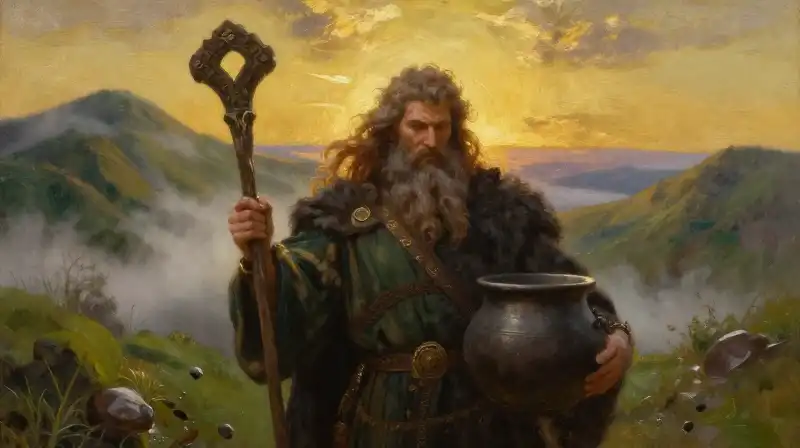
Perhaps the most potent aspect of the Dagda’s symbolism is his iconic magic staff, the *lorc*. This artifact is not merely a weapon but a powerful metaphor for the duality inherent in all supreme forces of nature. The *lorc* possesses the terrifying power to wield instant death from one end and the equally absolute power to revive the departed from the other 1. This duality—life and death, creation and destruction—is a central philosophical theme in his portrayal.
Complementary to this lethal staff is his magic harp, the *Uaithne*. Unlike a typical instrument, the harp was a cosmic regulator. The Dagda’s mastery over its three strains—joy, sorrow, and sleep—was said to compel the natural cycles and seasons into their proper order (1, 2). This links his divine authority directly to the agricultural rhythm of the land, underscoring his role as a patron of fertility and the proper timing of growth and harvest.
Architect of the Landscape: Power and Place
For the “Living Culture” enthusiast, the Dagda’s influence extends far beyond courtly myths; it is written into the very geography of the island. His powerful, laborious activities—such as clearing vast forests and digging extensive *raths* (ancient earthen enclosures)—are cited as features that may have historically defined modern land borders 1. His presence is also physically manifested in places across Ireland. Brú na Bóinne, Uisneach, and Knock Iveagh are all associated with him or named after his influence, cementing his ancestral ties to the physical environment 1.
This connection suggests that in the traditional understanding of his community, the spiritual authority of the Dagda was inseparable from the practical labor of shaping the land. He was the power that transformed wild nature into a sustainable and ordered societal space.
Domestic Cycles and Cosmic Resonance
While often depicted as a massive, bearded, powerful figure—sometimes resembling a giant—the Dagda’s narrative depth reveals a rich layer of domestic complexity. His relationships with other divine figures, such as the goddess Boann (Goddess of the River Boyne), are integral to these stories. One account details his relationship with Boann, which led to the birth of Aengus. Some modern scholars interpret this narrative structure as a representation of the winter solstice and the illumination of Newgrange (1, 3), framing the Dagda not just as a ruler, but as a participant in the cyclical mysteries of time and light.
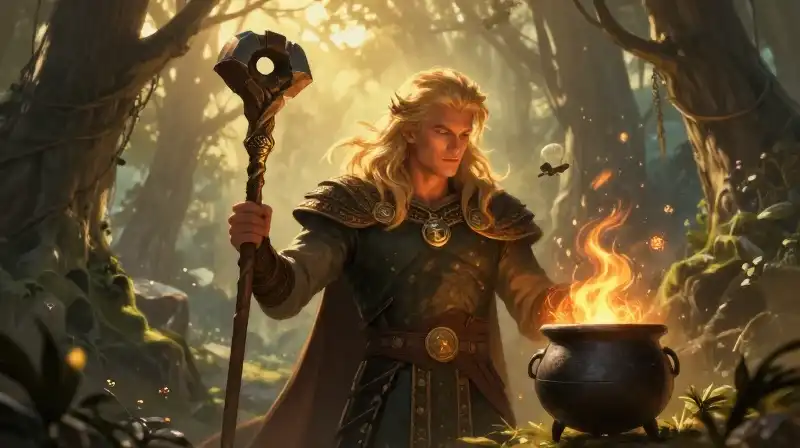
Further contributing to his wealth and identity are his magical possessions: a never-emptying cauldron (*coire ansic*) that guarantees prosperity, and specific magical animals that serve as totems for his domain 1. These elements ensure that even his personal domain is a reflection of boundless abundance.
The Modern Interpretation: Rogue, Trickster, or Proficient Master
In contemporary discussions of pagan spiritual practices, the Dagda’s figure is often re-examined through a more nuanced lens. While he fulfills the roles of the king and the druid, modern interpretations sometimes categorize him as a rogue or a trickster 1. This suggests that engaging with the Dagda requires more than simple worship; it requires an understanding of his “high ego” and his profoundly multifaceted nature 1.
This perspective acknowledges that the powerful forces he represents—the transformative power of life, the danger of death, and the uncontrollable energy of nature—are not always benevolent in a simplistic way. To understand the tradition fully, one must appreciate his sheer potency and the inherent ambiguity in his roles. He is a master of all things, yet that mastery carries a weight and a magnitude that demands respect and careful engagement.
Addressing Cross-Cultural Inquiries: Mythology and Scripture
A common point of confusion for readers is whether the Dagda holds any significance within Biblical tradition. It is crucial to understand that the Dagda belongs exclusively to the pantheon of pre-Christian Irish mythology (the Tuatha Dé Danann). The Dagda, the concepts of the *lorc*, or the cultural geography of Brú na Bóinne have no corresponding presence or meaning within the Bible or Abrahamic scriptures. The two traditions exist within entirely different cultural, spiritual, and historical frameworks. The Dagda represents a native expression of powerful, cyclic, and nature-focused divinity specific to ancient Celtic traditions.
In exploring the Dagda, a reader is engaging with a rich, distinct heritage—one defined by agricultural cycles, land sanctity, and the mastery of complex symbolic power, rather than a universal moral law.
Ultimately, the Dagda transcends the label of “old god.” He is a living symbol of the intricate balance between creation and dissolution, order and wild power. He invites us to look at power not as something static or inherently good, but as a dynamic, profound, and beautifully complex force that is woven into the very fabric of the natural world and human heritage.
References
Footnotes
Frequently Asked Questions
What does the name Dagda mean in the Bible?
The article clarifies that the Dagda belongs exclusively to pre-Christian Irish mythology and holds no corresponding presence or meaning within the Bible or Abrahamic scriptures. The two traditions exist within entirely different cultural, spiritual, and historical frameworks.
Related Articles