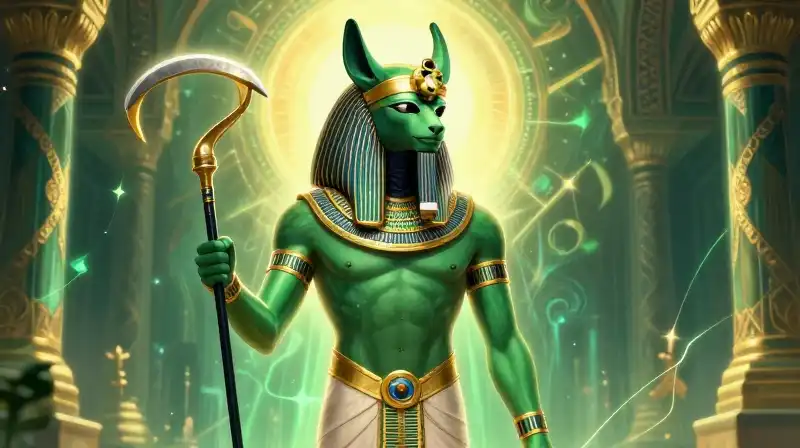
Ancient Egyptian Deities of Speed and Swift Action


Introduction
Ancient Egyptian culture approached the concept of speed not merely as a physical attribute, but as a divine power—a measure of efficiency, cosmic movement, and the rapid delivery of divine will. For those interested in the pantheon, the search often narrows to a specific “Egyptian god of speed.” However, to truly understand this tradition, one must see speed as an integrated attribute, woven into the fabric of justice, navigation, war, and the very passage of time. These deities embody the power of dynamic action; they do not merely run fast, they act with unstoppable swiftness.
The Flurry of Judgment: Mafdet and the Justice of Speed
One of the most definitive examples of speed in the Egyptian pantheon is the goddess Mafdet. Her name itself is a powerful linguistic clue, translating to “She Who Runs” 1. Mafdet is inextricably linked to the swift execution of justice. She was the deity who oversaw the judicial process and was directly associated with the rapid delivery of legal punishments. Her swiftness here is not a display of athletic vanity, but a reflection of divine impartiality and the immediate power of cosmic order. When justice needed to be rendered, Mafdet ensured it was delivered without delay, embodying a form of decisive action that could not be contested 1. This shows how a god’s name and function are directly tied to a crucial cultural concept: that cosmic justice must be immediate and relentless.
Divine Journeys and the Traveler’s Velocity
In the vast cosmology of ancient Egypt, movement and travel were often sacred. Khonsu, a god tied to the moon, possesses a name that resonates with “Traveller” 1. This naming convention suggests a profound role in navigation and protection, particularly during nighttime journeys. Khonsu is the cosmic traveler, charting the celestial currents. Similarly, the god Anhur, an early figure in the pantheon, was associated with hunting and war, but his domain included swift, dynamic action 1. Later, he was also identified with the god Shu, who represents air and wind, implying a connection to rapid, pervasive movement across the world 1. In these contexts, swiftness is less about a sprint and more about the ability to traverse great distances or govern the invisible, moving forces of the sky and the night.
Agility in Conflict and the Hunter’s Grace
Beyond navigation and justice, speed was fundamental to the domains of power and conflict. The god Anhur, as a deity of hunting and war, inherently represented rapid engagement and dynamic violence 1. The swiftness required to pursue game or to execute a brilliant military maneuver found a divine home in these powerful figures. Similarly, Bastet, a feline deity often associated with protection and prosperity, was linked to athletic agility. This grace and swiftness were so compelling that in later cultural periods, she became associated with the Greek goddess Artemis, the divine hunter and moon goddess (1, 2). This link reveals a persistent theme in Mediterranean and Near Eastern traditions: the embodiment of a powerful, agile female hunter whose grace is a form of divine energy. The legendary conflicts, such as the perpetual struggles between Horus and Seth over the throne, further illustrate how rapid, dynamic actions are the foundation of divine struggles and the assertion of power 1.
The Cultural Nuance: Function Over Physicality
Scholars have noted that while certain deities like Mafdet or Bastet possess titles or attributes linked to swiftness, it is challenging to pinpoint a single Egyptian deity explicitly defined solely by the attribute of speed 1. Instead, the Egyptian understanding of speed was largely integrated into the function of the god. Speed was the tool of swift execution of justice; it was the motion of the traveler Khonsu; and it was the dynamic energy of Anhur in battle. Some modern interpretations of Egyptian mythology suggest that deities possessed superhuman speed, allowing them to exceed the limits of mortal athletes 1. This superhuman ability is a reflection of their supreme status above mortal creatures 1. However, the overall cultural representation suggests that their power derived from the *action* itself—the flawless delivery of a verdict, the unimpeded journey across the cosmos, the swift strike of the hunter.
Beyond the Race: The Meaning of Rapid Action in Egyptian Thought
The study of these swift deities offers a window into the Egyptian understanding of efficacy. In a society structured by divine order (*Ma’at*), rapid, decisive action—whether it was the “swift execution” of Mafdet, or the rapid movement of a god across the heavens—was necessary to maintain stability and balance. The cultural presence of these gods reminds us that the divine is defined by both its power and its dynamism. They represent the unstoppable force of nature, justice, and cosmic flow. To encounter these deities is to witness the embedding of highly sophisticated concepts of time, movement, and responsibility within the very act of worship and storytelling.
References
Footnotes
Related Articles