Arawn: Exploring the Celtic God of Annwn in Welsh Lore

Introduction
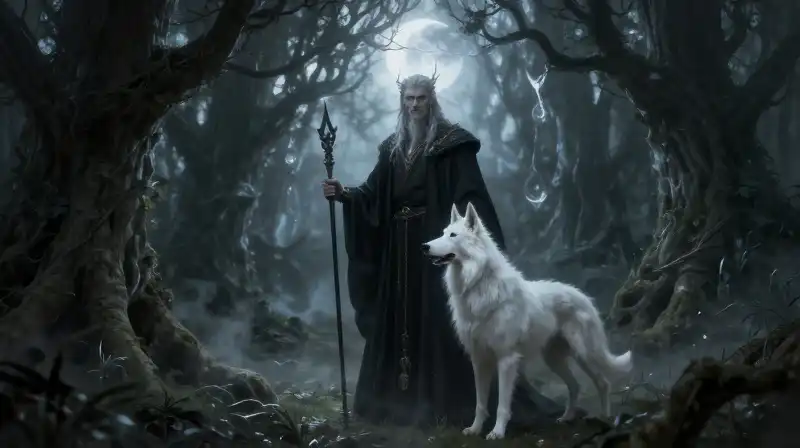
In the rich tapestry of Welsh tradition, Arawn stands as a figure of profound significance, reigning as the King of Annwn. He is far more than a simple deity; he is the monarch of the liminal world—the Otherworld that exists between the realm of the living and the realm of the dead [1, 2]. For those who study the folklore of the Britons, Arawn embodies the mystery of transition, the power of myth, and the eternal dialogue between the earthly concerns of human life and the sweeping, sublime mysteries of the spiritual realm.
To encounter Arawn is to delve into a tradition that prizes the ambiguous. He is not a straightforward hero or villain. Instead, his existence challenges the reader to explore the duality inherent in the Celtic worldview, where the idyllic and the terrifying, the beautiful and the formidable, often reside within the same landscape. This examination explores how Arawn is woven into the core narratives of Welsh lore, and how his powerful symbol continues to shape the cultural understanding of the supernatural in the British Isles.
The Dual Nature of Annwn: Idyllic Haven and Realm of Power
Arawn’s domain, Annwn, is perhaps the most fascinating aspect of his character. While the tales of the Otherworld often evoke fear, Annwn is simultaneously conceptualized as an idyllic and peaceful haven for those who pass beyond mortality [3]. It is a place where, within its boundaries, the traditional ravages of time, disease, and hunger are held at bay [2]. However, this sanctuary does not equate to simple serenity. Annwn is the realm of immense, unpredictable power, presided over by a king whose persona can swing from a powerful, almost benevolent ruler to a figure of imposing fear and war [3].
The true function of Annwn, therefore, is to act as a mirror—a space that reflects the complexities of human existence. It is a realm of potent magic where the rules of the mundane world are suspended. The inherent conflict between Annwn’s serene perfection and its association with the death cycle is what makes Arawn such a compelling figure in Celtic mythology, representing the eternal promise and danger that lie beyond the veil of life.
Arawn in the Mabinogi: The Catalyst of Mysticism
Arawn’s narrative role is most clearly and powerfully established within the First Branch of the Mabinogi, one of the most revered collections of Welsh mythology. In this foundational tale, Arawn serves as the key figure in establishing the mystique of the Otherworld through the experiences of Pwyll [1, 2]. Pwyll, the hero, interacts with Arawn, and the interaction is marked by a profound shift in reality—notably through Pwyll’s experience of body-switching while residing within Annwn [1, 2].
This encounter is a cultural touchstone, as it uses Arawn’s realm to introduce a fundamental truth to the reader: that the boundaries of our physical reality are permeable. Arawn’s presence drives the core themes of transformation and acceptance of the unknown. Later branches of the Mabinogi continue to utilize Arawn’s influence, most notably when he gives magical pigs to Pryderi, Pwyll’s son, a gift that precipitates significant conflict and further demonstrates the potent, often double-edged nature of gifts received from the Otherworld [1, 2].
The Celestial Hunt: Arawn and the Cŵn Annwn
One of the most evocative symbols tied to Arawn is the Cŵn Annwn, or the Hounds of Annwn. These spectral beasts are intrinsically linked to the kingdom of Annwn, and they are said to ride the skies during the transitional seasons—autumn, winter, and early spring—as part of the legendary phenomenon known as the Wild Hunt [1, 2].
The Wild Hunt represents a profound intersection of the ancient and the adapted. Historically, Welsh tradition held that the Wild Hunt was a supernatural event—the spirits of the lost being pursued toward Annwn [1, 3]. Over time, as cultural landscapes evolved, these powerful spiritual beliefs were influenced by external forces. The concept was eventually Christianized, shifting the interpretation to represent the capturing of souls by divine or supernatural forces [1, 3]. This evolution demonstrates the resilience of the mythological framework while acknowledging the dynamic, adapting nature of cultural belief.
Navigating the Lore: Meaning, Identity, and Literary Parallels
Scholars continue to explore the deeper linguistic and comparative meanings of Arawn. Etymological theories suggest that his name may be linked to the Hebrew name Aaron, meaning “exalted,” or perhaps tied to the Continental Celtic god Arubianus [2]. Furthermore, the themes surrounding Arawn and Pwyll’s encounter have led some scholars to draw thematic similarities to the narrative structure of the European tradition, specifically the story of Sir Gawain and the Green Knight, suggesting deep cross-cultural influences on “newcomer” or transitional lore [1].
Regarding his broader mythological role, some research suggests an uncertain but interesting link between Arawn and the Gaulish god Cernunnos, primarily due to their shared associations with the Otherworld and the hunt [1]. Yet, Arawn’s personal identity is also complex. While some tales present a terrifying figure, others detail mythological defeats, such as his loss to Amaethon ab Don and Gwydion ab Don, a detail preserved in the Welsh Triads but absent from the standard text of the Book of Taliesin [1]. This discrepancy indicates that Arawn’s mythology is not static; it is a living, contested record, with varying versions being preserved across regional folk traditions.
Defining the Ambiguity: Is Arawn Good or Evil?
The question of whether Arawn is good or evil is a false dichotomy in the context of complex mythology. The tradition does not cast him in stark moral absolutes. His powers are vast and his realm, while a peaceful haven [2], is also a place of powerful, unsettling change. Instead, Arawn functions as a symbol of necessary transitions—the challenging, often mysterious process of moving from one state of being to another. His “power” lies in his ability to mediate between the realms and enforce the cycles of life and death. While he can be an adversary of mortal heroes, he is also the sovereign of an eternal and perfect kingdom, proving him to be a force of nature rather than a mere moral agent.
Arawn represents the sublime—that point where grandeur and peril meet. His stories teach that the greatest truths often reside in the gray spaces between definition and definition.
References
Footnotes
Frequently Asked Questions
What are Arawn's powers?
Arawn possesses vast powers as the monarch of the liminal world and the realm of potent magic, Annwn, where the rules of the mundane world are suspended. His power lies in his ability to mediate between the realms and enforce the cycles of life and death.
Is Arawn good or evil?
Arawn is neither strictly good nor evil, as the tradition does not cast him in stark moral absolutes. Instead, he functions as a force of nature and a symbol of necessary transitions, possessing both the power to be an adversary to mortal heroes and the status of sovereign over an eternal, perfect kingdom.
Related Articles