Bastet: The Cat Head Egyptian Goddess of Protection

Introduction
In the tapestry of ancient Egyptian belief, few deities embody the powerful contrast between fierce protection and domestic grace as profoundly as Bastet. Far from being a simple pet god, Bastet is a figure whose form and function mirrored the complexities of the Egyptian worldview—a blending of untamable power and essential daily life. This article explores the multifaceted tradition of this feline deity, tracing her evolution from a formidable warrior goddess into the beloved patron of pleasure and health. To understand Bastet is to understand how the ancient Egyptians synthesized the majesty of the wild with the sanctity of the home, creating a divine force that both guarded the cosmos and graced the hearth.
The Evolution of the Feline Divine
The transformation of Bastet is a compelling cultural narrative. Initially, she was not primarily associated with domestic cats, but rather with the leonine power of the wilderness. Bastet’s original manifestation was that of a fierce, lioness warrior goddess 1. This early form embodied a potent, aggressive energy, tied to the most dangerous aspects of the natural world. However, a notable shift in the cultural perception of the deity occurred, particularly around the Twenty-second Dynasty. During this time, she transitioned into a gentler persona, frequently depicted as a domestic cat or a woman crowned with a feline head (1, 2).
This transition was not arbitrary; it reflects a fundamental cultural shift in how the Egyptians viewed divine power. While her leonine aspects represented the raw, life-giving heat and danger inherent in the sun—a powerful, primal energy 1—her feline shift emphasized benevolent protection and fecundity. Her core cultural significance lies precisely in this dual nature, combining the swift danger of the wild with the grace and domestic security found in the home 1. She remains a complex archetype of protective power in all its forms.
Feline Form and Universal Reverence
The Egyptian reverence for the domestic cat was deeply ingrained in their society, serving not just as pest control but as a sacred presence. This existing cultural reverence provided the perfect canvas for the adoption of Bastet’s feline form. Cats were considered physical embodiments of the goddess herself (3, 2). In this tradition, the cat became the living vessel of the divine.
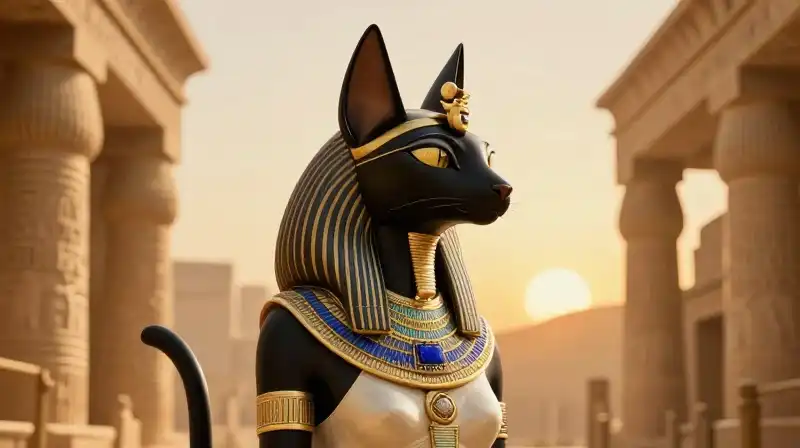
Sculpturally, this devotion is unmistakable. Bastet is frequently represented as a woman with a feline head, possessing a slender body, sometimes adorned with the sun disk or the uraeus (1, 3, 2). These artifacts often utilized materials like alabaster, as seen in pieces recovered from Tutankhamun’s tomb 1. This depiction merges human grace with animal potency, symbolizing her multiple roles: she is both the mother and the defender.
Bastet in the Solar Cosmology
Bastet’s role was not merely terrestrial; she played a crucial, cosmic function in the ancient Egyptian solar narrative. As a protector, she was deeply integrated into the divine family. She was revered as a daughter of the Sun God Ra and was also linked to the Eye of Ra and the Eye of the Moon (1, 3). Her primary cosmic duty was one of watchful defense. During the day, she protected Ra’s solar boat as it traversed the heavens (1, 3). More critically, as the sun descended, Bastet assumed a vital role in defending Ra against his greatest adversary, the serpent Apep 1. This illustrates her ultimate power as a cosmic guard, ensuring the cyclical victory of order (Ma’at) over chaos.
The Tradition of Bubastis and Sacred Offerings
The devotion to Bastet found its most concentrated expression in the Delta city of Bubastis. This regional focus gave the tradition a specific and vivid living culture. Bubastis became renowned for its dedication to the goddess (1, 2). This deep, local veneration manifested in practices that still resonate today: the dedicated worship of her benevolent, maternal aspects, focusing on health and pleasure (3, 2).
The community’s faith was expressed through tangible offerings. The veneration of Bastet often involved the offering of cat mummies, particularly those originating from the Bubastis region. These mummies were presented to the goddess as a sign of profound gratitude for protection or in earnest hopes of receiving her divine favor 1. This practice shows how deeply embedded the goddess was in the socio-religious fabric of the community, moving beyond abstract faith into tangible acts of service and devotion.
Understanding Bastet’s Role Today
While the ancient context of Bastet’s worship is rooted in the practices of the Delta, her symbolic meaning continues to influence contemporary understanding of cultural heritage. One common point of inquiry is the nature of her guardianship. While Anubis (a different deity) is often associated with death and judgment, Bastet embodies active, protective life. She represents the shield of the home and the fierce guardian of the community’s well-being. For modern readers engaging with ancient Egyptian culture, Bastet serves as a powerful example of how the human relationship with nature—specifically the domestic cat—was transformed into a sacred, multi-layered tradition of protection.
Ultimately, Bastet is a living symbol of balance. She illustrates how fierce power can be harnessed for protection, and how the image of the domestic cat can carry the weight of cosmic significance. She is the divine intersection where grace meets power, and where the security of the hearth meets the majesty of the sun.
References
Footnotes
Frequently Asked Questions
Does Anubis have a cat head?
The provided article mentions Anubis only as a different deity often associated with death and judgment. It discusses the depiction of Bastet as the one frequently represented as a woman with a feline head, but it does not specify that Anubis has a cat head.
Practicing Sacred Offerings to Bastet in Bubastis
Identifying the Region
Focus on the Delta city of Bubastis, which was known for its deep and specific dedication to the goddess Bastet.
Preparing the Offering
Select cat mummies originating from the Bubastis region, as these were the dedicated offerings of the community.
Making the Offering
Present the cat mummies to the goddess as a tangible act of service and devotion.
Stating the Intention
Offer the tribute as a sign of profound gratitude for protection or to seek the goddess's divine favor.
Related Articles