Who is the Egyptian God or Goddess of Peace and Calm?

Introduction
When we ask who the Egyptian god or goddess of peace is, we often look for a single figure of tranquility. Yet, the concept of peace in ancient Egyptian culture is less about quiet serenity and more about the restoration of perfect balance. For the Egyptians, peace was not a passive state; it was an active, cosmic requirement—a fundamental order that had to be maintained against the chaos of the world. Therefore, to understand the Egyptian concept of calm, one must first look at the fundamental principle upon which their civilization rested: Ma’at.
Ma’at: The Foundation of Cosmic Order
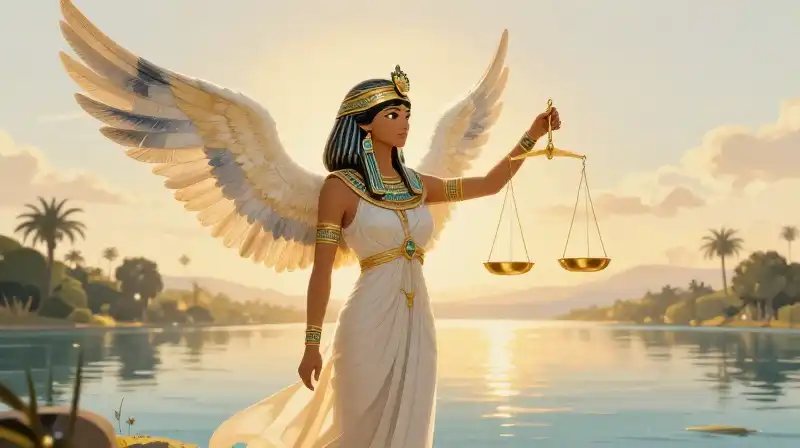
The most profound expression of peace in Egyptian theology is the concept of Ma’at. While Ma’at is often colloquially interpreted as a goddess of peace, it is formally understood as the god or principle of cosmic order, truth, and justice 1. In a world perceived as constantly threatened by chaos—or *Isfet*—Ma’at provided the necessary structure, ensuring that the sun rose, the rivers flowed, and life proceeded according to divine law. For the ancient people, peace was synonymous with maintaining this state of truth and righteousness, a concept critical to daily life and ultimate survival.
Shu: The Guardian of the Breath and Air
If Ma’at represents the overarching cosmic truth, Shu embodies the physical mechanism of order. Shu is specifically identified as the Egyptian god of peace, wind, and the air 1. As a deity linked to the very breath that sustained life, Shu symbolized the ability to impose order upon the volatile elements. He was tied to the necessary balance that allowed life to flourish within the ordered cosmos. In this context, Shu serves as a clear answer to who the “god of calm” was—a deity representing the pervasive, stabilizing energy of the atmosphere itself.
The Enduring Serenity of Isis: Peace as Divine Devotion
While Shu and Ma’at deal with the cosmic and environmental aspects of peace, the figure of Isis offers a different, deeply personal understanding. Isis is one of the most influential figures in ancient Egyptian religion, celebrated as a divine mother, powerful healer, and profound magical practitioner 1. Although she is not specifically categorized as the goddess of peace, her personification of peace and calm comes from her character and her actions. She is repeatedly depicted as a figure of kind, serene, and loving nature 1. The core of Isis’s spiritual power is rooted in her devastating loyalty and devotion. Her most famous narrative, the Osiris myth, portrays her as the epitome of a grieving widow who takes action to restore life and wholeness after her husband is murdered by Set 1. By using her incredible magical prowess, she protects the deceased and aids them in entering the afterlife. This immense, enduring emotional strength—her capacity for devoted care and magical restoration—represents a potent form of peace that comes from profound spiritual resilience and maternal love 1.
The Evolution and Global Influence of Egyptian Traditions
The spiritual resonance of figures like Isis and Ma’at did not remain confined to the Nile valley. The concepts of divine order and feminine power began to spread far beyond Egypt, particularly during the Hellenistic period 1. This widespread worship of Isis and her teachings of devoted power demonstrated how Egyptian traditions adapted to incorporate into the cultural landscape of the wider Mediterranean, particularly Roman and Greek society 1. This process sometimes led to the blending of traits; for example, during the New Kingdom, Isis began absorbing characteristics that had previously been associated with the earlier goddess Hathor 1. Some scholars even suggest that Isis might have originally represented a personification of the royal throne (*st*), a symbol of both kingly power and his divine mother, linking her divine nature directly to established structures of governance and family 1.
Synthesis: Order, Strength, and Inner Peace
To properly understand the search for the Egyptian goddess or god of peace, it is helpful to distinguish between the different dimensions of calm in the tradition. Peace, or the state of harmony, was a multifaceted concept:
- The Macro Scale: Ma’at, representing the ultimate cosmic order that governs the universe.
- The Elemental Scale: Shu, representing the stabilizing force of wind and air that maintains balance.
- The Human/Emotional Scale: Isis, representing the personal strength found in devotion, resilience, and a serene, protective spirit.
The tradition teaches that true peace is an ongoing act—it is the deliberate effort to maintain Ma’at in the world, and it is the ability of figures like Isis to restore balance through fierce, loving devotion when chaos takes hold. The concepts remain a powerful example of how ancient communities interpreted profound spiritual truths through the interplay of divine order and human emotion.
References
Footnotes
Frequently Asked Questions
Who is the Egyptian god of calm?
Shu is identified as the Egyptian god of peace, wind, and the air. He serves as the god of calm by representing the pervasive, stabilizing energy of the atmosphere itself.
Related Articles