
Khepri and the Scarab: Symbol of Renewal in Ancient Egypt

Introduction
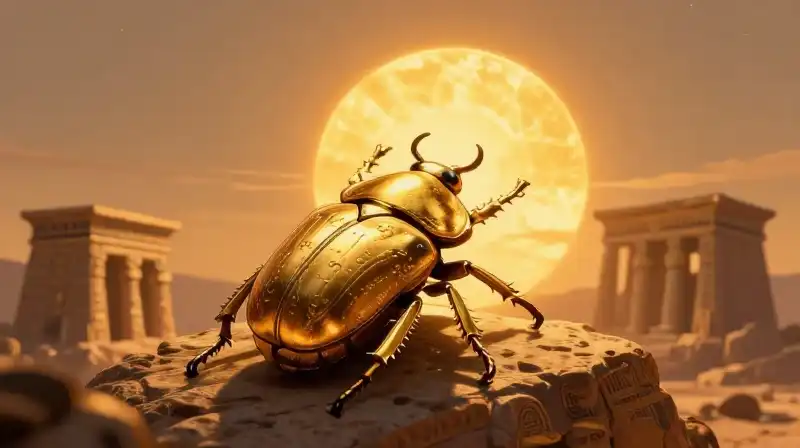
The ancient Egyptian reverence for the rising sun, or the morning light, was not simply a celebration of dawn; it was a profound meditation on the principle of continuous transformation. At the heart of this cosmic cycle lies Khepri, a powerful deity whose name, derived from the Egyptian verb *khpr*, means “to develop” or “to create” [1, 2]. Khepri embodies the moment of becoming, the powerful transition from obscurity into visibility. His primary earthly anchor, and the key to understanding his theological depth, is the dung beetle, or *Scarabaeus sacer*. This relationship between the mundane cycle of a creature and the sublime reality of the sun’s daily rebirth is what defines Khepri’s enduring cultural significance in Egyptian heritage.
From Nature to Divinity: The Birth of the Symbol
To the ancient Egyptians, the connection between the daily solar cycle and the life of a humble insect was a matter of keen natural observation. The dung beetle, seen rolling balls of dung and meticulously burying them, was observed by religious thinkers as a physical microcosm of the creation myth [1, 3]. The process mirrored the sun itself: just as the beetle produced fully formed young from the dung ball, the sun was understood to be reborn each morning, transforming from the darkness of the night into the power of the day [1, 3]. This observation elevated the beetle from a mere insect to a divine messenger. Khepri became the personification of this regenerative action. His role was not just to mark the start of the day, but to be the active creator of the new state of being—a deity who *made* the sun appear again. This foundational link allowed Khepri to embody the concept of spontaneous generation and eternal renewal, functioning as a primary symbol of cosmic persistence [1, 3].
The Mechanics of Transformation: Khepri in the Afterlife
Khepri’s significance extends far beyond the terrestrial cycle of sunrise. He was intrinsically tied to the journey through the Duat, the complex Egyptian underworld, where the soul navigated the challenges of death and hoped for rebirth. In funerary texts such as the *Amduat*, Khepri plays a pivotal role in the solar journey [1]. The god is depicted leading the solar barque out of the underworld during the critical 12th hour, thereby ushering in the dawn of a new day and ensuring the deceased’s successful passage. This integration makes Khepri a central figure in funerary mythology. For the ancient Egyptian, death was not an end but a necessary metamorphosis, mirroring Khepri’s daily rebirth. This theme of transformation is so pervasive that Khepri’s corpse is often referenced alongside the soul of Ra in the afterlife narratives, paralleling the metamorphic journey of Osiris [1, 3].
Iconography and the Language of the Scarab Amulets
Because the principle of transformation is so central to Khepri, the symbol was widely used in everyday culture and royal practice. Scarab-shaped amulets were not treated merely as decorative objects; they were sacred, powerful protective charms. These amulets, frequently crafted from durable and vibrant materials like faience or turquoise, served multiple purposes. During public festivals, they were worn to bring good fortune to the people. Furthermore, their importance was so profound that they were buried with the mummified corpse, intended to guarantee the wearer’s own rebirth and secure their safe transition through the Duat [1, 3]. The imagery of Khepri itself varied, allowing the symbol to adapt to different theological needs:
- He was often depicted as a male human figure wearing a scarab head.
- He was also frequently shown as a winged scarab actively pushing a sun disk, symbolizing his dual nature as both creator and sun-god [1, 2].
Iconography further integrated the scarab motif into the forms of various pantheistic gods and even late-period forms of Ra [2]. A striking example of this is the magnificent scarab pectoral of Tutankhamun, which powerfully underscored the symbol’s status in royal funerary practices [2]. The use of the color blue on these amulets often suggested the heavens, the primordial waters, or the constant, cyclical nature of life, death, and renewal [1].
Understanding the Symbol: Meaning, Gender, and Scope
A common point of curiosity among those researching Egyptian mythology is Khepri’s identity, given his varied appearances. Khepri is rarely understood through a single lens. While often viewed as an aspect of the broader solar deity Ra, he occupied a distinct space in creationist theories, particularly in Heliopolis and Thebes, where he embodied the *morning* sun, distinguishing him from Ra (midday) and Atum (evening) [1]. In terms of gender and creator role, Khepri’s definition is wide. Some myths posit that Khepri holds the power of primordial creation, having fathered the air god Shu and the goddess Tefnut from the chaos of Nun and his own shadow [3]. This wide-ranging creative power establishes him as a pivotal figure in Egyptian cosmogony. To answer the question, “What does a Khepri scarab mean?” is to acknowledge that it is a symbol of *potential*—the potential for life, the potential for rebirth, and the potential for continuous, self-made creation.
Synthesis: The Enduring Tradition of Self-Creation
The Khepri and the scarab story is fundamentally an ancient Egyptian framework for understanding perpetual motion and inherent potential. It is a tradition rooted in the observation that even the most common creature performs a ritual of perfect transformation. By linking the divine power of creation (the *khpr*) to the physical, observable process of the dung beetle, the Egyptians solidified a worldview where transformation is not a miracle, but an inevitable, glorious cycle. For a reader seeking to understand this heritage, the scarab should be viewed not as a simple ancient trinket, but as a metaphysical diagram. It maps the journey of every Egyptian soul—from the chaos of the underworld, through the necessary process of decay and metamorphosis, toward the radiant, inevitable promise of the morning sun. It is a powerful testament to a culture that found the cosmic truths in the smallest corner of the natural world.
References
Footnotes
Frequently Asked Questions
What does Khepri scarab mean?
A Khepri scarab is a symbol of potential, representing the potential for life, the potential for rebirth, and continuous, self-made creation. These sacred amulets were used as protective charms to guarantee the wearer’s rebirth and ensure their safe transition through the underworld.
What kind of beetle is Khepri?
Khepri is linked to the dung beetle, which is referred to by its scientific name, Scarabaeus sacer.
Related Articles