Anpu Egyptian God: Myths, Role, and Journey to Hermanubis

Introduction
Anpu, often known by the name Anubis, is one of the most evocative figures of the ancient Egyptian pantheon, representing a vital interface between the world of the living and the realm of the dead. Far more than a simple deity of burials, his role evolved to become a specialist in the intricate and essential ritual of embalming and mummification, particularly following the establishment of the Osiris myth (1, 2). For the ancient Egyptians, who placed profound importance on the continuity of the self after death, Anpu served as the crucial guardian and guide. His presence ensured that the body was preserved correctly, and that the soul successfully navigated the perilous journey toward the afterlife. To understand Anpu is not merely to know a god of the dead, but to glimpse the profound cultural reverence the ancient people held for transformation, protection, and the sacred cyclical nature of life.
The Function of the Jackal and the Colors of the Nile
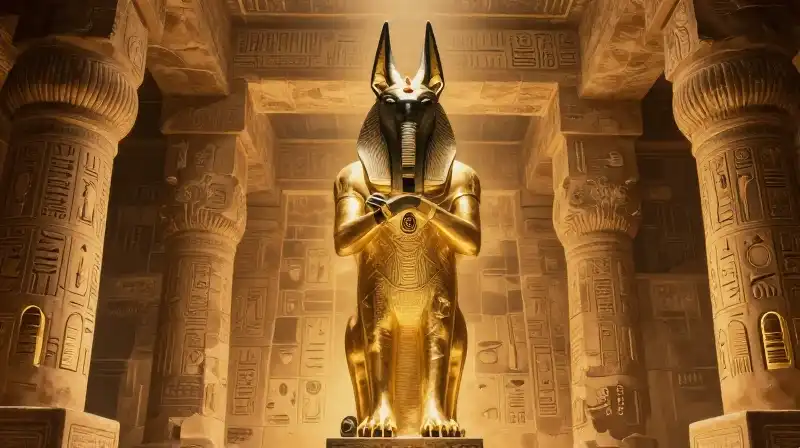
The identity of Anpu is deeply interwoven with specific, culturally meaningful imagery. He is almost always depicted as a man with the head of a canid or a jackal. The association with the jackal was a pragmatic and intentional cultural adaptation; these animals were commonly found in cemeteries and were viewed as natural guardians (1, 2). This chosen form allowed the ancient community to project a figure of protection directly into their most sacred, final spaces. The color in which he is rendered—a striking black—carries immense symbolic weight within Egyptian culture. This hue does not represent malevolence but instead symbolizes regeneration and the fertile, rich soil of the Nile, which sustains all life and speaks to the process of decay and rebirth 1. His titles reflect these deep-seated functions, such as “He Who is in the Place of Embalming” and “Foremost of the Westerners,” the latter referring to the Western necropolis, the city of the deceased 1.
The Judgment: Keeper of the Soul’s Passage
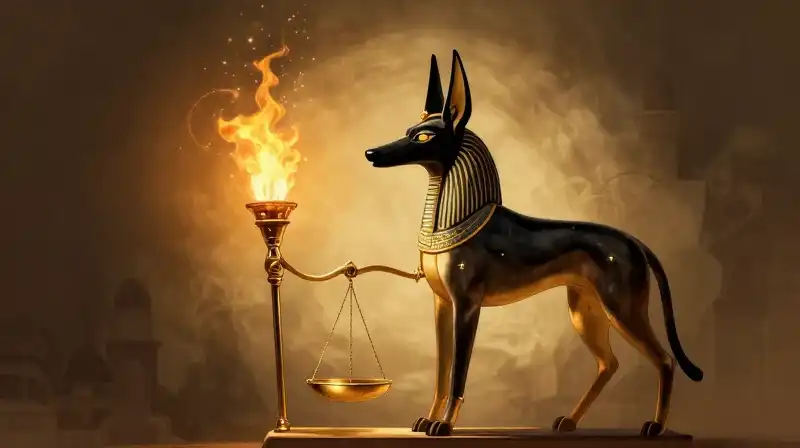
Anpu’s most dramatic and famous role occurs during the divine judgment of the soul. He is a pivotal figure in the “Weighing of the Heart” ceremony 1. In this sacred rite, Anpu acts as the custodian and protector of the grave, overseeing the proceedings that determine whether a soul has lived a life worthy of the afterlife. His function ensures that the physical remains are respected while the spiritual essence is measured against the standards of Ma’at (cosmic order). Through this critical involvement, Anpu served as the arbiter, safeguarding the divine process that determined eternal existence 1.
The Myth of Transformation: Anpu and Osiris
The foundational myths surrounding Anpu emphasize his role in the preservation of divine bodies. One central narrative involves the figure of Osiris and his eventual return to life, a story that solidified Anpu’s specialized domain 1. According to folklore, Anpu is dramatically involved in narratives where he successfully defeats the chaotic forces of Set during the mummification and preservation of Osiris’s body 1. Other narratives, such as the one recorded by the Greek historian Plutarch, provide a deeper familial layer to the deity, describing Anpu as the abandoned son of Nephthys and Osiris, eventually being raised by Isis 1. These complex familial ties highlight how the Egyptian religious framework was constantly evolving and integrating new layers of narrative to explain its core tenets.
Syncretism: The Journey from Anpu to Hermanubis
Like many ancient deities, Anpu’s identity was not static. As the cultural landscape of Egypt changed, so too did the pantheon, demonstrating a process known as cultural syncretism. This transformation is best seen in his later merged identities 1. When Egypt fell under the rule of Greek influence, Anpu began to be associated with the Greek god Hermes, leading to the creation of a hybrid deity: Hermanubis 1. This blending—a reflection of the cultural mingling between two powerful traditions—was maintained through the Roman and medieval periods. In later periods, his lineage also became fluid, sometimes being recognized as the offspring of Isis and Serapis, further adapting the tradition to the Hellenized religious environment 1.
Anpu’s Rank within the Pantheon
When considering who is “higher” than Anpu in the divine hierarchy, the context must shift from his specific function to the broader structure of Egyptian cosmology. While Anpu is a powerful and indispensable god of the deceased, his role as a specialized funerary deity places him beneath the highest cosmic powers. Figures such as Ra (the Sun God) represent the ultimate source of light and regeneration, and Osiris, as the primary king of the underworld, holds the position of supreme authority over the realm into which Anpu guides souls. Anpu operates *within* the system of judgment, ensuring the process is followed, but the major creators and cosmic rulers sit at the apex of the divine structure.
Conclusion: The Enduring Significance of Preservation
Anpu remains a powerful cultural archetype because he embodies the necessity of transition. He is not simply a figure who oversees death, but a divine agent of *transformation*. Through his role as embalmer, protector, and guide, he ensures that the physical passage through death does not equate to an ending, but rather a shift from one state of being to another. His complex journey from a specialized Egyptian god (Anpu) to a syncretized figure (Hermanubis) reflects the resilient and adaptable nature of the traditions he served. By understanding the symbols of black soil, the guardianship of the jackal, and his involvement in the sacred judgment, one grasps a worldview that highly values the sanctity of the individual soul and the profound hope that even death is merely a complicated transition into a renewed existence.
References
Footnotes
Frequently Asked Questions
Who is higher than Anubis?
Ra (the Sun God) represents the ultimate source of light and regeneration, and Osiris, as the primary king of the underworld, holds the position of supreme authority over the realm. While Anpu is powerful, his role as a specialized funerary deity places him beneath these highest cosmic powers.
Related Articles