The God Shu: Origin, Role, and Meaning in Ancient Egyptian Myth


Introduction
In the intricate tapestry of ancient Egyptian cosmology, few figures are as profoundly fundamental as Shu. He is not merely a deity, but the dynamic, cooling space itself—the essential atmosphere that makes the physical world possible. To understand Shu is to understand the concept of necessary separation: the primordial void that allowed existence to manifest when the sky and the earth were pulled apart. He embodies the concept of *space*, the critical medium through which life, breath, and order come into being. For the ancient Egyptian, Shu was the quiet, necessary force that ensured the cosmos did not collapse back into unity.
The Breath of Existence: Defining Shu’s Function
Shu’s role transcends that of a typical creator god; he is the facilitator. His primary function, as documented in several traditions, was to act as the mediator between the warring forces of the earth god Geb and the sky god Nut (1, 2). Without this separation, the physical world as we know it could not exist. This function is deeply tied to the concept of Ma’at—the fundamental pillar of Egyptian belief encompassing truth, justice, and balance 1. Shu’s nature was interpreted as a calming, pacifying influence, the air that cools the fierce forces of creation and brings necessary order to chaos.
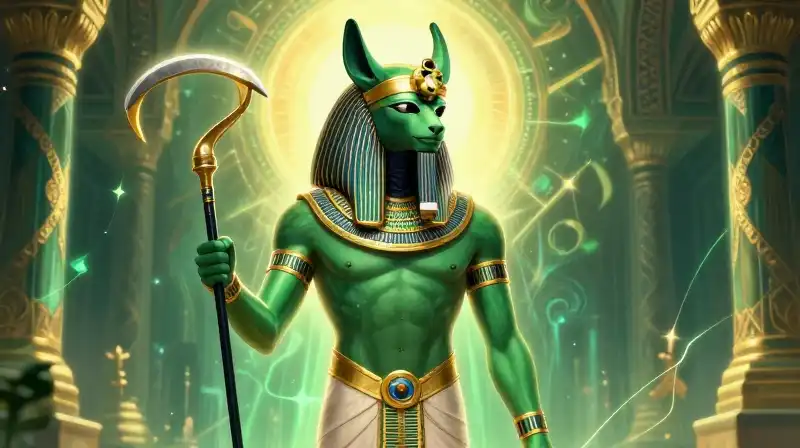
The visual representation of Shu emphasizes this role of emptiness and lightness. He is frequently depicted wearing an ostrich feather on his headdress, a powerful icon of lightness and emptiness (1, 3). Scholars theorize his name itself held a duality, perhaps meaning “emptiness,” derived from words signifying dryness, or alternatively, “He who rises up” (2, 3). This dual meaning perfectly captures his state: he is the empty space that allows things to be, and the rising force that enables life to begin.
Iconography and The Great Separation
The story of Shu begins with his emergence alongside his sister, Tefnut. According to ancient narratives, Shu and Tefnut were not simply the first beings created, but their separation and subsequent interaction were vital to their father, Atum 1. Through this process, they imparted the vital concepts of breath and life, enabling Atum to complete his self-creation of the cosmos. This establishes Shu as the literal provider of the vital force—the life-breath of the universe.
The iconographic portrayal of Shu also reflects regional and personal interpretation of his powers. While often depicted as a human figure, he held significant connections to the animal kingdom, most notably appearing in a fierce lion form alongside Tefnut, forming the “twin lion gods” (2, 3). This variation suggests that the power of the primordial forces was multifaceted, embracing both the refined, vital breath of man and the raw, protective strength of the beasts (3, 2).
Guardian of the Cycle: Shu’s Protective Powers
Beyond his role in the initial creation, Shu acted as a profound protector throughout the cyclical nature of time. He was intrinsically linked to the concept of neheh, or eternal time, which is defined by a ceaseless, perpetual cycle of birth, death, and rebirth 1. This is a continuous cycle of the breath and the flow of life itself.
One of his most significant functions involved safeguarding the sun god, Ra. As Ra traversed the dangerous journeys through the underworld or across the night sky, Shu was invoked to ensure his protection 1. This protection was not merely physical; it was cosmological, ensuring the sun’s rebirth each morning by maintaining the balance and atmosphere of the world 1. Because of this, Shu and Tefnut were frequently depicted on protective jewelry, such as the menat counterweight, signifying that their primordial protection was considered vital for shielding the wearer from worldly dangers 1.
Shu’s Legacy and Cultural Reach
The influence of Shu was not confined to theological texts; he was a deeply rooted religious concept dating back to the Old Kingdom. His presence is found in critical funerary and religious literature, appearing in both the Pyramid Texts and the Coffin Texts 1. This confirms his role was central to Egyptian thought from its earliest historical stages.
Culturally, Shu was revered across the land, with local sites of worship designated as “The House of Shu” in cities such as Dendera and Djeba 1. However, Shu’s prominence evolved significantly over time. His connection to the sun became particularly powerful during the period of the Aten heresy under Akhenaten. In this context, his cult was assimilated into the monotheistic ideology centered on the sun disk, Aten, allowing the essential nature of the atmosphere to be integrated into a solar doctrine 1.
Clarifying the Myths: Shu and Tefnut
When studying Shu, the most common question concerns his relationship to his consort. Shu’s wife is Tefnut, and their coupling is central to the entire Egyptian creative narrative. Their union—often visualized as the separation of sky from earth—is the ultimate source of breath and life 1. They represent the foundational duality: the space and the wet/dew (Tefnut), allowing the earth and the air to meet and the cosmic process of existence to begin.
This pairing is often misunderstood as a mere chronological sequence; in reality, Shu and Tefnut embody the dynamic tension that sustains the world. Shu represents the expansive, calming air, while Tefnut represents the wet, humid element. Together, they provide the necessary balance required for life to flourish—a constant reminder of Ma’at 1.
Synthesis: The Lesson of Dynamic Space
The enduring significance of the God Shu lies in his personification of dynamic space and balance. He teaches that existence is not merely a collection of static elements, but a necessary, continuous process of separation and breathing. By holding the heavens apart, Shu ensured that life had a place to live, a breath to take, and a cycle to follow. His tradition reminds us that true order is found not in absolute unity, but in the vital, pacifying space that exists between opposing forces—a space that is both empty and essential.
References
Footnotes
Frequently Asked Questions
Who is the wife of the god Shu?
Shus wife is Tefnut. Their coupling is central to the entire Egyptian creative narrative, representing the foundational duality of space and the wet/dew.
What are the powers of Shu?
Shu’s primary function is acting as the mediator between the earth god Geb and the sky god Nut, providing the essential space and life-breath for existence to manifest. He also serves as a profound protector of the sun god Ra, safeguarding the necessary balance and the cyclical order of time.
What does Shu mean in the Bible?
The provided article does not contain any information regarding Shu in the Bible. It discusses Shu solely within the context of ancient Egyptian cosmology, where he personifies dynamic space and acts as the essential atmosphere.
What is the story of the Shu?
The story of Shu begins with his emergence alongside his sister, Tefnut; their coupling—often visualized as the separation of sky from earth—is the ultimate source of breath and life. Shu is defined as the dynamic, cooling space that acts as a vital mediator, ensuring the cosmos does not collapse and allowing the physical world to exist.
Related Articles