
The Ancient Egyptian Crocodile God: Sobeks Power and Forms

Introduction
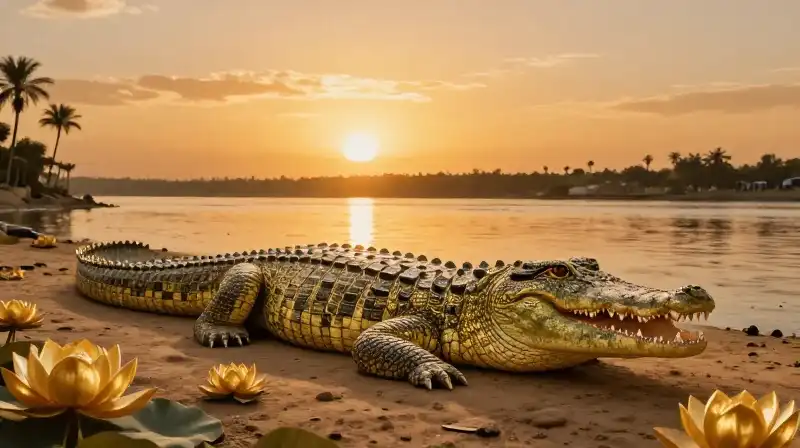
Along the fertile banks of the Nile, where the waters brought both life and unpredictable change, emerged one of ancient Egypt’s most powerful and complex deities: Sobek. Often depicted as a magnificent crocodile or a humanoid bearing the fierce features of the Nile’s most formidable predator, Sobek was far more than a simple nature god. He represented the very pulse of Egyptian existence—the life-giving, yet sometimes dangerous, inundation of the great river itself. His presence dates back to the Old Kingdom, making him a foundational figure in the spiritual landscape of a civilization obsessed with order and divine continuity (S1). To understand Sobek is to glimpse a culture that revered the raw power of the earth, finding divinity not only in the celestial skies but in the murky depths of the marsh and the ferocious strength of the beast.
The Root of Power: Sobek in Early Egyptian Life
Sobek’s origins are deeply tied to the local communities nestled in the “Land of the Lake,” known as the Faiyum region. Here, the cult was most intensely focused, centered particularly on Sobek Shedety in the capital of Crocodilopolis (S1). Initially, Sobek was strongly associated with the fertility of the land and the vital function of the Nile’s seasonal flooding. In his earliest manifestations, he was seen as a direct reflection of the crocodile, the ultimate symbol of predatory power within this specific region.
This raw, localized power was so profound that early Egyptian traditions began integrating the divine into the state itself. Pyramid Texts from the Old Kingdom recorded the Pharaoh as the living incarnation of the crocodile god, suggesting that the ruler’s authority was inextricably linked to the crocodile deity’s primal strength (S1). This connection established Sobek’s role not just as a local protector, but as a powerful guarantor of royal legitimacy and the cosmic order itself.
The Evolution of a God: Syncretism and Expansion
Sobek’s story is a narrative of continuous evolution and merging, a characteristic trait of Egyptian polytheism. What began as a regionally specific god gradually ascended to become a monumental figure within the wider Egyptian pantheon, particularly during the Middle Kingdom (c. 2055–1650 BCE) (S1, S2). This shift was often driven by syncretism—the merging of one deity with another to create a more potent, or socially convenient, divine form.
One of the most significant transformations occurred when Sobek fused with the sun god Ra, giving birth to the divine union Sobek-Re (S1, S2). This fusion dramatically elevated his status, transitioning him into a creator god. Simultaneously, in the Faiyum, a powerful syncretism with Horus led to Sobek-Horus (S2). These fused identities were often used strategically by the priesthood to affirm and cement the identity of the king with the divine might of the god, solidifying his cosmic authority.
Scholars continue to debate the deep meaning of his name, Sobek (Sbk). While some theories suggest a linguistic derivation from the causative form of the verb “to impregnate,” others propose that the term itself means “he who unites” (S1). Regardless of the etymological specifics, the practice of combining Sobek with other major deities demonstrates his essential role as a central unifying force in the Egyptian spiritual landscape.
The Duality of the Beast: Protector and Predator
The complexity of Sobek is reflected in his dual nature. He was celebrated for his immense physical power and his formidable, often aggressive character—epitomized by epithets such as “he who loves robbery” (S1). However, this fierce exterior was balanced by a deep, protective benevolence. He served as a powerful guardian, a divine force that protected the borders, the people, and the sanctity of the kingdom (S1).
The protective aspect of this deity found tangible expression in the cult’s ritual use of mummified crocodiles. Often, these preserved crocodiles—sometimes accompanied by baby specimens—were venerated, emphasizing the themes of guardianship, nurture, and the cyclical nature of life embodied by the Nile (S1). These practices illustrate how ancient people integrated their most terrifying and unpredictable natural elements into a sacred framework of hope and safety. The “Baptism of the Pharaoh,” for instance, was a ritual where Sobek was depicted anointing the king with symbols of life, reaffirming his role in divine kingship (S2).
Worship Across the Land: Regional Expressions of Sobek
While the Faiyum remained the epicenter of Sobek’s power, his influence spread far beyond it. The worship of Sobek was not static; it possessed vibrant regional variations (S1). As the Ptolemaic and Roman periods dawned, major cult centers like Kom Ombo in southern Egypt established dedicated “Per-Sobek”—temples consecrated solely to the god (S1).
The presence of Sobek in these regional temples demonstrates how a major deity could root himself into the local communities of various provinces, providing a culturally relevant form of protection and spiritual guidance tailored to specific landscapes. This regional variation allows us to see the tradition not as a monolithic dogma, but as a living, breathing cultural practice adapting to the needs of different communities across the desert and the Delta.
Sobek in the Wider Tradition: Understanding the Myth
To help clarify his significance, it is helpful to understand that Sobek is primarily a figure of the Nile and Egyptian myth. While various cultures possess powerful serpentine or crocodilian deities, Sobek is a specific manifestation rooted in the socio-political structure of ancient Egypt (S1, S2). For readers who might confuse him with deities found in other traditions, such as the crocodile god in the Bible, it is important to note that Sobek is unique to the Egyptian cosmological framework and his specific role in state-shaping (S2).
His symbolism is complex, covering themes of:
- Primal Power: The raw, untamable strength of nature.
- Kingship: The divine right and spiritual defense of the Pharaoh.
- Fertility and Renewal: The life cycle dictated by the Nile’s floods.
- Protection: Guardianship against both mortal and cosmic threats.
The Enduring Legacy of Sobek
Sobek’s story teaches us that the most enduring traditions are often those that successfully harmonize contradictions. He stands as a testament to how ancient people wrestled with the duality of existence—the terrifying power of a predator and the life-giving generosity of a flood. His regional temples and his evolution into complex divine forms ensure that his legacy persists in the rich tapestry of Egyptian heritage. He reminds us that culture is not just about reverence, but about how communities make meaning out of the powerful, unpredictable rhythms of the world around them.
Frequently Asked Questions
Who is the crocodile god in the Bible?
The article does not name a crocodile god in the Bible. Rather, it clarifies that Sobek is unique to the Egyptian cosmological framework and is not the deity found in other traditions.
Related Articles