
Hathor: Exploring the Diverse Roles of the Egyptian Goddess

Introduction
The study of ancient Egyptian traditions reveals deities who were not defined by a single, static characteristic, but by the vast array of roles they played in the cosmic and daily lives of their worshippers. Among these complex figures, Hathor stands out as a goddess of profound and multifaceted significance. Often superficially categorized as merely the “Goddess of Love and Beauty,” her divine function was far more expansive, weaving together elements of cosmic creation, royal lineage, and essential human experiences—from the joy of music and dance to the powerful mandate of maternal care (1, 2). Hathor served as one of the forty-two recognized state gods of Egypt 3, and her veneration stretches back to the Predynastic Era, establishing her as a foundational pillar of Egyptian religious life (1, 2). To understand Hathor is to understand a complete Egyptian conception of femininity: one that is both tender and terrifying, beautiful and eternal, and wholly essential to the continuity of life itself.
The Spectrum of Divine Roles
Hathor’s most compelling feature is her expansive nature, suggesting that she was understood by her community as a broad, encompassing divine archetype rather than a single, monolithic entity 3. Egyptian texts frequently referred to her various manifestations as “Seven Hathors” 3, reflecting her adaptability and ubiquitous presence. Culturally, she acted as a powerful bridge between the human and celestial realms. As a sky deity, she held powerful epithets such as “mistress of the sky” and “mistress of the stars,” embodying the cosmic mother who presided over the dawn and birthed the sun god each new day 3. Her relationship with the primary solar deity, Ra, was deeply significant. Hathor often functioned as the feminine counterpart to Ra, embodying the role of the powerful “Eye of Ra.” This aspect meant she was not just a partner, but a vigilant protector who guarded the sun god and the stability of the cosmos (1, 2). Because of her proximity to the sun and her role as a celestial guide, her influence extended even into the realm of the afterlife. She played a vital role in the transition of the deceased, assisting souls in navigating the underworld and guiding them through their spiritual passage (3, 2).
Hathor and the Mandate of Kingship
Within the political and social structure of ancient Egypt, Hathor’s influence was directly tied to the stability of the state. She was revered as the mythological consort and divine mother of the Pharaoh (1, 2). This positioning was critical because it directly linked the sacred continuity of the pharaoh to the divine will of the cosmos, reinforcing the legitimacy and sanctity of the monarchy (1, 2). Her role as a maternal deity meant that her blessing ensured the fertility, prosperity, and enduring lineage of the royal house. Beyond the palace, Hathor was a pervasive figure in Egyptian daily life. She symbolized essential human virtues and pleasures: fertility, music, dance, pleasure, and profound maternal care (1, 2). Her worship was inclusive; while she protected women and mother figures, her veneration was broad and encompassed both men and women in the community 3. This widespread worship was reflected in daily practices, such as the Egyptians viewing the application of cosmetics as a form of devotion directed toward her 3.
Symbols of a Fluid Deity
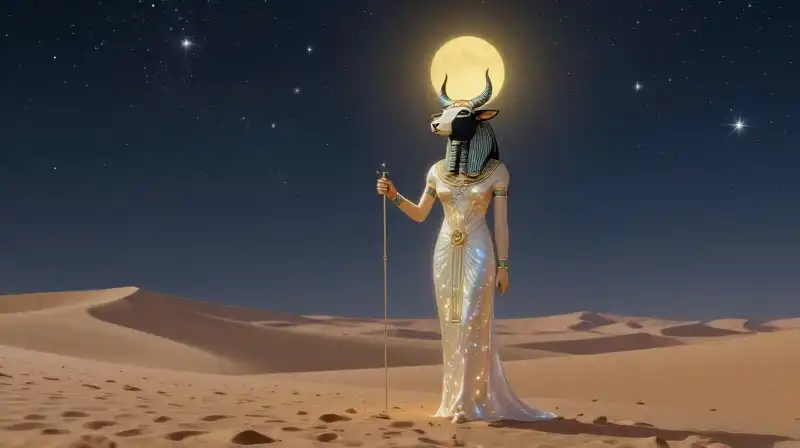
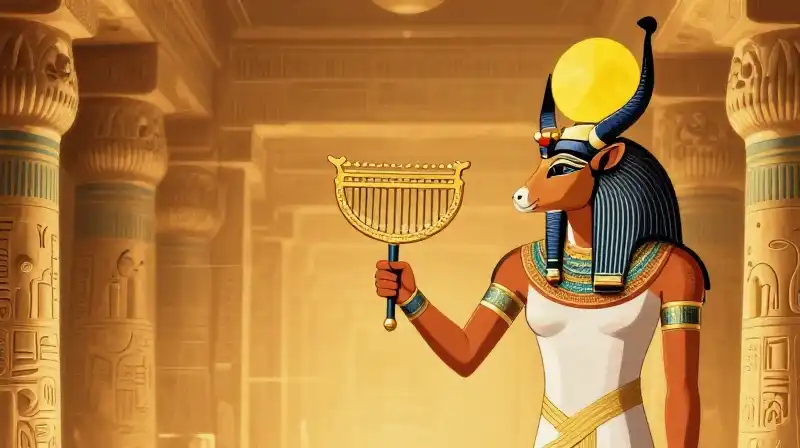
The physical representation of Hathor is as varied as her duties, contributing to the understanding that she was a broad concept. While she is most commonly depicted as a regal woman wearing a headdress adorned with cow horns and a sun disk, her symbolism is far more fluid 3. She was also represented through various animals and symbols, including a lioness, a cow, a cobra, or even the sacred sycomore tree 3. This fluidity is supported by both the nature of her cosmic roles and historical scholarly debate. Some researchers question the earliest depictions, considering if the Hathor shown on the Narmer Palette might represent an earlier goddess named Bat, whose cult later fused with and evolved into the larger Hathor tradition during the Middle Kingdom 3. These variations demonstrate that the tradition of Hathor was not a rigid theological doctrine, but a living, adaptable cultural concept that absorbed and synthesized various aspects of ancient Egyptian spiritual life.
Hathor’s Presence in Sacred Space
The most significant site of Hathor’s veneration was the temple of Dendera in Upper Egypt (1, 2). This temple served as her most prominent place of worship, surpassing many other religious structures in Egypt (1, 2). Within the cultural context of the temple, Hathor was housed in a manner that reflected her diverse nature—as a deity of both serene beauty and immense cosmic power. The tradition of worship at her temples, which remain important cultural landmarks today, was not about rote ritual but about engaging with the full breadth of her attributes. This involved celebrating her roles as a source of creative energy (through music and art), as a protector of order (through the ‘Eye of Ra’ concept), and as the source of life itself (through her maternal and fertility roles). Thus, the physical space of the temple functioned as a nexus where the divine power of the cosmos met the human needs of the community, offering reassurance in a world subject to cycles of birth, death, and renewal.
Conclusion: Understanding the Essence of Hathor
Hathor is far more than the mythical “Goddess of Love.” She represents a fundamental Egyptian commitment to the interconnectedness of all things: the sun to the cosmos, the mother to the lineage, the beauty of the individual to the stability of the state. Her tradition teaches that the highest forms of divine power are often found not in singular, aggressive forces, but in the nurturing, creative, and cyclical forces of life. To genuinely understand Hathor is to appreciate a worldview where art, love, protection, and cosmic order are not separate domains, but the integrated manifestations of a single, powerful divinity. Her legacy remains a rich testament to the ability of a tradition to define femininity and power through infinite, nuanced dimensions.
References
Footnotes
Frequently Asked Questions
What did the Egyptian god Hathor do?
Hathor was a complex, multifaceted goddess who acted as a sky deity and the cosmic mother, bridging the human and celestial realms. She functioned as the Eye of Ra, a protector of the sun god, and held critical roles as the mythological consort and maternal figure to the Pharaoh, symbolizing fertility, music, and maternal care.
Related Articles