Heka: Ancient Egyptian God, Magic, and Cosmic Force Explained

Introduction
In the vast tapestry of world traditions, few concepts possess the profound, pervasive quality of Egyptian Heka. While often quickly reduced in modern popular culture to the simple idea of “magic,” Heka is far more complex and foundational. It is not merely a collection of spells; it is the vital, creative force itself—a cosmic principle that the Ancient Egyptians believed underpinned the very fabric of existence. For the reader seeking to understand ancient Egyptian traditions, Heka represents a pathway into how life, language, creation, and power were unified in Pharaonic society.
To grasp Heka is to grasp a worldview where the thought, the spoken word, the image, and the deed were not separate entities, but facets of a singular, potent energy. This force was so integral to their belief system that it was considered the foundational power utilized by the creator god, Atum, to bring the universe into being (1, 2). Understanding this concept requires looking past the modern definition of “magic” and seeing it instead as the engine of creation and the maintenance of cosmic order.
The Nature of the Cosmic Force
At its heart, Heka embodies a boundless vitality. In the Egyptian understanding, this power was not something applied externally, but something intrinsic to life, capable of holding the universe together, as well as dissolving or protecting it 1. This unique philosophical stance differentiates Heka from the Western concept of magic, which often relies on codified formulas or arbitrary intervention.
This concept of unified power was deeply tied to language and intention. The belief was that the power of the word and the act of creation were interwoven, meaning that every deliberate act, every thought, and every image held inherent creative potential 1. While Heka is most famously associated with its powerful expression through the divine, its function extended into the structure of the Egyptian belief system itself.
The Divine Embodiment of Heka
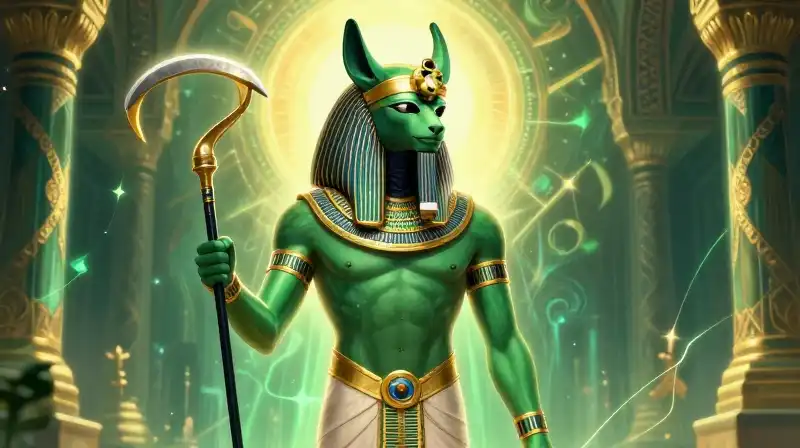
While Heka is primarily a principle, it was often embodied by a deity, lending the concept immense ritual and political weight. The god Ḥeka held significant roles, notably appearing in divine triads within Upper Egypt, where he was identified as the son of ram-headed Khnum and various goddesses 1. His participation was crucial to major societal events, such as the pharaoh’s enthronement ceremony, where he was seen as the son of Isis 1.
In these divine manifestations, the god Ḥeka was depicted in the solar barque, utilizing his power to battle chaotic elements—such as mythical serpents—in the Duat, ensuring order against demonic forces (1, 2). Therefore, Heka served both as a cosmic principle and as a recognizable divine agent of order.
Heka in Ritual and Societal Practice
The tradition of Heka did not remain confined to the grand temple halls or the solar barques of the gods. It permeated the social fabric, acting as a source of protection and a tool of spiritual intervention across various social strata. Its practical applications show the practical depth of Egyptian belief.
Different roles within Egyptian society utilized Heka for specific, often apotropaic (protective) functions. Priests, midwives, and specialized practitioners like scorpion charmers incorporated the energy of Heka into their practices 1. For the Pharaoh, this divine protection was physically manifested in potent symbols, such as the golden uraeus worn upon the brow, which relied on Heka to defend the monarch against harm 1. The energy of Heka was thus a key component of royal security and state stability.
The Calculated Use of Proxy and Image
Beyond personal protection, the tradition also understood the concept of directed harm. One notable utilization of Heka was through the use of “proxy curses.” This practice involved creating wax figures or similar symbolic representations of an enemy. By affecting these images, the practitioner could symbolically inflict harm upon the target, demonstrating the belief that the physical representation was linked directly to the reality of the individual 1.
Understanding Heka in Modern Context
The study of Heka is currently undergoing a resurgence, driven by modern scholars and a dedicated community of practitioners who are examining the rich depth of ancient Egyptian belief. This contemporary interest falls within the realm of “experimental Egyptology,” a method where researchers attempt to reproduce and understand ancient techniques related to Heka 1.
This modern engagement is particularly visible within the Kemetic community. For these practitioners, the concept of Heka is seen not just as an artifact of history, but as a living tradition. Some contemporary discussions hold that Heka is a gift to all of humanity, a powerful, accessible force granted by the creator god 1. This living culture perspective elevates the concept from historical curiosity to a philosophical and spiritual offering.
Distinguishing Heka: God, Magic, or Force?
The questions of whether Heka is a god or a form of magic are often conflated, but the tradition itself offers a nuanced answer. Heka is most accurately understood as a cosmic force or principle that has been anthropomorphized (made into a deity) to give it a clear presence within the pantheon 1. It is the underlying energy that *enables* the magic, rather than the magic itself.
To differentiate the concept from the deity in historical records, careful examination of hieroglyphs is necessary. The distinction lies in the inclusion or absence of a seated god determinative added to the symbolic representation of Heka 1. This distinction highlights how Ancient Egyptians categorized and utilized the force across both the theological and practical spheres.
The Enduring Meaning of Heka
Heka offers a window into a culture that viewed the cosmos as fundamentally interconnected. It taught its people that the separation between a human action, a spoken word, and the state of the universe was an illusion. By exploring Heka, one moves beyond merely defining an ancient religion; one begins to understand a deep philosophical commitment to the power of intention and the vitality of life. Whether encountered in historical texts, scholarly research, or through contemporary living traditions, Heka remains a testament to the belief in a dynamic, creative energy that shapes existence.
References
Footnotes
Frequently Asked Questions
What is heka magic?
Heka is not merely a collection of spells, but a complex cosmic principle and vital, creative force that Ancient Egyptians believed underpinned the fabric of existence. It is a foundational energy where thought, the spoken word, the image, and the deed are facets of a singular, potent power that enables magic and maintains cosmic order.
Is heka a god or goddess?
Heka is primarily understood as a cosmic force or principle that has been anthropomorphized (made into a deity) to give it a clear presence within the pantheon. While it was often embodied by the god Ḥeka, it serves as the underlying energy that enables magic.
How to Utilize Proxy Curses via Heka
Select the Target
Choose the individual against whom directed harm is intended.
Create Symbolic Figures
Make wax figures or similar symbolic representations of the intended target.
Apply the Force
Apply the energy of Heka to these symbolic representations.
Inflict Harm
Perform the actions on the images so that the practitioner can symbolically inflict harm upon the actual individual.
Related Articles