Khonsu vs Thoth: Decoding the Egyptian Moon and Time Gods

Introduction
For those navigating the complexities of ancient Egyptian mythology, the names Khonsu and Thoth often appear together, creating confusion about whether they represent the same divine force. While both deities are intrinsically linked to concepts of time and lunar passage, viewing them as interchangeable simplifies a rich and nuanced cosmological tradition. In the context of ancient Egyptian life, Khonsu, the moon-god, was far more than a celestial tracker; he was a dynamic force, the “traveller,” whose phases and cycles mirrored the annual renewal of life and death 1. Understanding Khonsu requires moving beyond a simple definition of “moon god” to grasp his evolving cultural significance—from a fierce funerary entity to a protector and healer—and recognizing how his presence in the sky was intertwined with the broader interconnected energies of the sun and nature (1, 2).
Khonsu: The Archetype of the Lunar Cycle
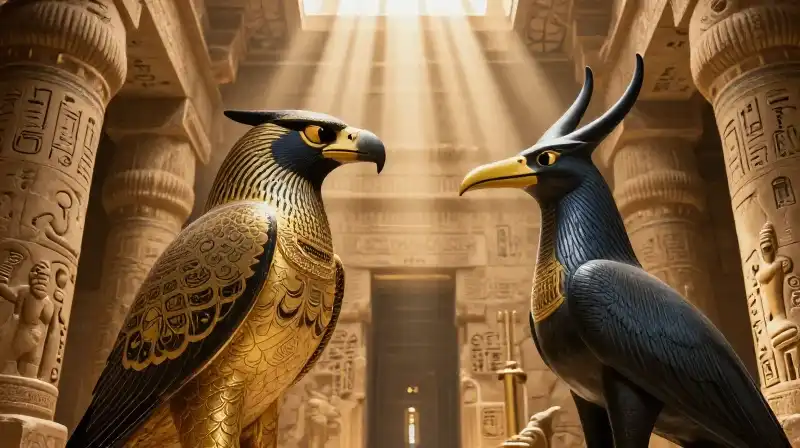
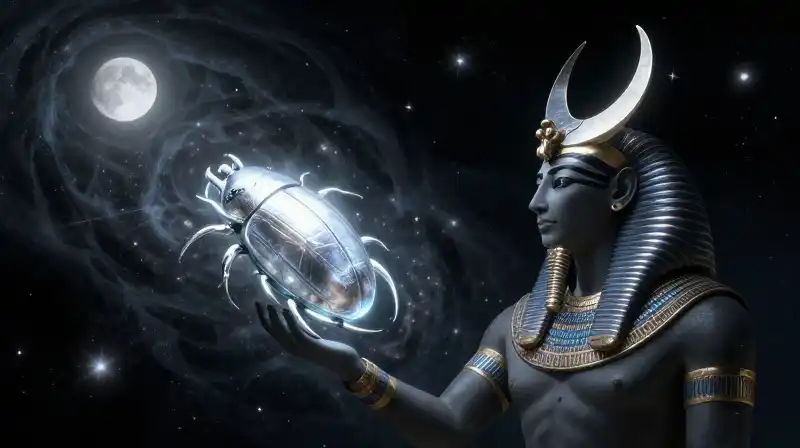
The significance of Khonsu is rooted in the observable reality of the cosmos: the nightly passage of the moon across the sky. This perception gave him his appellation, the “traveller” 1. Culturally, Khonsu was deeply rooted in Thebes, where he functioned within a vital divine family triad, alongside Mut (his mother) and Amun (his father) 1. His iconography was multifaceted, reflecting the fluidity of the divine. He was often depicted as a human child distinguished by a unique sidelock, or as a falcon wearing a crescent moon and moon-disk upon its head 1. This symbolism extended beyond mere observation; it was tied to powerful forces. The crescent moon, which adorned Khonsu, became associated with the ancient Egyptian sickle sword—a potent instrument of justice 1. Furthermore, the very developmental arc of the god—moving from a youthful child to an old man before renewing his birth—was a deliberate symbolic representation of the moon’s phases and the perpetual renewal that the lunar cycle represents 1. In certain regional traditions, such as those documented in Edfu, Khonsu was referenced as the “Son of the Leg,” a title connecting him to the preservation of Osiris’s body parts, linking lunar protection to the ultimate goal of eternal life 1.
Khonsu, Thoth, and the Interconnected Cosmos
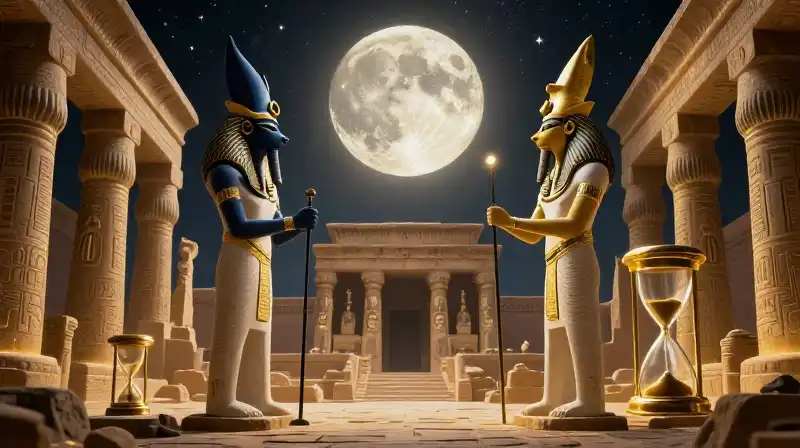
Addressing the common query regarding Khonsu and Thoth, it is crucial to understand that while both were deities associated with time, their domains were distinct, yet inseparable. Thoth was traditionally recognized as the god of wisdom, knowledge, scribes, and the measurement of time itself, often acting as the divine chronicler 1. Khonsu, conversely, embodied the tangible, visible cycles—the actual movement and waxing of the moon. However, contemporary spiritual discussions within Kemetic practices reveal a more complex picture of the ancient worldview. The Egyptian concept of the Sun and Moon was not always viewed through a strict duality, but rather as a system of interconnected energies. Khonsu and Thoth, though often associated with the lunar calendar and knowledge, operated within a cosmological fabric where the sun, the moon, and other deities represented different aspects of a single, vital natural system 1. For instance, a Ptolemaic inscription described the meeting of Khonsu and the sun god as two “illuminators” rising together in the east, perhaps signifying the fullness of the lunar cycle 1. This dynamic suggests that time in ancient Egypt was perceived not as a linear, separate mechanism, but as a cyclical, vibrant interplay of natural forces.
The Multifaceted Divine: Protection, Healing, and Transformation
Khonsu’s influence profoundly shaped the spiritual life and practical beliefs of his people, particularly in matters of health and survival. While his early appearances in the Pyramid Texts involved a fierce, quasi-destructive aspect—where he was depicted extracting entrails from other gods for the deceased king—his role evolved dramatically. During the New Kingdom, Khonsu transitioned into a prominent healer, shifting his focus from divine destruction to divine restoration 1. This capacity for transformation highlights the depth of the tradition. He was not merely a celestial object but an agent of change and stability. His association with the menat necklace further links him to these protective qualities. Moreover, his connection to the symbolic cycle of the crescent moon also linked him to the ancient Egyptian sickle sword, emphasizing his role not just as a passive watcher of the sky, but as a proactive agent of cosmic justice 1. His presence thus represented a blend of guardianship, wisdom, and the inevitable cycles of nature that govern life and death.
Living Culture: Beyond the Traditional Archetypes
The understanding of the lunar pantheon is still evolving among modern scholars and spiritual practitioners. While Khonsu is the traditionally recognized moon god, 2 notes that other powerful figures within the pantheon, such as Isis or Nebet-Het, are also associated with lunar or “dark” aspects. This demonstrates the inherent flexibility and depth of the ancient Egyptian religious system, where divine energy was not rigidly categorized. Today, for those engaging with Kemetic practices, understanding the “traveller” concept is key to appreciating the significance of the tradition. The moon is not just a calendar device; it is a constant, measurable force that links the human community to the vast, cyclical energies of the cosmos 1. The tradition teaches respect for these cycles—the ebb and flow, the renewal, and the necessary interplay between the forces of light and shadow.
A Synthesis of Meaning and Context
To truly understand Khonsu, one must move beyond seeing him as a simple definition of “ancient Egyptian god of the moon” and instead appreciate his narrative journey. He represents the cyclical nature of existence—the constant motion and renewal inherent in the cosmos. Khonsu is the living embodiment of transformation, demonstrating that divinity is dynamic, shifting from powerful force to protector, from destructive to healing. By recognizing his interconnectedness with figures like Thoth and the dynamic relationship between the sun and moon, the reader gains insight into a worldview that viewed time not as a straight line, but as a magnificent, ever-turning cycle of interconnected life and celestial power.
References
Footnotes
Frequently Asked Questions
Are Khonsu and Thoth the same?
While both deities were associated with time, the article clarifies that Khonsu and Thoth had distinct domains. Thoth was traditionally recognized as the god of wisdom, knowledge, and the measurement of time, whereas Khonsu embodied the tangible, visible cycles of the moon.
Related Articles