
Celtic Protection: The Powerful Symbols and Sigils Explained

Introduction
In the tapestry of world heritage, the Celtic traditions offer a profound look at a worldview built upon cycles, unity, and the sacred interconnection between humanity and nature. When one speaks of “Celtic protection,” they are often looking for powerful sigils or symbols—a way to guard one’s life, home, or spirit. However, these symbols are rarely mere protective charms; they are distilled philosophies. They are visual language used to express the deep understanding that all things are linked. Rather than defining “protection” in a modern, adversarial sense, Celtic symbols often relate protection to *harmony*—the maintenance of balance against chaos. They speak not just of warding off evil, but of embracing the cyclical flow of life itself.
The Hearth and the Shield: Protection in Practice
For the communities that have practiced these traditions, protection was fundamentally practical and deeply rooted in local history. The **St. Brigid’s Cross** exemplifies this blending of the sacred and the everyday. Traditionally hung upon doors, this symbol is crafted from rushes, grounding its power in the natural world. Its function, according to local legend, is to guard the home against fire and malice. This is not a distant, mythological shield, but a physical artifact rooted in a poignant human narrative—the story of a young girl weaving the cross for her dying father [1]. It represents a localized, domestic form of protection and devotion. Beyond the home, symbols were used in more active, martial contexts. The **Shield Knot** or other complex knot designs functioned as powerful defensive sigils. These tightly interwoven patterns were seen as embodying a strength that is continuous and unbreaking, suitable for those in conflict. While often associated with military imagery, these knots ultimately represent an unbroken continuity of spirit and defense [1].
The Triskele and the Eternal Cycle: Symbols of Motion
If the St. Brigid’s Cross guards the boundary of the home, the **Triskelion** and the **Celtic Spiral** represent the energetic movement within the universe. Both are ancient conduits for understanding motion and existence. The Triskelion, composed of three interlocking spirals, is widely interpreted as a channel for eternal flow. It does not simply represent movement; it symbolizes a complete cycle that includes creation, protection, and destruction [1]. It suggests that life operates through necessary transitions. Similarly, the **Celtic Spiral**, which dates back to ancient complexes like Newgrange, is a powerful motif signifying the Eternal Cycle of Life, Death, and Rebirth. It is a symbol of organic growth and personal evolution, mirroring the way an individual unfolds over time [1]. These motifs speak to a cosmic understanding: that destruction is simply a necessary step in renewal.
Knots: The Language of Interconnection
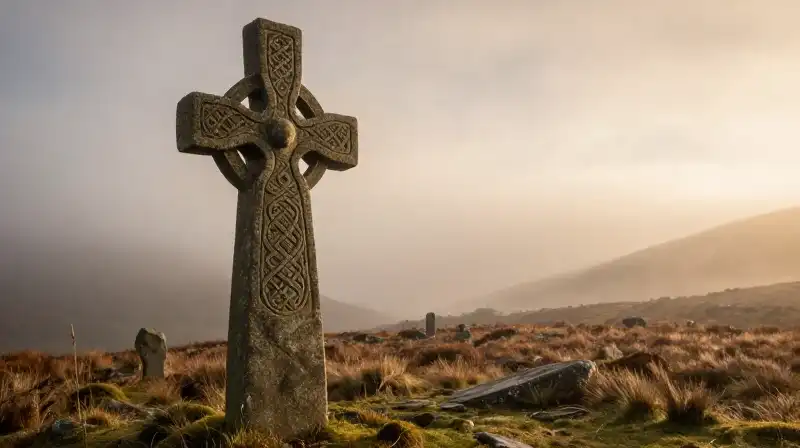
Perhaps the most sophisticated aspect of Celtic symbolism is the use of the knot—a visual representation of continuity. The hallmark of Celtic knot design is the single, continuous thread, possessing no discernible start or finish. This design is a profound metaphor for the eternal nature of life and the interconnectedness of all things, whether in terms of friendship or eternity [1]. Different knots carry specific, intricate meanings:
- The **Triquetra**, an interlaced knot of three arcs, symbolizes fundamental cycles—such as past, present, and future, or the tripartite elements of the earth, air, and water. It is a powerful representation of unity and eternity [1].
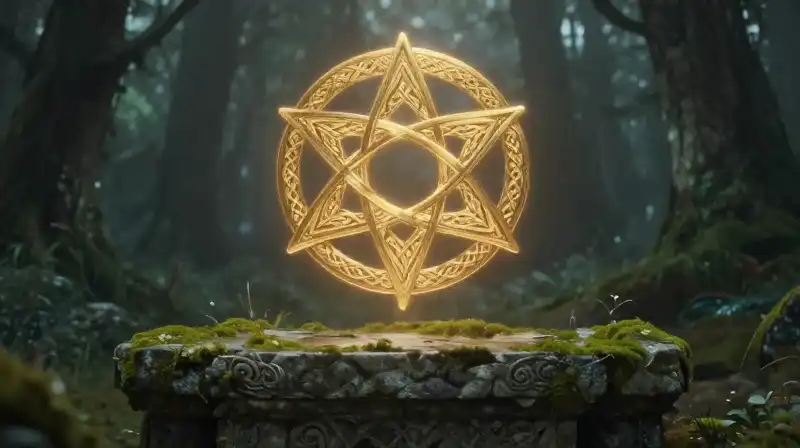
- The **Triiskele** was understood to represent the three realms of material existence—earth, water, and sky—emphasizing their vital interdependence within the Celtic worldview [1].
- The **Claddagh Ring**, originally conceived by a master goldsmith in County Galway, is perhaps the most personal knot. Its crown symbolizes loyalty, while the ring itself represents a bond of lasting friendship and love [1].
- Concepts like the **Celtic Love Knot (Anam Cara)** leverage this unending line to emphasize the enduring, eternal bond between individuals [1].
The Sacred Triad: Balance and Harmony
Beyond the physical bonds, many Celtic symbols focus on achieving metaphysical balance. This often involves the concept of the “triple entity.” The philosophical representation of the **Maiden, Mother, and Crone** embodies the entire life cycle, mapping the journey from youth to ultimate wisdom [1]. Further reinforcing this concept of balance is the **Celtic Tree of Life**, or *Crann Bethadh*. This symbol represents perfect harmony, visually uniting the underworld, the earthly plane, and the heavens, suggesting that life finds its center in integrating all planes of existence [1]. On the spiritual level, the shamrock, utilized by Druids, carried specific meaning: its three heart-shaped leaves represented a sacred triad of essential ideals—faith, love, and hope [1].
Answering the Reader’s Questions
Those curious about the practical application of these designs often ask: *Are there Celtic symbols for protection?* The answer is definitively yes, but the meaning of protection is broad. Whether it is the localized, hearth-focused protection of the St. Brigid’s Cross, or the cosmic, continuous protection implied by the Shield Knot and the Triskelion, the symbols operate as metaphysical anchors. Regarding the *Celtic safety symbol*, it is important to understand that no single, modern “safety” symbol exists within the tradition. Instead, safety is achieved through aligning oneself with the eternal, protective cycles of nature and community. The continuous knots and spirals are the closest approximation, suggesting that the safest state is one of continuous flow and unbroken connection to the larger whole [1].
A Synthesis of Meaning
To view Celtic protection through a modern lens of danger and defense is to miss the depth of the tradition. These symbols are not merely charms to ward off intruders; they are mirrors of the Celtic worldview, a sophisticated understanding of dynamic equilibrium. They teach that protection comes from recognizing the unity of all things—from the cycle of a spiral to the unending bond of a knot, and from the integration of the maiden, mother, and crone. By utilizing these motifs, one is not simply invoking magic; one is participating in a philosophy that celebrates the perpetual movement, resilience, and inherent beauty of life itself [1].
References
Footnotes
Frequently Asked Questions
Are there Celtic symbols for protection?
Yes, the article states that Celtic symbols for protection are definitively present. These symbols include the St. Brigid’s Cross, used to guard the home against fire and malice, as well as the Shield Knot and the Triskelion, which function as powerful defensive sigils.
What is the Celtic safety symbol?
No single, modern safety symbol exists within the tradition; instead, safety is achieved by aligning oneself with natures protective cycles and community. The continuous knots and spirals are the closest approximations, suggesting that the safest state is one of continuous flow and unbroken connection to the larger whole.
Related Articles