Celtic Healing Symbols: Meanings and Spiritual Significance of Ancient Motifs

Introduction
In the rich tapestry of global cultural heritage, the symbols of Celtic tradition offer a window into a worldview deeply intertwined with nature, cyclical time, and profound spiritual transformation. For those seeking a genuine understanding of ancient motifs, Celtic iconography moves beyond mere decoration; it serves as a visual language for core human experiences—life, decay, renewal, and the journey of the soul. These symbols are not static icons but active representations of the living forces that shape a community’s relationship with the natural world 1. To understand the concept of “Celtic healing symbols,” one must look at how these motifs represent not just physical health, but the restoration of the inner spirit, the harmony of nature, and the balance of existence itself 1.
The Cosmology of Cycles and Transformation
At the heart of Celtic belief is the concept of perpetual renewal, a recognition that life is an endless cycle, much like the seasons or the flow of water. Symbols frequently depicted in Celtic art embody this dynamic movement. The Triskelion, for instance, is far more than a simple design; it is widely interpreted as signifying the continuous movement and the duality of life, death, and rebirth 1. Furthermore, it is culturally significant for representing the triad of land, sea, and sky, or the movement between past, present, and future 1. This emphasis on perpetual cycles is also captured by the Wheel of Taranis, a symbol documented in the Celtic Iron Age, which represented the unending turning of time, seasons, and fate 1. These motifs suggest that true wholeness comes from embracing the full spectrum of existence, including its inevitable endings and regenerations.
Embodiments of Natural Vitality and Restoration
Several figures and designs illustrate the raw, regenerative power of the natural world, which forms a central theme in Celtic spiritual practice. The Green Man, perhaps the most visually striking of these symbols, is a foliage-wreathed face that powerfully represents the regenerative ability of nature—the unwavering persistence of life even when the surface shows signs of decay 1. He embodies the ceaseless return of vitality through the natural cycle. Closely related is the concept of the Tree of Life, a motif that underscores the profound spiritual connection the Celts held between the earthly realm, nature, and the divine 1. This connection is personified by Cernunnos, the antlered god. He is associated with fertility and the wild, untamed aspects of life, and is prominently featured in Celtic iconography, notably on the Gundestrup Cauldron 1. Cernunnos represents the powerful, enigmatic force of the wild, often embodying the vital and untamed aspects of life 1. For some, the Ailm, a symbol derived from the Ogham alphabet, carries a specific and ancient meaning as a representation of the “healing of a person’s inner soul” 1.
Mapping the Internal and External Journey
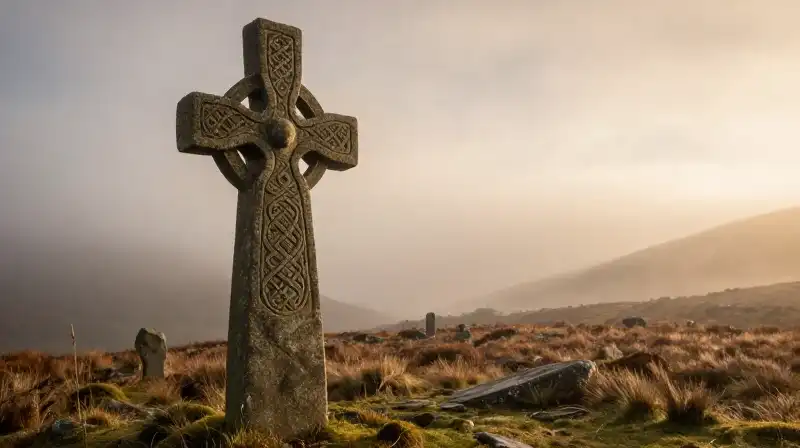
The pursuit of balance and internal healing is often reflected in more contemplative symbols. The Celtic Labyrinth is frequently misunderstood by modern eyes as a simple maze. In traditional practice, however, it functions instead as a meditative and contemplative tool, reflecting the soul’s inward journey, its cycles, and the transformative process it undertakes 1. This inward focus mirrors the concept of the Solar Cross, which uses its four sections to encode the rhythms of the agricultural year and the great seasonal festivals (Imbolc, Beltane, Lughnasadh, and Samhain), grounding spiritual life in the tangible, predictable shifts of the land 1. The Dagda, another principal deity, exemplifies the diverse powers and potential for renewal. He is often depicted wielding objects that signify life and abundance—such as his endless cauldron and his powerful club—representing the harmony and fertility of the natural world 1. The Celtic Cross, while its precise meaning varies across different scholarly interpretations, is often interpreted through its four arms, which may symbolize the cardinal directions, the four elements, or the four crucial seasons 1.
Understanding the Limits of Written Lore
When exploring these complex symbols, it is vital to understand the context of how they were transmitted. Unlike many traditions that rely heavily on recorded scriptures, many historical Celtic symbols were passed down through oral tradition and never fixed in writing 1. This historical reality means that the meanings we assign to them today are often interpretive and have evolved over time, shifting based on the community and the scholar studying the tradition 1. Therefore, while iconography like Cernunnos offers a powerful visual shorthand, the lack of written records leaves him as a significant yet largely enigmatic force in the wild aspects of life 1.
Synthesis: Finding Meaning in the Living Tradition
Ultimately, the search for “Celtic healing symbols” reveals a profound cultural preoccupation with balance: the balance between life and death, the human interior and the expansive wild, and the cyclical nature of time. These motifs are tools for understanding and harmonizing with one’s own place within nature’s larger design. They are expressions of an ancient reverence for the transformative power of time and the vital energy of the natural world 1. When engaging with these symbols, the most valuable approach is to view them not as static definitions but as active reflections of the living, enduring spirit of the tradition, acknowledging the deep roots of the land and the enduring journey of the soul.
References
Footnotes
Related Articles