Thoths Spiritual Meaning: Wisdom, Knowledge, and the Inner Self

Introduction
Thoth, the ancient Egyptian deity, is far more than a simple god of knowledge or writing; he represents the intricate bridge between divine order and human intellectual pursuit. In the complex landscape of ancient Egyptian culture, he serves as the master of both physical and moral law [1]. For those exploring the concept of his spiritual meaning, Thoth embodies the idea that true wisdom lies not just in the accumulation of facts, but in the ability to record truth, discern pattern, and live in alignment with cosmic balance. He stands as the ultimate guardian of the records, ensuring that the laws of the universe—and the deeds of humanity—are properly witnessed.
The Record Keeper: Thoth and the Law of Ma’at
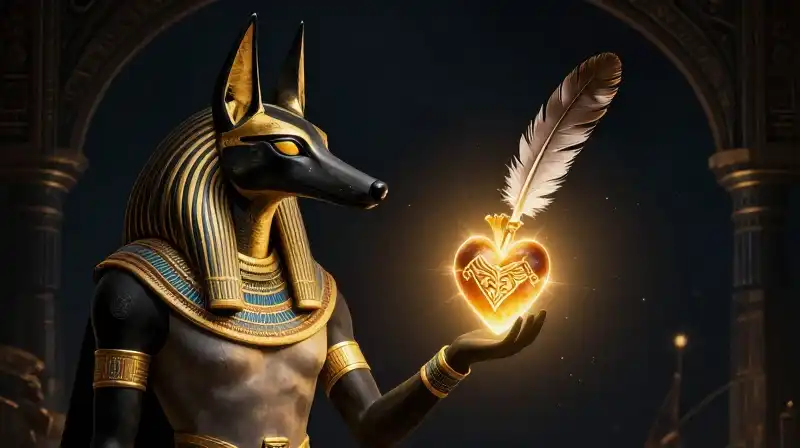
At his core, Thoth was intrinsically linked to the principle of *Ma’at*, the foundational Egyptian concept of cosmic order, truth, and balance. His role was profoundly judicial: he was the entity responsible for documenting the critical moment in the afterlife when the deceased’s heart was weighed against the feather of Ma’at [1]. This task solidified his identity as the ultimate scribe, not merely recording words, but recording deeds and ensuring that every life was judged against a standard of universal right. This duty extended beyond the individual soul. Culturally, Thoth was the deity responsible for establishing the heavens, the stars, and the Earth [1], giving him a role as a divine architect. He was the comprehensive master of law, governing both the physical structure of the cosmos and the moral framework that allowed society to function.
The Scribe of Gods and Human Intellect
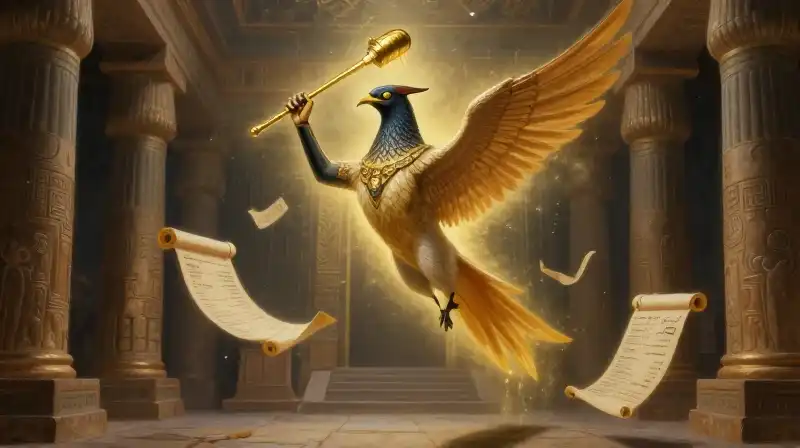
The designation of Thoth as the “scribe of the gods” is central to his influence on Egyptian civilization. According to [1], he is credited with inventing hieroglyphs, music, and the practice of writing itself. This power to bring structured communication into the world gave him universal worship among Egyptian scribes, those who served as the primary record-keepers and interpreters of divine intent. However, the tradition also contains a fascinating nuance regarding his origins. While he is widely revered as a powerful deity, there exists an acknowledged scholarly and popular debate concerning whether Thoth was a revered, highly knowledgeable human figure, or a *Pera* (a divine or semi-divine individual) whose legendary status and achievements were later elevated to full godhood [2]. This tension highlights how spiritual traditions often evolve, blurring the lines between the mortal sage and the divine principle. The iconography reflects this blend of bird-like celestial wisdom and human intellect, typically depicting him in human form but with the head of an ibis, a symbol some scholars suggest relates to the crescent moon or the bird’s deep connection to the divine [1, 2].
Thoth as an Intellectual Guide: The Inner Self
When contemporary traditions discuss the “spiritual meaning” of Thoth, the focus often shifts away from formal ritual and toward the internal practice of virtue. [2] Personal belief suggests that engaging with Thoth is fundamentally about living out virtues such as the pursuit of learning, writing, and careful observation. He functions not just as a distant cosmic force, but as an intellectual guide who encourages clarity of thought and moral accountability. Thoth embodies the concept of Thoth the Educator and Thoth the Wise, who represents a profound closeness to the creative source itself [2]. This aspect of his spiritual significance teaches that the path to understanding the universe begins with the mastery of the self—through reading, disciplined writing, and intellectual honesty. He is the ultimate “Keeper of the Records,” holding the keys to hidden truths and connecting the perceived, seen world with the unseen mysteries [3].
Transitional Figures: From Thoth to Hermetic Thought
The influence of Thoth did not remain confined to ancient Egypt; his attributes traveled through cultural exchange and were adopted by the Greeks. He became associated with the Greek god Hermes, the messenger and god of travelers and thieves. This conceptual legacy eventually played a part in the emergence of the title “Hermes Trismegistus” (Thrice Great), a title derived from the Greek understanding of Thoth’s original concept [1]. In later esoteric narratives, Thoth’s significance deepens further, moving into complex mythologies of forgotten civilizations. [3] Esoteric accounts posit that Thoth may have been a priest-king of ancient Atlantis, a figure tasked with bringing forth the Emerald Tablets—a legendary living transmission of wisdom encompassing the Seven Hermetic Principles. In this context, Thoth’s legacy evolves from a celestial scribe into a transcendental figure who holds the master keys to universal understanding.
Conclusion: The Living Tradition of Wisdom
Thoth’s enduring meaning resides in the synthesis of order and intellectual rigor. Whether he is viewed as the master of cosmic law ensuring the balance of the dead, the scribe who codified language, or the educator who champions personal virtue, his spiritual essence remains one of disciplined inquiry. He reminds us that the grand myths and celestial movements are underpinned by a structured, understandable reality—one that can be accessed and preserved through the tools of knowledge. His presence in tradition is a powerful call to recognize the inherent order in the world and the profound responsibility that comes with recognizing and recording the truth.
References
Footnotes
Frequently Asked Questions
What does Thoth say about the inner self?
Thoth functions as an intellectual guide who encourages clarity of thought and moral accountability. His teachings suggest that the path to understanding the universe begins with the mastery of the self through reading, disciplined writing, and intellectual honesty.
Related Articles