The True Meaning of Anubis: God of Death and Guide to the Underworld

Introduction
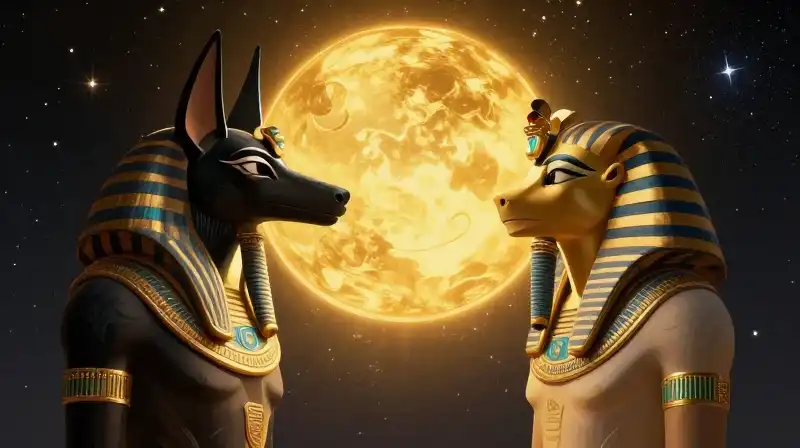
In the rich tapestry of ancient Egyptian heritage, very few deities capture the weight and necessity of transition as profoundly as Anubis. Often simplistically categorized as the “god of death,” this label fails to convey the sophisticated cultural understanding of life, decay, and the journey beyond. For the communities that preserved this tradition, death was not a cessation, but a complex transition—a necessary part of the natural cycle of existence [1]. Anubis, typically depicted as a man with the head of a canine, embodies the organized, impartial processes that govern this transition, serving as the protector of the deceased and the ultimate guide through the halls of the underworld.
The Roots of the Guardian: Protection and Natural Order
The deep connection between Anubis and the concept of funerary rites is not purely mythological; it has practical origins rooted in the natural world. Early in the First Dynasty, the god’s role as the foremost protector of tombs and necropolises was recognized [2]. His initial association with jackals—animals naturally found near cemeteries and acting as scavengers of the deceased—led to his adoption as a protective deity based on the concept of “fighting like with like.” He was chosen specifically to safeguard the bodies from further scavengers [2]. This dedication to the safe and orderly handling of the dead established his primary function as a protector, ensuring that the transition was managed with divine order. Anubis’s association with the color black is profoundly meaningful within this tradition. It is not merely a color of gloom, but a duality that represents both the discoloration of a corpse after the meticulous process of embalming and the vital, fertile soil of the Nile—a dual symbol of decay and regeneration [2, 1]. His epithets, such as “He Who Is in the Place of Embalming,” underscore his highly specific and functional role within the rigorously organized religious practices of ancient Egypt [2].
The Core Duty: Adjudicator in the Realm of the Dead
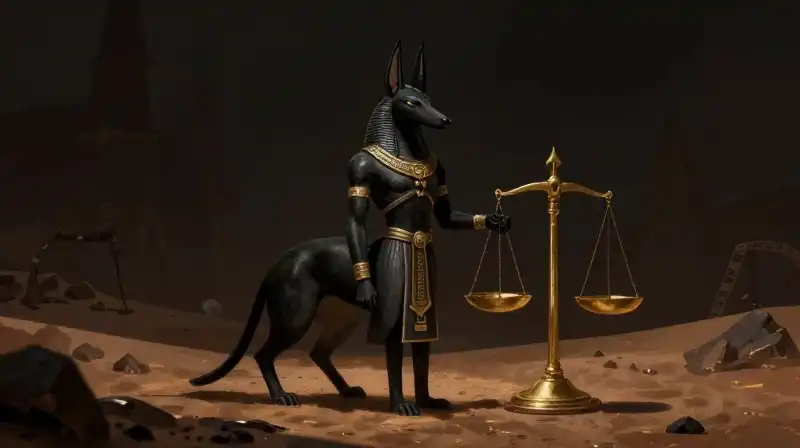
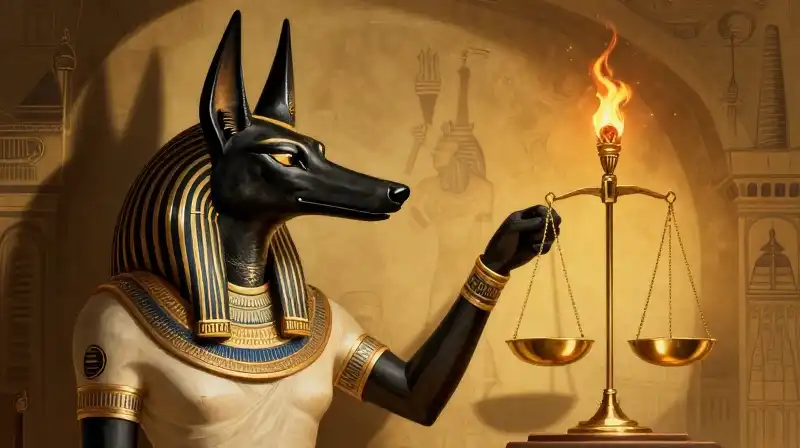
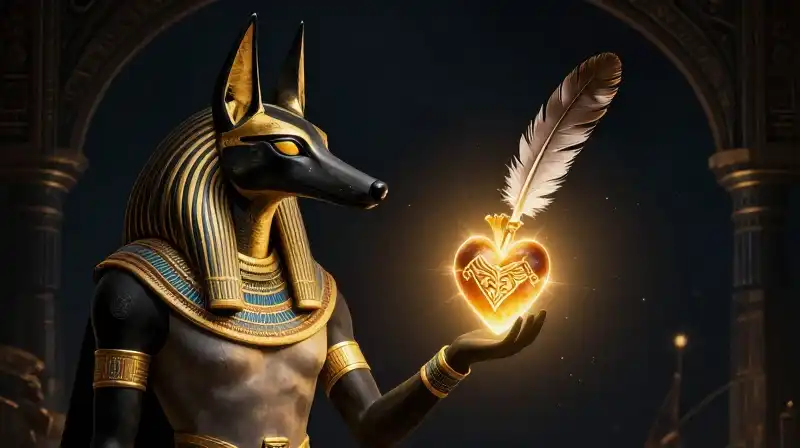
While his origins lay in protection, Anubis’s most critical function within the Egyptian cosmology is that of an adjudicator. In the pivotal ritual known as the “Weighing of the Heart,” Anubis served as the crucial overseer of the soul’s journey [2, 1]. During this process, the soul’s heart was balanced against a feather to determine its worthiness for the afterlife. This process demonstrates the Egyptians’ worldview: the soul’s fate was not decided by divine caprice, but by the physical evidence of a life lived. Anubis did not act as a moral judge who decreed good or evil; rather, he performed his duty as a lawful, impartial keeper of the sacred law of the deceased. Scholarly interpretation clarifies that he is viewed as an arbiter who executes a predetermined process rather than a figure embodying personal judgment [1].
An Evolving Myth: The Shift to Osiris and Divine Lineage
The role of Anubis was not static throughout Egyptian history. His functions underwent significant evolution over time. Initially the primary god of the dead during the Old Kingdom, his responsibilities were eventually assumed by Osiris, who became the more widely recognized lord of the underworld, particularly during the Middle Kingdom [2, 1]. This shift in power is important for understanding the tradition’s dynamism. While Osiris became the ultimate ruler of the realm of the dead, Anubis remained indispensable as the active facilitator and guide within that realm. His divine parentage, too, was fluid, varying from the common myth of being the son of Osiris and Isis, to other traditions that place him as the son of Ra, Hesat, or Nephthys [2].
The West and the Westerners
Anubis’s connection to the funerary world is further cemented through his association with the “West” (Khentiamentiu). In ancient Egyptian cosmology, the West symbolized the land of the dead and the ultimate destination of the departed [2]. This designation solidified his role not just as a guide, but as the master of this sacred territory.
Beyond the Sands: Syncretism and Modern Interpretations
The tradition of Anubis did not remain isolated within the sands of Kemet. As Egyptian culture interacted with Hellenistic traditions during the Ptolemaic period, a fascinating cultural syncretism occurred. He merged with the Greek god Hermes, giving rise to the figure of Hermanubis [2]. This new cult focused particularly in the “city of dogs.” This evolution shows how deeply ingrained the tradition was; it proved adaptable enough to interact with external belief systems while maintaining its core function. Furthermore, the cultural understanding of Anubis today remains nuanced. While some modern discourse sees him primarily as an assistant to Osiris, others emphasize his role as the singular, impartial protector and guide of the dead [1]. Even philosophers, like Plato, referenced the figure, using him as an arbiter of truth in the underworld [2].
Anubis as a Transition, Not a Termination
To genuinely understand Anubis is to understand the fundamental Egyptian perspective on existence. He does not represent “evil,” nor is he “good” in a human moral sense. Rather, he represents an inevitable, lawful passage. The divine parentage of Anubis—be it with Osiris, Ra, or others—and his evolving status demonstrate that his meaning lies in the constant maintenance of cosmic balance. His function is rooted in the natural cycle of life and death, viewing the end not as a tragic loss, but as a vital transition that is inherent to all existence [1]. Anubis is the embodiment of the ritual, the ceremony, and the ordered movement from one state of being to another. This tradition teaches that even in the deepest darkness of the final journey, there is structure, guidance, and a commitment to the eternal process. Anubis is not merely a depiction of a canine deity; he is the ultimate symbol of the cultural acceptance of inevitable change.
References
Footnotes
Frequently Asked Questions
Why is Anubis the god of death?
Anubis embodies the organized, impartial processes that govern the transition from life to death, serving as the protector of the deceased and the ultimate guide through the halls of the underworld. His most critical function is acting as an adjudicator, overseeing the Weighing of the Heart ritual.
Related Articles