Egyptian God Shu: Powers, Mythology, and Cosmic Importance

Introduction
To engage with the traditions of Ancient Egypt is to encounter a civilization where myth was not simply storytelling, but a profound framework for understanding the very physics of existence. Within this intricate cosmology, the god Shu stands as the quintessential architect of reality. He is recognized as one of the nine foundational deities of the Heliopolitan Ennead, a primordial figure whose existence was a necessary step in the unfolding of the universe itself. Shu’s significance extends far beyond his association with air; he embodies the fundamental concepts of light, peace, and the vital separation that allows for life to exist within the ordered cosmos.
The Primal Act of Separation: Creating Space
The narrative of Egyptian creation begins with Atum, the self-created god, who brought forth the initial elements of existence. From this genesis, Shu emerged as one of the earliest divine forms (1, 2). In the Heliopolitan cosmogony, Shu’s role is defined not by forceful action, but by the essential act of separation. He represents the very atmospheric division between the realm of the sky and the terrestrial domain of the Earth. This cosmic “action” was vital to the physical manifestation of life (1, 2). Without Shu, the celestial and terrestrial realms would have remained indistinct, perhaps fused in undifferentiated matter. By creating the breathable atmosphere, he provided the space and medium upon which the life of the world could flourish 1. Art frequently captures this crucial function: Shu is depicted with his arms uplifted, visibly supporting the vast, arched body of the sky goddess Nut. This imagery serves as a powerful reminder of his role as the primal sustainer of the cosmic order, ensuring the distance between the earth god Geb and the heavens (2, 3).
Iconography: Emptiness, Light, and Form
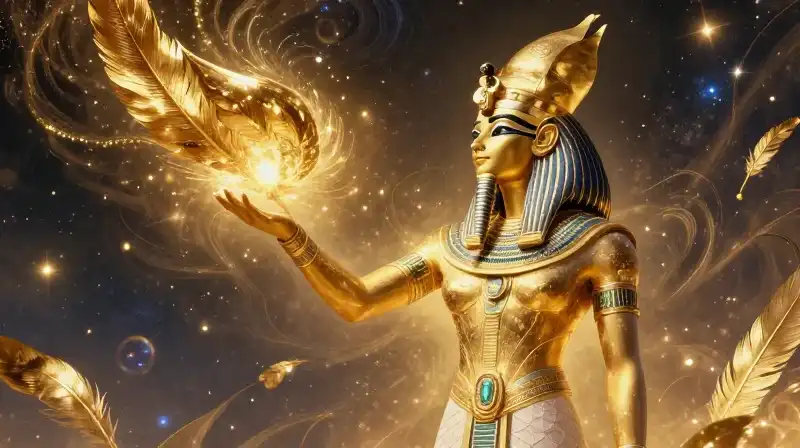
The visual language of Shu’s tradition is deeply symbolic, utilizing imagery to convey concepts that are otherwise invisible, such as air and light. His iconography is marked by several defining features, though these can vary regionally or across periods (1, 3, 2). Most commonly, Shu is portrayed wearing an ostrich feather headdress. This element is critically important, as the feather symbolizes “emptiness” and lightness—the essence of the air he governs. This ethereal attribute links him to the intangible nature of wind and sky. However, his varied nature is also shown in other representations: at times, he is shown with a lion’s head, or associated with the warrior god Onuris, suggesting that the forces of air and order can manifest in both sublime and protective, powerful forms (1, 3, 2).
Ma’at and the Sustaining Wind
The deeper cultural meaning embedded in Shu’s role is his embodiment of *Ma’at*. Ma’at is the cornerstone of Egyptian civilization, representing the balance of truth, justice, and order. Shu’s association with the gentle, dry air and the stability of the atmosphere connects him directly to this principle 1. His power, therefore, is not merely elemental, but ontological; he sustains the necessary conditions for Ma’at to prevail. Furthermore, this connection to order and protection is seen in ancient artifacts. Because of his direct link to air and clouds, Shu was often represented on the *menat* counterweights. These were protective amulets designed to safeguard the wearer from worldly dangers, a testament to his role as a divine guardian of balance 1.
Evolving Roles and Regional Worship
While his foundational role remained constant, the interpretation and expression of Shu’s tradition evolved over millennia. In later periods, Shu was identified with the solar aspects of the sun god Ra, cementing his link to light 1. This shift in identity reflects the perennial Egyptian need to harmonize the cosmic forces of air and sun. His protective nature also extended into the cycles of life and death. His connection to rebirth and preservation is evident in his role in warding off corruption during the crucial judgments within the Halls of Ma’at. In certain regional traditions, particularly in areas like Iunet and Nay-ta-hut, Shu and his consort Tefnut were venerated in specific leonine forms, highlighting local interpretations of their divine power 1.
The Semantic Weight of Shu’s Name
Understanding the nuances of Shu’s name sheds light on the essence of his tradition. While scholars continue to debate the exact translation, the prevailing understanding links his name to concepts such as “emptiness” or “He who Rises Up.” This meaning directly ties him to the metaphysical idea of rising air—the subtle, ever-present energy that drives the atmosphere (1, 2). It is this capacity to embody “nothing” and yet be the medium through which everything else exists that makes him a profound figure. During periods of theological upheaval, such as the Aten heresy, Shu continued to hold importance. In these contexts, the pharaoh and queen were sometimes represented as the human personifications of Shu and Tefnut, demonstrating how deeply intertwined the divine cosmology was with the state and the cycles of divine presence 1.
Shu’s Legacy in the Modern Narrative
Shu remains a vital figure for those seeking to understand the intricate balance of ancient Egyptian spiritual life. His story is not a simple tale of a god who commands the wind; it is a complex theological statement on the nature of existence itself. It teaches that the very space in which we live, the atmosphere that permits breath and movement, is a deliberate and divine construction. By recognizing Shu, the reader begins to grasp that Egyptian religion was a system of cosmic physics—a meticulous mapping of how the world came into being, how order (*Ma’at*) is maintained, and how the forces of chaos are managed. He is the silent, yet absolutely essential, foundation upon which the entire celestial stage is set.
References
Footnotes
Frequently Asked Questions
What powers did Shu have?
Shu was the architect of reality who performed the essential act of separation, creating the breathable atmosphere and providing the space for life to flourish within the ordered cosmos. He embodies light, peace, and the principle of Maat, serving as the primal sustainer of cosmic order.
Who were Shu's children?
The provided article does not state who Shus children were.
Who is the wife of the god Shu?
Shu’s consort is Tefnut, who was worshipped alongside him in certain regional traditions such as those in Iunet and Nay-ta-hut.
What are some interesting facts about Shu?
Shu is a primordial deity and one of the nine foundational deities of the Heliopolitan Ennead, embodying concepts of light, peace, and the necessary separation that allows life to exist. He is responsible for providing the breathable atmosphere and is often depicted wearing an ostrich feather headdress that symbolizes emptiness.
Related Articles