Khnum: The Ram-Headed Egyptian God of Creation

Introduction
In the vast tapestry of ancient Egyptian spirituality, few deities represent the fundamental relationship between raw matter and living form as powerfully as Khnum. Often referred to as the “Potter god,” Khnum was more than a craftsman; he was a primordial creator who bridged the gap between the inanimate clay of the earth and the divine spark of life. To understand Khnum is to grasp a core element of Egyptian cosmology: the belief that everything, from the human form to the cyclical flow of the Nile, was purposefully shaped and maintained by divine hands. He held the prestigious title “Father of Fathers,” signifying his role as the ultimate architect of the Egyptian pantheon and humanity itself 1.
The Divine Artisan: Molding Life from Clay
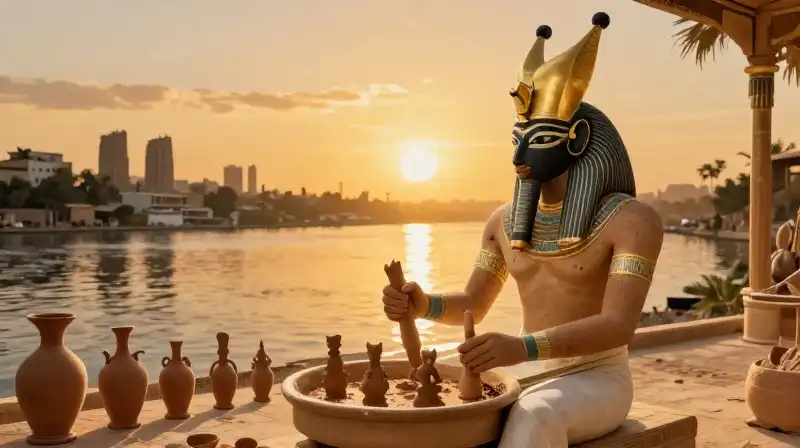
Khnum’s essential function revolved around creation. According to traditional narratives, he was the deity who fashioned human bodies directly from clay, embedding the life force, or *kꜣ*, into the completed forms (1, 2, 3). This was not merely the crafting of physical appearance; it was an act of profound generative divinity. Khnum was believed to mold not only the subsequent generations of humankind but also the other major gods and the “First Egg” from which the sun would eventually emerge 1.
His mastery over form gave him cultural weight that extended beyond the physical realm. His divine power over the act of shaping led to the Egyptian word *khn.m* being applied to mean “shape” or “build” itself, reflecting the deep belief that his creative power was foundational to reality 1. This role placed him among the earliest known deities, tracing his importance back to the First Dynasty, solidifying his status as a cornerstone of Egyptian belief systems (1, 2).
Anchors of Life: Khnum and the Cycles of the Nile
A crucial aspect of Khnum’s influence was his inextricable link to the lifeblood of Egypt: the Nile. His function was deeply tied to the annual inundation, as he was understood to regulate the river’s flow and ensure the reliable arrival of fertile silt. By controlling the inundation, he intrinsically linked himself to fertility, sustenance, and the continuation of life itself (1, 2, 3). In this sense, Khnum served not just as a creator of individuals, but as a vital guardian of the environmental conditions that allowed Egyptian culture to flourish.
This reverence for the Nile manifested regionally. In Lower Egypt, Khnum held a recognized equivalent known as Banebdjedet 1. Furthermore, ritual practices often occurred at sacred riverside sites. For example, at Elephantine in Upper Egypt, Khnum formed a divine triad alongside the Nubian goddesses Satis and Anuket, emphasizing his powerful relationship with the river and the neighboring cultures (1, 3).
Guardians of the Cosmos: Khnum and Funerary Ritual
Khnum’s dominion over creation extended into the eternal journey of the deceased. He held a protective role in the afterlife, acting as a guiding force for the sun god, Ra, as Ra navigated the perilous journey through the underworld 1. Because of this protective function, Khnum became a significant figure in funerary practices. This is why he is frequently depicted in tombs and why burial spells often associated with his name were considered essential (2, 3).
The temple life of Khnum reflected this expansive role. In the cult center of Esna, he was worshipped alongside deities like Menhit and Heka. The local traditions even featured unique fertility rites where women participated in chants involving the movement of a potter’s wheel, mirroring his primary function as the master of form 1. Culturally, his role as “Father of Fathers” meant his protection encompassed both the mortal lineage and the divine order 1.
The Ram Head: Symbolism and Form
The most distinctive cultural representation of Khnum is the ram head, a symbol that speaks to his primal, powerful nature. While the ram was one of many sacred animals revered in Ancient Egypt, Khnum’s use of the ram head highlights his role as a powerful, authoritative deity (1, 2). Over time, the visual depiction of Khnum evolved. Early depictions might have featured long, corkscrew horns, but these often transitioned into forms with downward-turned horns, giving him an appearance reminiscent of Ammon (1, 2).
Beyond the ram, Khnum’s connection to the Nile sometimes led to imagery incorporating the crocodile head, a symbol of his dominion over the river’s unpredictable but vital power (1, 2). Thus, his visual identity is not singular; it is a complex amalgam of creative power (the clay/potter), environmental mastery (the crocodile/Nile), and divine majesty (the ram).
The Meaning of Khnum: Beyond the Definition
The enduring significance of Khnum lies not just in his role as a mythological character, but in what his tradition suggests about the Egyptian worldview. His story is a sophisticated statement on the relationship between the human experience and the divine structure of the world. He reminds the worshipper that the physical forms we inhabit and the life force we possess are not random, but carefully crafted entities.
For those researching this tradition, it is essential to understand that the concept of a “Ram Egyptian God” refers specifically to Khnum. Unlike simpler definitions, his worship encompasses three major cultural areas: the source of life (creation), the stability of the earthly realm (the Nile), and the guidance into eternity (the afterlife). The cultural tradition surrounding Khnum thus provides a holistic narrative of how Egyptians perceived existence itself.
Synthesis of Form and Function
Khnum represents the divine principle of shaping potential into reality. By grounding his divine powers in practical necessities—the need for fertile soil, the need for predictable rivers, and the human need for structure—the tradition makes the abstract concept of creation tangible. He is the living embodiment of the idea that all form, whether of a human child molded from clay or the steady flow of the life-giving Nile, requires a divine artisan to bring it into being.
References
Footnotes
Frequently Asked Questions
Did Egyptians worship Rams?
The concept of a Ram Egyptian God specifically refers to Khnum, whose ram head is used to symbolize his powerful and authoritative nature. He is depicted with this head as part of his visual identity.
What is RAM in Egypt?
The most distinctive cultural representation of Khnum, the Ram Egyptian God, is the ram head. This symbol speaks to his primal, powerful nature and highlights his role as an authoritative and divine deity.
Related Articles