Anubis: Exploring the Dog-Headed Egyptian God of the Afterlife

Introduction
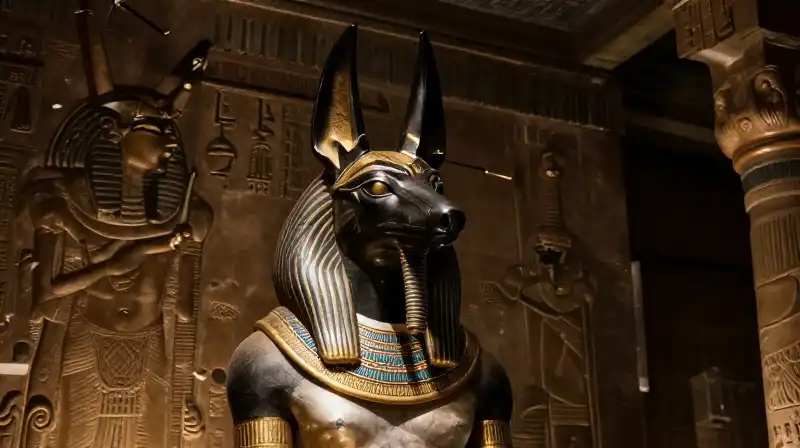
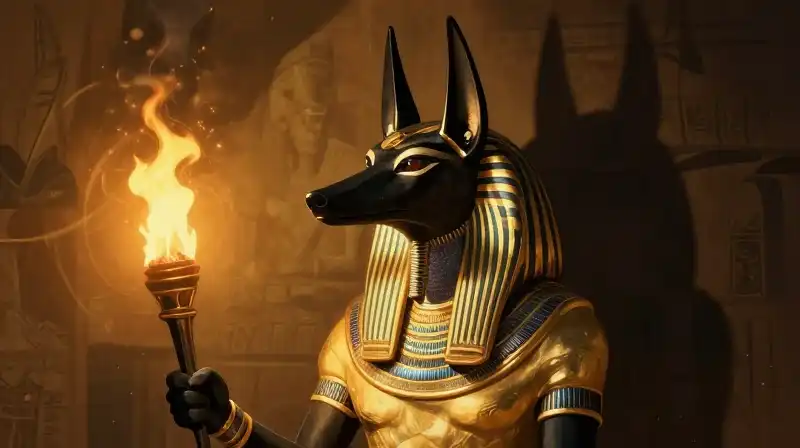
Anubis, depicted as a divine canine, represents a powerful intersection of ancient Egyptian spirituality and practical cultural necessity. More than a mere figure in a mythology textbook, he is understood as the essential guide and protector within the complex tradition of the afterlife. This dog-headed deity, often found at the heart of funerary rites, served as the ultimate orchestrator of passage between the world of the living and the Duat, the Egyptian underworld [1]. To understand Anubis is not simply to learn about a mythological character; it is to grasp the profound Egyptian concern with death, transformation, and the meticulous process of ensuring a soul achieved eternal life.
The Symbolic Form: Protector of the Ancestral Road
In early Egyptian society, the form of the divine was often tethered to the natural world. Unlike later, more formalized depictions, Anubis was initially portrayed in his full, unadorned jackal form during the Early Dynastic period [1]. This form, likely influenced by the pervasive presence of jackals, who were often scavengers in Egyptian cemeteries, likely lent the god an immediate, visceral connection to the landscape of death. His function was rooted in the careful management of this space. Central to his identity was his role as a facilitator of the embalming process, a meticulous and sacred procedure. He held the epithet *jmy-wt*, which translates to “He who is in the place of embalming,” signaling his direct involvement in protecting the deceased and guiding the process of mummification [1]. This is a key cultural distinction: he was not simply a watcher; he was an active, participatory agent in the physical preservation of the soul’s vessel. The specific artistic convention of depicting Anubis in black further deepened his significance. This color was highly deliberate, representing regeneration, the fertile black soil of the Nile, the very nature of life itself, and the discoloration that occurs during the embalming process [1].
The Weighing of the Heart: Determining Passage into the Afterlife
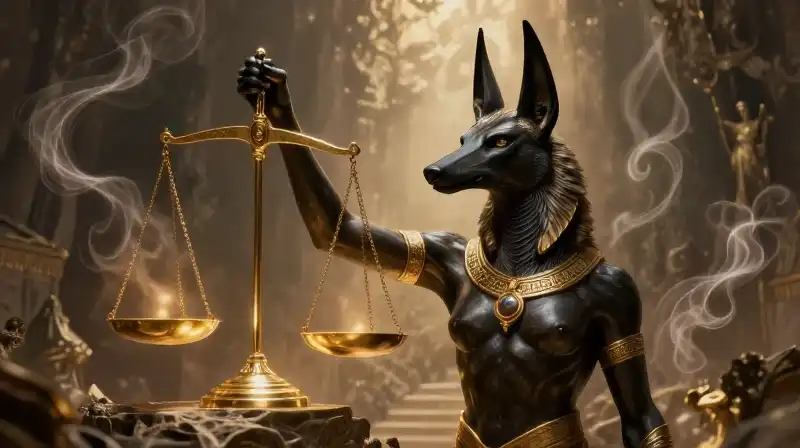
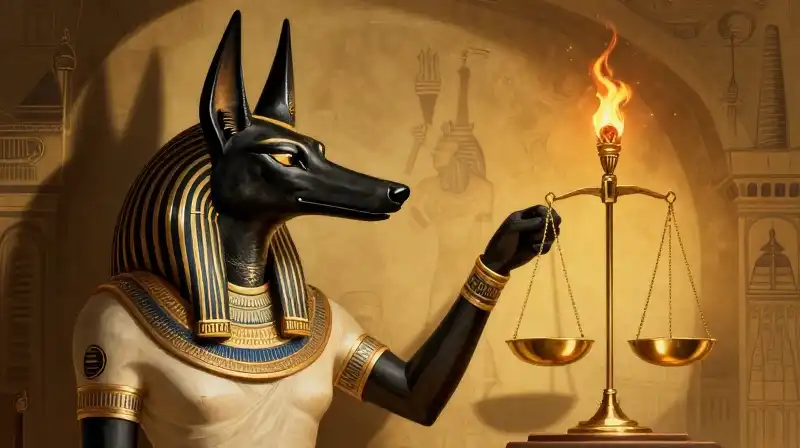
The ultimate demonstration of Anubis’s power lay in his critical role during the “Weighing of the Heart.” This ritual was the final, defining test for any soul seeking entry into the realm of the dead [1]. It was Anubis who assisted in this pivotal moment, helping to determine if the deceased possessed a heart light enough—in terms of virtue and moral conduct—to successfully pass judgment. The complexity of this belief system suggests that the tradition offered a profound framework for moral accountability. The god was the impartial custodian of the cosmic scales, ensuring that the soul’s journey was grounded in actions taken during their mortal life [1]. Although other deities, most notably Osiris, eventually took on the role of the ultimate lord of the underworld during the Middle Kingdom, Anubis retained his essential position as the “Foremost of the Westerners,” a title reflecting his primary function as the guide through the path of the deceased [1].
Shifting Roles: From Jackal Guide to Universal God
Like many deities across ancient cultures, Anubis underwent transformations and syncretisms over millennia, reflecting evolving theological understandings. His role as the primary authority in death was not always singular. Scholarly analysis of the Egyptian pantheon suggests his parentage was varied, sometimes linked to Osiris and Isis, but also connected to figures like Ra, Hesat, or the goddess Bastet [1]. His prominence also led to cultural merging. For example, another canine deity, Wepwawet, was associated with him. Wepwawet, typically depicted with a white dog’s head, is believed to have been eventually merged into the unified image of the dog-headed god, contributing to the iconographic fluidity of the tradition [1]. Furthermore, during the Ptolemaic period, the need to harmonize local traditions with powerful incoming cultures led Anubis to merge with the Greek god Hermes, becoming Hermanubis [1]. This syncretism ensured the survival and widespread adoption of the canine deity even as the structure of the Egyptian pantheon shifted.
Anubis in Regional Cultures: Beyond the Nile’s Banks
The cultural influence of Anubis radiated far beyond the geographical boundaries of Egypt. His potent symbolism—death, guidance, and transformation—made him a cross-cultural touchstone. His devotion led to the establishment of regional cult centers located in areas whose names translated as “city of dogs,” solidifying his presence in the spiritual landscape of surrounding communities [1]. Even among the ancient Greeks, who sometimes viewed these animal-headed figures with skepticism or mockery, Anubis remained a figure of profound utility. The Greeks frequently invoked him in formal oaths during philosophical dialogues, demonstrating that despite cultural differences, the idea of a divine, knowledgeable guide for the passage between worlds held tremendous sway [1]. The notion of his counterpart, Anput, also provided a rich female dimension to this canine lineage within Egyptian tradition [1].
Understanding the Dog-Headed God: A Cultural Synthesis
The fundamental essence of Anubis is not found in a single, fixed definition, but in his function as a spiritual transition specialist. He embodies the rigorous transition from the tangible world to the intangible realm of judgment. While the modern understanding of Anubis often centers on his association with the afterlife, the tradition that shapes his image is equally rooted in the practical, ritualized, and deeply respectful handling of mortality—the very embalming process that began his sacred duties. Whether identified through the lens of the jackal, the regal black god, or the amalgamated Hermanubis, Anubis remains a powerful symbol of the delicate bridge between life’s physical end and the soul’s eternal continuation.
References
Footnotes
Frequently Asked Questions
What is the Egyptian god with a dog head?
Anubis is the Egyptian god depicted as a divine canine and a dog-headed deity. He serves as the guide and protector within the complex tradition of the afterlife.
Weighing of the Heart: Determining Passage into the Afterlife
Approach the Final Judgment
The soul must undertake a final journey and test of moral conduct to seek entry into the realm of the dead.
Present the Heart to the Scales
The soul's heart is placed in the hands of Anubis, who serves as the impartial custodian of the cosmic scales.
Pass the Ultimate Test
The scales are used to weigh the heart, determining if the soul possessed a heart light enough in terms of virtue and moral conduct to successfully pass judgment.
Related Articles