Mermaids and Myth: Tracing the Origins of Waters Dual Spirits

Introduction
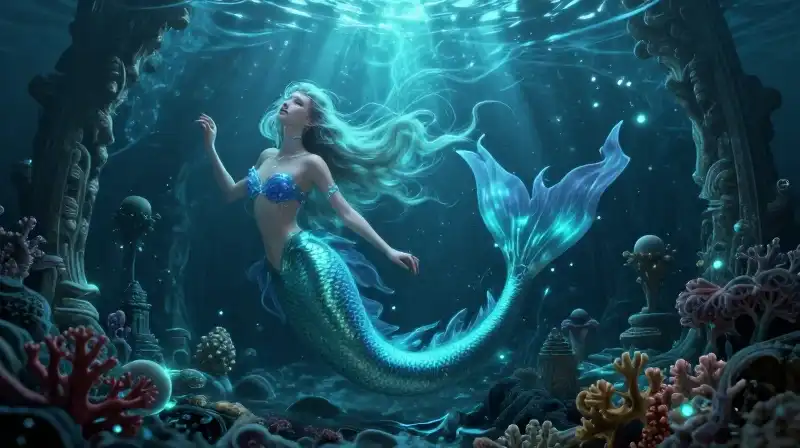
The mermaid is more than a creature of fantasy; she is a profoundly ancient symbol of the liminal—of the boundary where worlds collide. Across the globe, from the fertile shores of the Indian Ocean to the turbulent coastlines of the Irish Sea, the mythical water spirit represents the intersection of elements: land and sea, danger and allure, the known and the unknown. Mermaids, therefore, are less a singular biological concept and more a living reflection of the communities that created them. They serve as cultural vessels, articulating anxieties about the unpredictable nature of the ocean, the complexities of feminine power, and the shifting boundaries of identity itself.
The Proto-Archetype: Tracing the Ancestry of the Water Spirit
The concept of a partial aquatic being predates modern European folklore by thousands of years. One of the earliest recorded precursors is the Assyrian deity Atargatis. This figure, associated with fertility, was described with “the face of a woman, and otherwise the entire body of a fish” [1]. This suggests that the connection between human forms and marine life is not a product of later myth-making but a deep-seated, ancient perception of the sacred waters.
Later, the Western tradition focused on the Sirens, whose earliest depictions in the Greek *Odyssey* showed them as half-bird chimeras. However, the shift toward the more recognizable fish-tailed form is a historical area of uncertainty. Scholars suggest this transformation might be linked to Germanic myth traditions [2, 3]. The mythological journey of the mermaid—from a bird-like, alluring temptress to a serpentine fish-tailed spirit—traces a fascinating cultural evolution that reflects changing beliefs about the sea’s power and its relationship to humanity.
A Global Cartography of Liminality: Spirits of the Boundary
To truly understand the mermaid archetype, one must look beyond the Atlantic. Water spirits are a universal phenomenon, but their function differs according to the specific environment and cultural needs of the community. In various traditions across Africa, Iran, and Indonesia, spirits such as Mami Wata and Nyai Roro Kidul are powerful figures. These figures are rarely just “pretty”; they are inextricably linked to profound concepts of wealth, fertility, and the powerful, often demanding, intersection of land and sea [1].
In the Irish tradition, the Merrow is also found, where their power is often tied to specific cultural elements, such as the use of a feathered cap known as a *cohuleen druith* to enhance their status underwater [2]. Similarly, in Slavic folklore, the Rusalki are understood as local fables concerning the spirits of women or children who died by water. These spirits serve as potent cautionary tales, reflecting a community’s understanding of the dangers inherent in the wild, boundary-blurring space of the river and the sea [2]. These regional variants reveal how the global mermaid myth is tailored to local needs: for some, she is a harbinger of fortune; for others, a reflection of mortality.
The Double-Edged Call: Danger and the Boon of the Sea
The narrative surrounding the mermaid is rarely singular; she embodies a dual nature. While European folklore frequently paints the Siren as a dangerous entity, a lure designed to lead sailors to wreck and destruction, many traditions allow for benevolence. The archetype suggests that the merfolk possess the capacity to bestow boons or, conversely, cause catastrophe depending on the perceived alignment of the human and the spirit [3].
This dynamic is central to narratives like the Germanic legend of Lorelei. Lorelei embodies the irresistible power of the water nymph—a figure who seduces fishermen, leading them to their doom along the Rhine [2]. Yet, in the same folklore, mermaids are depicted as figures who can fall in love with humans, challenging the rigid boundaries between human and animal worlds. Furthermore, the iconography of mermaids in medieval bestiaries, often shown holding a comb or a mirror, hints at an older cultural fascination with vanity and the seductive power of the feminine, which was later reinterpreted through a Christian moralizing lens [3]. The sea, in this light, is a powerful space that blurs the lines of gender, power, and fate.
The Fluid Identity of Sea Folk
The mermaid archetype is heavily gendered, focusing predominantly on the female form. However, the existence of the merman in folklore and heraldry provides a counterpoint, if less frequently encountered [3]. The fact that the earliest surviving textual attestations conflate the ancient Greek sirens with monstrous or female sea spirits from first-century Greek writings [1, 3] reinforces the historical primacy of the female half-fish figure. This strong focus has allowed scholars to view the mermaids as powerful reflections of how certain cultures perceive and negotiate the feminine—a force that can be deeply nurturing or overwhelmingly destructive [3, 1].
The sea itself acts as a metaphorical space where gender and identity are frequently challenged. In maritime cultures, the water is seen as a zone of transformation, similar to the concept of liminality in daily life. Just as the seafarer may experience cross-dressing or a temporary loss of established identity on a long voyage, the mermaid represents that state of being caught between worlds—neither wholly land-bound nor fully aquatic [1].
The Archetype in Modern Myth: Reflections of Cultural Fears
Throughout history, the mermaids have served as a subject for the creative arts—in literature and painting—and these creations have often solidified cultural fears about the unknown or the powerful feminine [3, 1]. The consistent reappearance of the mermaid allows for the externalization of internal cultural anxieties: fears of the untamable deep, fears of uncontrollable desire, or the recognition of a deep, ancient power residing in places beyond the limits of human dominion.
While modern searches often ask “Are mermaids real” or for “real mermaid photos,” the true intent of the tradition is not to find literal figures underwater, but to understand the rich semantic territory they occupy. The myth exists to help us understand the nature of the unknown. They are cultural shorthand for transformation, for the boundaries we cross, and for the powerful, dual nature of forces—both natural and human—that we cannot fully categorize.
Ultimately, the mermaid is a story told by the sea itself. Whether she is a dangerous Lorelei, a fertile Mami Wata, or a seductive Siren, she remains a constant in human storytelling, a mirror reflecting humanity’s most complex relationship with power and the profound mysteries of the boundary between the known world and the vast, beautiful ocean.
References
Footnotes
Related Articles