Bunny Myth: The Global Symbolism of the Hare and Rabbit

Introduction
Across vastly different geographies and millennia of human history, the figure of the hare and the rabbit has emerged not merely as a common field creature, but as a powerful and versatile cultural archetype. While its physical appearance may be familiar—a creature defined by its quickness and instinct—the rabbit’s symbolic weight is far more complex. In diverse global contexts, the hare serves as a mirror for humanity’s most ancient concerns: the cycle of the seasons, the mysteries of the cosmos, fertility, and spiritual transcendence. From the intricate carvings found in medieval European cathedrals to the profound lunar myths of East Asia, the rabbit provides a unique vantage point from which to understand the interplay between the earthly and the divine. This exploration seeks to move beyond a simple definition, examining how these creatures have been adopted and transformed by communities to represent the flow of life and the enduring power of mythology.
The Rabbit and the Celestial Cycle
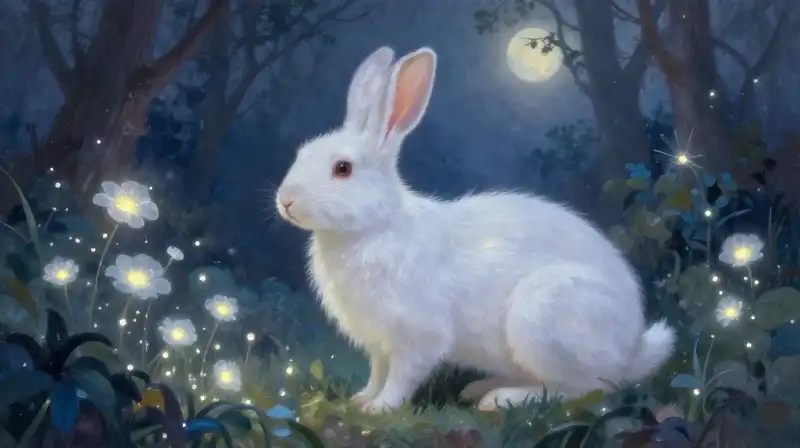
One of the most universal associations with the rabbit is its connection to the lunar cycle. This association is strongly reflected in East Asian traditions. In Chinese folklore, the figure of Chang’e provides a central narrative, involving the myth of her retreat to the moon after the loss of her husband and child 1. This celestial theme is further embodied in the Jade or Moon Rabbit, a creature whose mythological duty involves grinding the elixir of life for the moon goddess and other immortals 1. This narrative positions the rabbit as a key intermediary between the mortal realm and the eternal workings of the heavens.
The association with the moon is not limited to China. Japanese mythology also features the rabbit prominently in various legends, notably through characters like Princess Kaguya in the *Tales of the Bamboo Cutter* and the folklore of *Kachi-Kachi Yama* 1. These stories often weave the hare into narratives concerning wonder, change, and the ethereal boundary between worlds.
Sacred Forms: The Three Hares and Universal Symmetry
A specific and compelling manifestation of this global symbolism is the motif of the three hares, often referred to as the *Drei Hasenfenster* or ‘Window of Three Hares.’ This pattern is characterized by its distinct circular and threefold rotational symmetry and has appeared in numerous cultures, spanning East Asia, the Middle East, and various European locations 1. These designs are not always decorative; they are often rooted in deeper philosophical or theological interpretation.
In European sites, the symbol has taken varied forms and meanings. In historical synagogues and churches in regions like Devon, England, the motif has been observed in structures known as the “Tinners’ Rabbits.” Conversely, in German architecture, such as the Paderborn Cathedral, the three hares are integrated into architectural features 1. The interpretations here are varied and often contested: some scholars suggest the symbol may have roots in pre-Christian pagan solar symbolism; others view it as a visual puzzle or challenge. However, when utilized within Christian church designs, it is frequently interpreted as a visual representation of the Holy Trinity 1. The enduring power of the motif lies in its ability to be adapted, whether symbolizing cyclical time, divine presence, or a cryptic secret.
Ritual and Transformation: The Rabbit in Ancient Myths
Beyond lunar cycles and architectural symmetry, the hare’s cultural presence is often defined by sacrifice and spiritual merit. In ancient cultures, the rabbit has been depicted as an animal capable of profound spiritual actions. In Buddhist narratives, the Inaba Rabbit exemplifies this; a figure whose self-sacrifice—jumping into a fire to feed the disguised god Sakra—resulted in the god subsequently drawing the rabbit’s likeness upon the moon 1. Similarly, within certain Buddhist contexts, figures such as Bodhisatta are depicted using the rabbit as an emblem of profound spiritual quality achieved through virtuous sacrifice 1.
Ancient Aztec mythos further demonstrates the animal’s symbolic weight, represented by the deity Centzon Totochtin 1. This shows that the rabbit’s meaning is not singular but is shaped by the specific religious and mythological needs of each community. Even in the Arabic poetic tradition, the complex themes of the *Al-mi’raj* incorporate references to the rabbit motif 1, suggesting its role in spiritual journeys and cosmic transitions.
Modern Reinterpretation and Living Tradition
The rabbit’s powerful cultural resonance has ensured its survival long past its initial mythological function. In modern Western literary heritage, we find the hare as an enduring trope, from the playful rivalry in the nursery rhyme “Tortoise and the Hare” to the fantastical explorations of the rabbit in *Alice in Wonderland* 1. In contemporary life, the rabbit persists as a recognizable and potent symbol in modern art, jewelry, and heraldry 1. These modern applications often harness the creature’s innate qualities—agility, fertility, and cyclical rebirth—to communicate complex ideas. While scholarly consensus remains elusive regarding the precise and original significance of the ubiquitous Three Hares symbol, its continued presence suggests that its meaning is perpetually renewed and redefined by contemporary users 1.
The Enduring Significance of the Hare
The journey of the hare and rabbit across global traditions reveals a consistent thread: they are often conduits between seemingly disparate realms—day and night, earth and sky, and mortal and divine. Whether viewed as a symbol of fertility, a representative of a cosmic cycle, or an agent of spiritual sacrifice, the creature demands our attention as a powerful narrative element. The bunny mythical creatures mentioned in these histories do more than populate a story; they embody the human impulse to find pattern, meaning, and beauty within the cycles of nature. To truly understand this tradition is to recognize that the hare is not just an animal, but a living embodiment of the universal interplay between the immediate, visible world and the deep, enduring currents of belief.
References
Footnotes
Related Articles