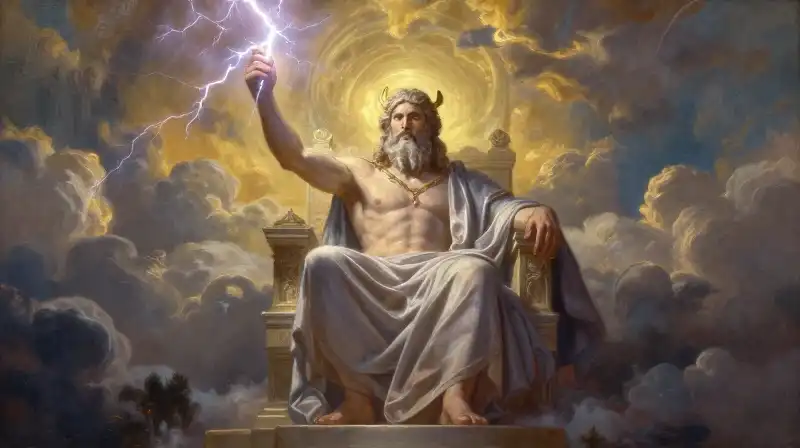
Hypnos: Understanding the Greek God of Sleep and His Role


Introduction
In the tapestry of ancient Greek and Roman cosmology, few figures are as intimately tied to the rhythm of human experience as Hypnos. He is the personification of sleep, a deity whose dominion stretches far beyond the quiet repose of the sleeping mortal. Hypnos represents a powerful nexus point between the waking world and the boundless unconscious—a state of being that was viewed not merely as rest, but as a transformative and profoundly potent realm. To understand Hypnos is to understand the critical role of transition in the ancient worldview: the shifting boundaries between light and darkness, life and death, and reality and the inner landscape of the dream.
The Foundations of the Night
Hypnos’s existence is intrinsically linked to the deepest aspects of the cosmos. He is fundamentally a deity of night, operating within the same celestial architecture as other primal forces. Scholarly records detail varying genealogies for this complex figure. While some texts designate him solely as the offspring of Nyx (Night), others acknowledge a more complex lineage, listing both Nyx and Erebus (Darkness) as his progenitors (1, 2). This connection to primal darkness anchors his domain in the vast, unlit reaches of existence. His sphere is further defined by his association with the Oneiroi—the spirits of dreams—and the Land of Dreams, a place situated near the River Lethe, the legendary flow of Forgetfulness (1, 2). This setting suggests that Hypnos’s power is tied not just to the act of sleeping, but to the ephemeral, sometimes baffling, nature of memory and subconscious thought. His Roman counterpart, Somnus or Sopor, serves the same function, allowing the tradition of sleep’s divine presence to persist across the Mediterranean cultures (1, 2).
The Symbiosis of Sleep and Death
What distinguishes Hypnos most profoundly within the Greek pantheon is his deep, inescapable connection to the finality of mortality. He shares a familial bond with Thanatos, the god of Death, and the two are frequently portrayed together. This pairing is particularly striking when examined in the sunless depths of the underworld (1, 2). This linkage implies that sleep was not seen as an escape from death, but often as a prelude to it, or at least a gateway managed by the same cosmic powers. This profound connection between the slumber and the tomb lends a gravity to his presence. It speaks to an ancient cultural understanding that the boundary between life and death was porous, traversed often through the nightly journey into the unconscious.
The Power to Shift Destiny
Hypnos’s immense power was not limited to the personal sanctuary of the sleeper; it extended into the great movements of mortal conflicts and divine affairs. In the great epic traditions, such as the *Iliad*, Hypnos is shown to hold a profound cultural significance. His ability to induce sleep was a mechanism for dramatic change, capable of putting the most powerful gods into a restful, vulnerable state, thereby altering the course of mortal wars (1, 2). Though traditional representations portray him as a calm, gentle deity, his vast capacity for influence also makes him a figure of complex manipulation. His gentle power can be harnessed for immense ends. A notable instance involves Hera successfully petitioning Hypnos to lull Zeus into a state of deep sleep, an act demonstrating how even the most serene of forces can be leveraged in the intricate political theatre of the gods (1, 2).
The Intimate Observation: Hypnos and Endymion
Beyond the battlefield and the underworld, certain mythological narratives delve into the intimate and contemplative side of his domain. The myth featuring Hypnos and Endymion offers a rare, tender glimpse into the nature of his power. In this narrative, Hypnos is portrayed not merely as a force that takes life, but as a loving observer who maintains a profound awareness even while lulling his beloved to sleep. This myth suggests a form of compassionate, attentive presence within the realm of dreams, elevating his role from a powerful agent of rest to a figure of quiet, sustained care 1.
From Divine Power to Modern Concept
The influence of Hypnos does not end with the scrolls and the bronze statues; it persists through language and art. His power over the deepest states of rest led to the etymological origin of the word “hypnosis,” referring to a sleep-like state that is deeply suggestive and alters perception 1. This modern application shows how the ancient concept of the controlled, altered state of consciousness has echoed through millennia. In the visual arts, Hypnos has served as a constant motif in Greco-Roman visual culture. He appears on countless vases and bronze statues. His enduring status within imperial culture is perhaps best exemplified by monumental representations, such as the head of Hypnos discovered within Hadrian’s Villa, cementing his transition from a mythological figure to a revered cultural icon 1.
Synthesizing the Meaning of Rest
Hypnos, the Greek god of sleep, demands that we look beyond a simple definition of rest. He is a powerful guardian of transition—a cosmic arbiter who governs the movement between the stark reality of wakefulness and the fluid landscape of the subconscious. His relationship with death, his capacity for subtle manipulation, and his gentle presence in stories like that of Endymion reveal a tradition that valued the mysteries inherent in the unconscious. He is not simply the god who makes you sleep, but the deity who holds the boundary between what we know and what we dream, shaping both the intimate life of the individual and the grand conflicts of the divine world.
References
Footnotes
Related Articles