Anubis: The Jackal God, Guardian of Egypts Afterlife

Introduction
In the rich tapestry of global heritage, few figures evoke such a potent sense of transition and solemn responsibility as Anubis. He is not merely a character in ancient myth; he is a deeply cultural embodiment of the necessary journey from the physical world into the Duat—the realm of the dead. To the ancient Egyptians, Anubis represented the critical juncture where life met eternity. He served as the paramount guide and protector of the soul, a deity whose role demanded precise ritual and unyielding authority. Understanding Anubis requires moving past the simple image of a jackal and seeing him instead as a profound cultural facilitator, a figure whose identity shifted from a pragmatic local protector to a central arbiter of cosmic justice.
The Jackal: Pragmatism and the Symbol of Renewal
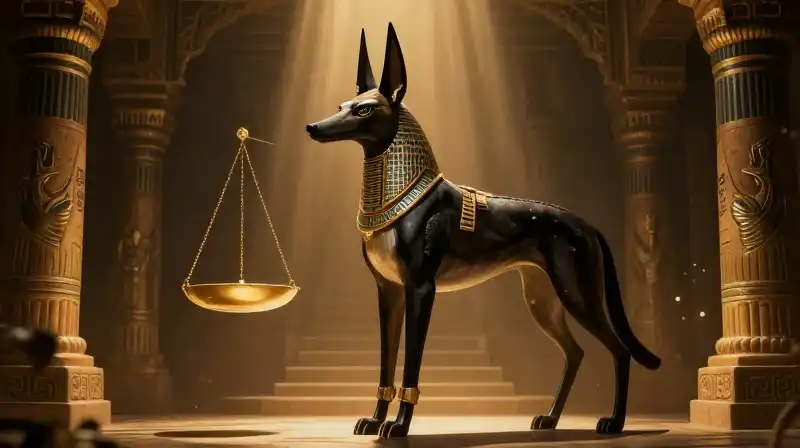
The choice of the jackal as Anubis’s form was not arbitrary; it was a testament to cultural adaptation. In early periods of Egyptian history, these resourceful creatures were often scavengers living in proximity to the burial grounds 1. This pragmatic link between the jackal and the cemetery allowed Anubis to grow from a local guardian of the necropolis into a significant figure in the national pantheon. The deep black color often associated with Anubis carried immense cultural weight. It was not a color of despair, but one of potent regeneration and rebirth. This symbolism connected the deity directly to the fertile, rich soil of the Nile River and the intricate process of embalming itself (1, 2). In this way, the jackal god represented the transformative power of decay and renewal—the essential process that allowed life, even in its eternal form, to persist.
The Guardian of Transition: Roles in the Afterlife
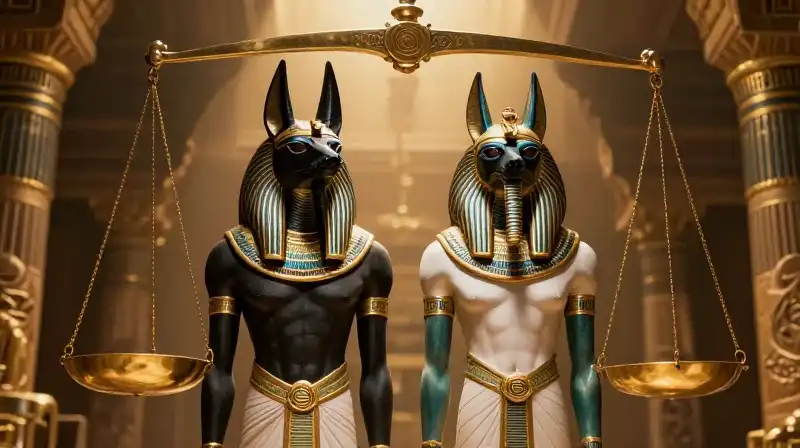
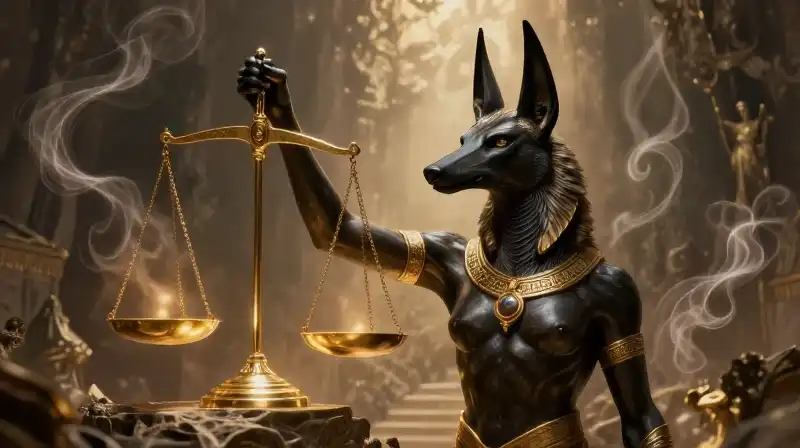
Anubis’s function was twofold, serving both the physical preparation of the body and the spiritual vetting of the soul. In the foundational stages of funerary rites, he acted as the ultimate embalmer and protector of the tomb (1, 2). His involvement in the mummification process was hands-on, ensuring the safe and proper preservation of the deceased. However, his most critical role in the spiritual afterlife was the supervision of the “Weighing of the Heart” ceremony. Anubis was the one who ensured the deceased’s heart was laid before the feather of Ma’at, the embodiment of cosmic truth and order. He oversaw this monumental process, determining whether the soul was pure enough to merit entry into the Duat, thus serving as the first critical judge of the soul’s worth (1, 2).
The Evolution of Power and Intellectual Reach
The tradition of Anubis was not static; it evolved significantly across Egyptian history, reflecting changing theological priorities. In the Old Kingdom, Anubis held the status of a paramount deity regarding death, but as dynasties progressed, his influence expanded into a broader role as a protector of graves and cemeteries 1. Critically, his standing relative to other gods changed: during the Middle Kingdom, his role was somewhat supplanted by Osiris, who assumed the role of the definitive lord of the underworld 1. Beyond Egypt, Anubis became a subject of keen intellectual inquiry and cultural assimilation. His complexity led to fascinating shifts. During the Ptolemaic era, his identity fused with the Greek god Hermes, resulting in the figure Hermanubis. This syncretism highlights the remarkable cultural ability of ancient Egyptian beliefs to integrate foreign traditions without losing their essential core (1, 3). Even in ancient Greece, Anubis’s importance was recognized by figures like Plato, who referred to oaths taken “by the dog, the god of the Egyptians,” cementing his identity as an arbiter of truth and a powerful figure in the underworld, regardless of the skepticism surrounding his animal form 1.
Nuance and Complexity in the Tradition
The cultural understanding of Anubis is rich with nuance that separates traditional mythology from modern simplification. The idea of a “jackal god” is not monolithic; some local cult inscriptions depict him serving highly specific, centralized funerary roles, contrasting with other traditions (1, 3). Furthermore, the traditional portrayals are not uniform. While sources often present him in male form, Egyptian folklore also features a complex array of jackal deities. These include female counterparts, such as Anput and his daughter Kebechet, illustrating that the themes of guardianship and transition were embodied by multiple divine figures within the broader jackal tradition 1. This complexity helps explain variations in depiction and belief across different communities.
Conclusion
Ultimately, Anubis transcends a mere definition of a mythical creature. He is a living testament to the human need for order in the face of death. His tradition teaches that transition is a powerful and necessary act, guided by an entity that understands both the earthy reality of decay and the eternal aspiration of the soul. Whether understood as the original embalmer, the ultimate judge, or a figure absorbed into later Greek culture, Anubis remains a profound symbol of the disciplined journey toward cosmic truth.
References
Footnotes
Frequently Asked Questions
Is Anubis based off of a jackal?
Yes, the jackal was chosen as Anubis’s form, and this choice was not arbitrary but was a testament to cultural adaptation. This association stemmed from early periods where these resourceful creatures lived near the burial grounds.
Who is higher than Anubis?
During the Middle Kingdom, Anubiss role was supplanted by Osiris, who assumed the role of the definitive lord of the underworld.
Why does Anubis not look like a jackal?
Anubis is understood as more than a simple jackal form; he is a profound cultural facilitator whose identity shifted into that of a central arbiter of cosmic justice. His tradition further evolved, leading to syncretism with other figures like Hermes during the Ptolemaic era.
Related Articles