Asgards All-Father: Exploring the Myth and Legacy of Odin

Introduction
In the world of Norse mythology, few figures loom as large as Odin, the All-Father. He is more than merely a powerful deity; he is a complex cultural embodiment of the unending human quest for knowledge, the burden of leadership, and the volatile balance between peace and conflict. For the modern reader of Living Culture, understanding Odin requires looking beyond his descriptions of martial prowess. To truly grasp this tradition is to appreciate the narrative of a leader who must sacrifice everything—including parts of himself—to ensure the continuity and welfare of the nine realms.
The Price of Insight: Odin and the Pursuit of Knowledge
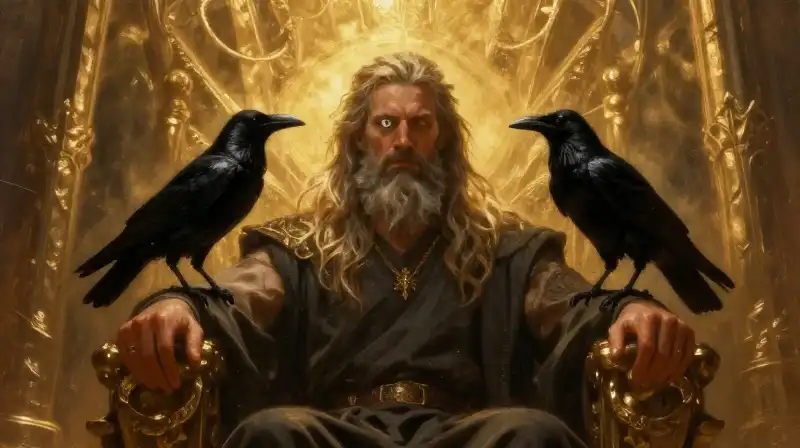
Odin’s traditional role extends far beyond that of a simple ruler of Asgard. He is fundamentally a God of wisdom, poetry, divination, and magic (1, 2). This pursuit of comprehensive knowledge drives much of his narrative. The cultural tradition surrounding this search is perhaps best exemplified by the legendary sacrifice of one eye. To drink from the Well of Urđr—a source of deep, esoteric knowledge—Odin famously gave up his sight 3. This act is not presented as a flaw, but as a defining characteristic of his culture: wisdom is not given; it must be earned through immense sacrifice.
This cultural dedication to insight is further reflected in his iconography. His loyal companions, the ravens Huginn (Thought) and Muninn (Memory), perpetually fly the world and return the gathered information to him 3. Alongside these intellectual aids are the wolves Geri and Freki, who represent his necessary engagement with the worldly elements of life, bridging the gap between abstract knowledge and raw existence 3. The presence of these specific animals illustrates the multifaceted nature of Asgardian wisdom—it requires both the keen insight of the mind and the enduring strength of instinct.
The Evolution of Leadership: From Conqueror to Stabilizer
The narrative arc of Odin provides a compelling study in leadership transformation. Early depictions often paint him as a conquering figure focused on maintaining imperial order through force. However, his cultural trajectory demonstrates a shift toward a model of collaborative governance 3. Recognizing that pure power is unsustainable, he worked to establish a new era of order that prioritized stability and diplomacy.
This evolution is marked by key strategic partnerships. His union with Frigga is portrayed as a move toward a powerful, collaborative bond. Frigga is described as a strong partner and a helpful ear, symbolizing the necessity of two sides of power working in harmony 3. Furthermore, his adoption of Loki, a Frost Giant born from Jotunheim, represents a profound attempt to bridge the ancestral gaps between the realms of Asgard and the volatile Jotunheim. This effort was a deliberate cultural gesture to foster permanent peace between beings who are inherently opposed, highlighting Odin’s focus on systemic harmony 3.
Conflict and Legacy: Managing the Realms
The challenges to Odin’s rule are often internal, reflecting the inherent fragility of the realms he governs. Conflicts with his daughter, Hela, illustrate a deep internal struggle regarding the nature of authority. In these stories, Odin ultimately chooses banishment and protection over demanding absolute dominion, signaling a leader who values the life and welfare of his subjects over unyielding personal power 3.
While Odin is inextricably linked to martial concepts and the protection of Asgard, his later actions underscore a shift in focus toward legacy. He actively works to ensure the long-term welfare of the realms and the eventual transfer of essential wisdom and leadership to a worthy successor, such as Thor 3. This ensures that even as Asgard undergoes change, the cultural thread of guardianship and responsibility remains unbroken.
Deeper Understanding: Addressing the All-Father’s Context
For many seeking to understand this tradition, questions arise regarding Odin’s specific roles and lineage. Odin is fundamentally known as the All-Father, the protector and ruler of Asgard and the Nine Realms (3, 1). This title signifies his ultimate authority across the known cosmology.
In terms of his family structure, Odin is revered as the father of Thor 3. While the traditions detail his many offspring, the specific count of his sons can vary across different narratives; however, the presence of Thor highlights the continuity of strength within the leadership of Asgard. Beyond these well-known figures, modern cultural adaptations often expand Odin’s reach, incorporating powers like dimensional transportation or the “Odin Force”—interpretations that adapt his ancient authority to serve the narrative demands of contemporary fiction (1, 2).
Living Culture and The Tradition’s Enduring Meaning
Odin’s myth is far from a dusty relic; it is a living cultural template for grappling with the complexities of governance and the cost of enlightenment. The tradition teaches that true power lies not in mere physical might, but in the willingness to pay a profound personal price—the price of an eye, the price of constant vigilance, and the price of political reconciliation with sworn enemies.
He represents the paradox of the ultimate leader: the seeker who sacrifices himself for the sake of the whole. Whether viewed through the ancient tales of Asgard or the lens of modern artistic portrayals, Odin remains a powerful symbol of the arduous journey toward wisdom and the enduring struggle to maintain a balance in a fractured world.
References
Footnotes
Frequently Asked Questions
Who is Odin of Asgard?
Odin is fundamentally the All-Father, recognized as the protector and ruler of Asgard and the Nine Realms. He is a God of wisdom, poetry, divination, and magic, representing the pursuit of knowledge and the complex burden of leadership.
Who are the seven sons of Odin?
The article states that Odin is the father of Thor, but it does not list the seven sons of Odin or specify the exact number of his offspring.
Related Articles