Ancient Egyptian Goddess Tefnut: Legend, Appearance, and Legacy


Introduction
In the vast cosmology of the ancient Egyptian worldview, deities were not merely distant figures but dynamic forces that shaped the very air we breathe and the cycles of life upon the fertile banks of the Nile. Tefnut, the goddess of moisture, stands as a vital component of this delicate, often paradoxical balance. She is intrinsically linked to the primordial atmosphere, positioned as the feminine counterpoint to the air god Shu 1. Far from being a passive figure in a celestial pantheon, Tefnut represents the essential, life-giving element of dampness and rain—the fluid transition between dry air and abundant life. To understand Tefnut is to understand the enduring Egyptian reverence for the delicate balance of creation, where the harsh, dry desert must meet the life-giving deluge.
The Cosmic Dialogue: Moisture and Air
The foundational narrative of the Egyptian creation is built upon the interaction of elemental forces, and Tefnut’s relationship with Shu is central to this drama. While Shu represents dry air, Tefnut personifies the moisture and humidity—the critical elements needed to sustain life. Scholars suggest her name, Tefnut, may itself be onomatopoeic, possibly referencing the sound of spitting or associated with her capacity as “she of moisture” (1, 2). Her mythological origin is not static; different traditions offer varying accounts of her birth, attributed to major creator figures like Ra or Atum. Some texts describe her being spat out like saliva, while others suggest she was sneezed into existence (1, 2, 3). This variability in her birth suggests that Tefnut’s existence is tied to the spontaneous, unpredictable nature of creation itself. She is an embodiment of the spark of life that emerges from the prime matter, serving as the mother to the primal cosmic elements: the sky (Nut) and the earth (Geb) (1, 2, 3).
Iconography and Symbolism: The Leonine Aspect
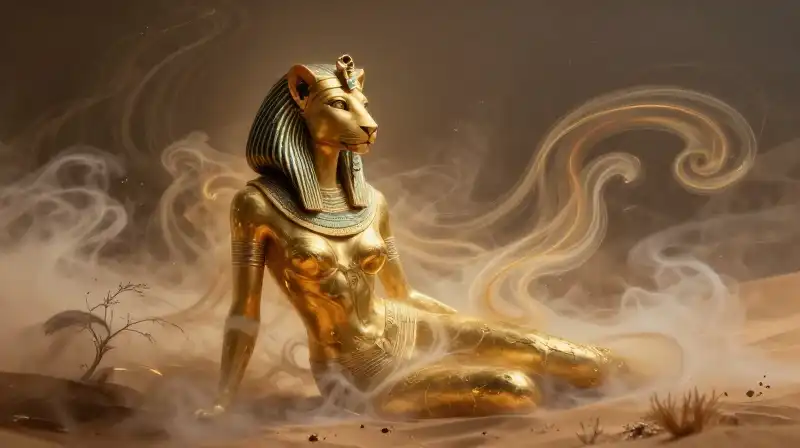
When depicted in temple reliefs and ancient artwork, Tefnut is characterized by powerful and intricate iconography that reinforces her dual nature. She is frequently portrayed as a leonine deity, appearing either as a powerful lioness or as a human woman possessing the noble, fierce head of a lion (1, 2). This lion motif speaks to both her royal stature and the primal strength she holds within the atmosphere. Her divine regalia further communicates her essential function:
- Solar Influence: She often bears a solar disk and the Uraeus (the sacred cobra), integrating her into the grand, sun-centered theology (1, 2).
- Divine Roles: Her symbols include the diadem, which denotes her status as a powerful goddess, and the role of “the Eye” and “the Daughter” within the divine lineage (1, 2).
Perhaps most profoundly, her narrative includes the title “Eye of Ra.” This term elegantly encapsulates her dual role: she represents the lunar aspect, tied to moisture and the rain that feeds the land, while simultaneously holding the solar aspect, which connects her to the forces of dryness necessary for the survival of arid lands 1.
Tefnut in Ritual and Regional Lore
Tefnut’s presence in Egyptian religious life was significant, particularly in major spiritual centers like Heliopolis, where she was an honored member of the Great Ennead 1. Her function was often tied to ritual purity and cleansing; she was incorporated into temple rites specifically for purification 1. Beyond her roles in creation and purity, her narrative gains a complex, regional dimension. Some traditions recount that Tefnut chose to leave Egypt for Nubia following a profound disagreement with her father, Ra 1. The narrative suggests she took with her the vital essence of all water. However, she did not remain away indefinitely; she eventually returned, tasked with bringing the life-giving inundation that allows the Nile to flow and the land to flourish 1. Furthermore, the portrayal of Tefnut was not uniformly benevolent across all mythological renderings. Certain specific traditions present a more “blood thirsty aspect” to the goddess, demonstrating the complex and evolving identity of the divine forces within the Egyptian spiritual landscape 1.
The Shifting Identity of the Goddess
The long history of Egyptian religion saw deities evolve, and Tefnut was no exception. Her identity was not fixed; it shifted in response to theological developments and political changes. For instance, her early associations with a god named Tefen, or later modifications to her role in the funerary traditions (such as the Weighing of the Heart), demonstrate a continual refinement of her mythological function 1. A striking example of this evolution is found during the Amarna Period. Under Pharaoh Akhenaten, the theological landscape was transformed. Here, Akhenaten and Nefertiti were frequently depicted as twin lion gods. This suggests a nuanced henotheistic phase in Egyptian solar religion where the characteristics associated with Tefnut—the lion imagery and the blend of solar/lunar forces—were elevated to the status of the divine couple 1. This shift illustrates how the powerful, primal energies of a traditional goddess like Tefnut could be repurposed and integrated into new, revolutionary religious expressions.
Synthesis: The Embodiment of Necessary Conflict
Tefnut offers a powerful lesson in the nature of balance within ancient Egyptian thought. She is not simply a god of rain, but a divine embodiment of *transition*—the movement from the dry, sterile air (Shu) to the moist, vibrant earth (Geb). Her legacy is one of essential duality: the interplay between life and dryness, life and death, the lunar and the solar. Her story, from her mysterious birth to her complex role in the Amarna pantheon, reveals that in the “Living Culture” of ancient Egypt, the deepest religious truths were often found in the harmony of opposing forces. Tefnut reminds us that life is sustained not by a single perfect state, but by the dynamic, sometimes volatile, relationship between its necessary opposites.
References
Footnotes
Frequently Asked Questions
What is the legend of Tefnut?
In one regional tradition, Tefnut left Egypt for Nubia after a profound disagreement with her father, Ra, taking the vital essence of all water with her. She eventually returned, tasked with bringing the life-giving inundation of the Nile to allow the land to flourish.
What did Tefnut look like?
In ancient artwork, Tefnut is frequently portrayed as a powerful leonine deity, appearing either as a lioness or as a human woman possessing the noble, fierce head of a lion. She is also depicted wearing a solar disk and the Uraeus.
What happened to Tefnut?
Some traditions recount that Tefnut left Egypt for Nubia following a profound disagreement with her father, Ra, taking with her the vital essence of all water. She eventually returned, tasked with bringing the life-giving inundation that allows the Nile to flow and the land to flourish.
Related Articles