The Kraken: Global Myths and the Origins of the Mythical Octopus

Introduction
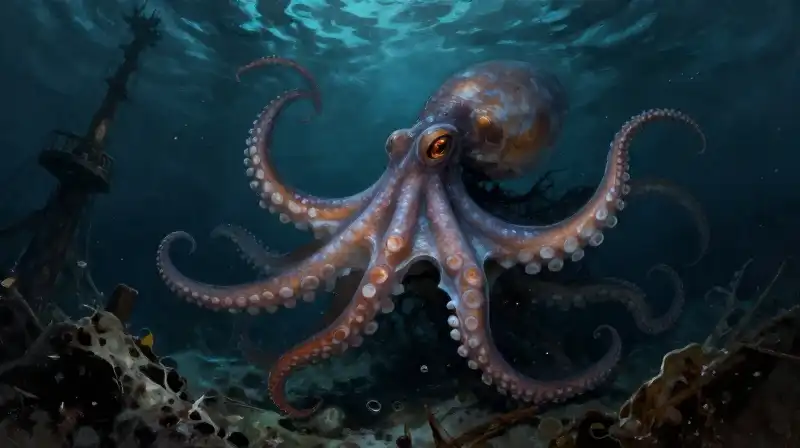
Few creatures command as much primal fear and mythological grandeur as the cephalopod. Yet, across the global tapestry of human tradition, the octopus, squid, and cuttlefish have never been confined to the biological realm. Rather, they have been elevated to symbols of untamable power, divine duality, and the profound, often dangerous, mysteries of the deep sea. While the modern Western imagination is often dominated by the colossal, tentacled menace known as the Kraken, a closer look reveals a far richer, more diverse heritage. The “mythical octopus” is not a single story; it is a shared cultural motif, reimagined in the folklore of Norwegian sailors, the divine cosmology of Hawaiʻi, and the epic confrontation narratives of the Pacific Northwest. These traditions illustrate how human communities interpret the immense, complex life of the ocean, transforming natural phenomena into narratives that define their relationship with the wild, unknowable forces of nature.
The European Enigma: Fear, Literature, and the Kraken
In European tradition, the Kraken exists as a figure of staggering, almost existential threat. Rooted primarily in the maritime lore of Norway and Greenland, the Kraken evolved as a narrative response to the historical sightings of massive deep-sea squid and the sheer terror of the unknown abyss. Early documentation, such as that provided by the Danish explorer Erik Pontoppidan in 1752, described the creature as a polypus of immense size [1, 2].
The literary portrayal of the Kraken solidified its position in the popular imagination during the 19th century. Works by authors like Victor Hugo expanded the local lore of the Guernseys’ “pieuvre octopus” and associated it directly with the mythical giant [2]. This cultural image is further supported by historical accounts from the 18th and 19th centuries, such as those documented by Denys-Montfort, which captured the intense zoological curiosity and maritime anxiety generated by the supposed “colossal octopus” [2].
Scholarly examination of the name itself offers a nuanced view of the creature’s origins. The etymological uncertainty surrounding the term is striking; the Old Norse root *krake* is often interpreted to mean “malformed or overgrown,” suggesting that the creature was not merely defined by size, but by its strange, complex, and sometimes overwhelming nature. This linguistic metaphor resonates with the sprawling, complex anatomy of a cephalopod and its drag-like tools [2]. Today, the term has even influenced the nomenclature of certain octopus species in various languages, referred to as “giant krakens” or “true krakens” [2].
The Divine Cephalopod: Cosmology and Power in the Pacific
While the Kraken is often framed as a destructive beast, the traditions of the Pacific cultures represent a different, more spiritual relationship with cephalopod life. Here, the octopus is frequently viewed not as a monstrous threat, but as a powerful divine intermediary.
In ancient Hawaiʻi, the cephalopod is intrinsically linked to the god Kanaloa. This divine figure is symbolized by the octopus or squid, embodying a profound spiritual duality—representing both the wild, untamable forces of nature and the forces that can be brought under human control. Kanaloa serves as a powerful god associated with the Underworld [1]. The mythological dynamic deepens in the Akkorokamui myth, a tale where a Hawaiian sea kami transforms a purely predatory monster into an octopus. This transformation allows the creature to evolve, ultimately developing venom and becoming a powerful, albeit destructive, symbol of a curse [1]. A variation of this myth adds a layer of cultural complexity: after being poisoned by trapped fishermen, the venomous octopus harnesses its pain, using it to better attack its prey, a narrative of transformation through suffering [1].
Similar powerful depictions are found in the Pacific Northwest among groups like the Haida, Tsimshian, and Nootka. These indigenous accounts feature the Cecaelia, a figure belonging to a spiritual octopus-tribe. Their narratives often place these figures in high-stakes confrontations with the trickster Raven, showcasing a worldview where the octopus represents primal, often powerful, forces in balance with more cunning, terrestrial forces [1].
Linguistics and the Anatomy of Myth
From a purely academic standpoint, the mythological fascination with the cephalopod aligns with its unique biology. Linguistically, the term used for these creatures often reflects their characteristic shape. The Greek concept of the cephalopod, for example, is built upon the prefix *cephalo* (head) and *podis* (foot), directly echoing the creature’s recognizable anatomical features [3]. This simple linguistic parallel highlights how human language has adapted to capture and categorize the strange, intricate anatomy of these creatures.
This relationship between form and meaning suggests that the power of the mythical octopus lies in its inherent strangeness. Whether through the Norse lens of something “malformed” or the Hawaiian lens of divine duality, the octopus embodies complexity, fluidity, and profound power—qualities that resonate deeply within human cultural narratives.
Addressing the Sea’s Mysteries: Divinity and Perception
The breadth of cephalopod mythology naturally leads to questions about their spiritual roles and biological capabilities. While no single global consensus exists on a definitive “octopus god,” cultures have long honored powerful sea entities. The Hawaiian traditions clearly identify Kanaloa, a divine figure symbolizing the powerful, dual nature of the cephalopod [1]. The general presence of these powerful mythical figures in various cultures serves as a way for communities to conceptualize the vast, unpredictable, and often indifferent power of the ocean itself.
Regarding biological perception, current understanding of the animal suggests that while they are not known to hear sound in the same way as terrestrial mammals, they are acutely aware of their surroundings through chemical, pressure, and tactile senses. This ability to perceive the environment, even in ways humans cannot, perfectly mirrors the mythological trait of these creatures—a knowing, watchful, and often inscrutable presence in the deep.
The Enduring Significance of the Sea’s Powers
The varied stories of the Kraken, Kanaloa, and the Cecaelia demonstrate that the mythical octopus is a cultural mirror. It is not merely a monster; it is a vessel for communities to explore concepts of duality, the balance between chaos and civilization, the weight of history, and the sheer force of nature. The difference between the fear of the Kraken and the divinity of Kanaloa is not a difference in the creatures themselves, but a difference in the community’s relationship to the uncontrollable power of the sea.
These traditions remind us that when we encounter the truly powerful or the deeply mysterious in nature, human culture rarely responds with a simple label. Instead, we craft complex narratives—transformations, gods, and behemoths—to help us understand the immense, living culture of the world’s deep waters.
References
Footnotes
Frequently Asked Questions
Who is the god of octopi?
In ancient Hawaiʻi, the cephalopod is intrinsically linked to the god Kanaloa. This divine figure is symbolized by the octopus or squid, embodying a profound spiritual duality.
Can octopuses hear?
While octopuses are not known to hear sound in the same way as terrestrial mammals, they are acutely aware of their surroundings. They perceive their environment through chemical, pressure, and tactile senses.
What is the octopus god called?
In ancient Hawaiʻi, the cephalopod is intrinsically linked to the god Kanaloa, who embodies a profound spiritual duality. Kanaloa serves as a powerful divine figure associated with the Underworld and the wild, untamable forces of nature.
Related Articles