Greek Fertility Goddesses: Their Roles in Agriculture and Birth

Introduction
In the study of living cultures, fertility—the ability to create life, sustain abundance, and ensure the continuation of a community—is perhaps the most profound and universal theme. It is a concept that transcends geographical boundaries, linking the success of the harvest directly to the prosperity of the human family. While the Greeks crafted a complex pantheon, their view of fertility was not monolithic; it was a nuanced tapestry woven from the raw power of the earth and the delicate, cyclical processes of human life. To understand the Greek fertility goddesses is to understand how ancient communities negotiated the most fundamental challenges of existence: famine, death, and the constant need for renewal.
The Sacred Cycles: Earth, Water, and Sustenance
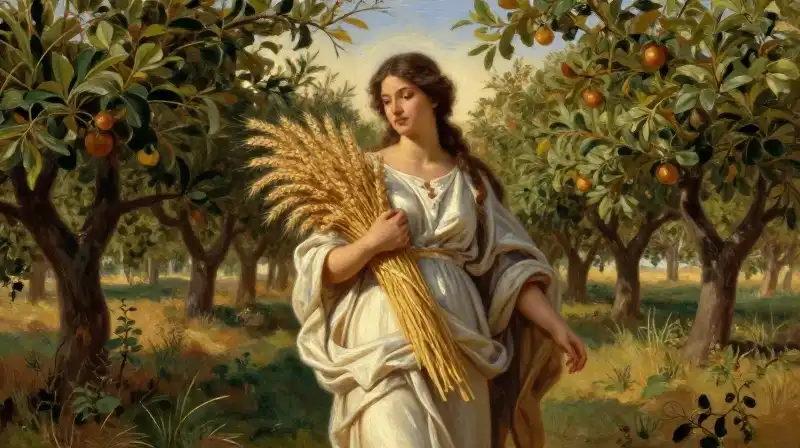
For the ancient Greeks, the concept of abundance was inseparable from the land itself. Fertility in this context was often viewed through the lens of agricultural richness, where the divine was seen as the guarantor of the yield. The Greek “earth mother” archetypes, such as Gaia, symbolized the ultimate foundation of existence, while figures like Demeter are strongly linked to agricultural fertility through their connection to the cycle of the seasons and the nourishment of the land 1. These myths were deeply rooted in the practical needs of farming societies. It is important to note that the divine roles were highly specific. While the mother goddess governed the earth’s bounty, other figures focused on particular elements. Cronus, for instance, is suggested by scholars to be linked specifically to the fertility of plants, demonstrating how mythological duties were often tied to the specific domains of growth and cultivation 1. This focus on agricultural richness contrasts sharply with the domain of sexual fertility, highlighting that the Greeks viewed the source of life in many multifaceted ways 1. These agricultural concerns are mirrored in global traditions; the very notion of life-giving power extends from the fertile fields of Greece to the nourishing waters of the Nile and the vibrant rivers venerated by deities like Oshun and Yemanjá 1.
The Architecture of Life: Deities of Birth and Conception
If the earth goddesses managed the crops, other divine figures handled the critical, often more vulnerable, transition of human life. The transition from concept to reality, from womb to birth, required a distinct set of divine intervention and observation. The Greeks utilized specialized deities to oversee the birth process, recognizing its complexity and sacred nature. Eileithyia was the primary goddess dedicated specifically to the process of childbirth 1. While she presided over the physical act, other figures like Hera, Artemis, and others appeared in narratives concerning birth, lending different layers of meaning—perhaps representing family protection or natural wild cycles—to the experience 1. Separately, the spark of conception itself was often attributed to other deities. In the Greek myth, Aphrodite occupied the domain of sexual fertility, representing the power of attraction and creation 1. By separating the forces of conception and the forces of delivery, the Greek mythological framework offered a granular understanding of reproduction, assigning specific roles to maintain cultural balance.
Beyond Taxonomy: Roles and Elements in Global Context
To genuinely understand a traditional system like that of the Greek pantheon, one must look beyond simple definitions and see how these deities function within a broader human narrative. Fertility, universally, is interpreted as a complex amalgamation of creation and death 1. This is a concept echoed in other global traditions, such as the Aztec figures like Coatlicue and Xochiquetzal, whose myths embody life cycles in their entirety 1. The range of elements assigned to these powerful feminine figures shows the adaptability of the concept. Some goddesses were linked directly to the physical elements required for life, such as fresh water and rivers (Oshun, Yemanjá), others to the earth itself (Pachamama, 2), and still others to astronomical bodies. The moon, through figures like Artemis and Hecate, was believed to influence the cyclical nature of woman’s bodies, pregnancy, and the nourishment of wildlife and plants 1. Scholars often stress that a deity’s ability to influence fertility is not always a singular, divine “power,” but rather a function of the specific roles assigned to them by the stories of that culture 1. For instance, the Yoruba goddess Oshun is venerated not just for sexuality and fertility, but also for luxury and pleasure, showing how a tradition can hold multiple, seemingly disparate aspects within one powerful archetype 1.
Navigating the Symbols: What Modern Study Reveals
When examining the symbols of fertility, the scope is immense. From the prehistoric Venus of Hohle Fels, hypothesized to symbolize abundance in food and milk 1, to the profound agricultural concerns of the Greek pantheon, the theme is clear: life requires sustenance, connection, and renewal. The study of these traditions offers a lens into how ancient communities viewed their relationship with the natural world. They did not see the earth as merely a resource; they saw it as a living entity, a recipient of divine care and offering. This respect for cycles—the planting and harvest, the birth and the passing—is the enduring legacy of these traditions. While modern scholarship continues to debate the precise “powers” these myths held, the cultural function remains the same: to provide language, reverence, and order for the fundamental forces of creation.
The stories of the Greek fertility goddesses are ultimately stories of balance. They illustrate how a people use mythology to grapple with the most essential truths of existence: that life is cyclical, creation is a multifaceted process, and the health of the community is inextricably linked to the health of the earth.
References
Footnotes
Frequently Asked Questions
What is a fertility goddess in Greek mythology?
In Greek mythology, fertility goddesses represented various facets of creation, such as the ultimate foundation of existence (Gaia), agricultural richness (Demeter), sexual fertility (Aphrodite), and the physical act of childbirth (Eileithyia). These deities assigned specific roles to maintain a granular understanding of reproduction and the cycle of life.
Who are the female fertility gods?
In Greek mythology, female figures linked to fertility include Gaia, Demeter (agricultural fertility), Eileithyia (childbirth), Aphrodite (sexual fertility), and Artemis. Other goddesses mentioned in global traditions include Oshun, Yemanjá, Pachamama, Coatlicue, and Xochiquetzal.
Related Articles