Lamia Mythology: Tracing the Shift from Tragic Queen to Monster

Introduction
In the vast tapestry of Greek and regional folklore, the figure of Lamia exists not as a static monster, but as a dramatic mirror reflecting humanity’s deepest anxieties regarding beauty, desire, and the consequences of loss. While often categorized simply as a child-devouring beast, Lamia’s myth is one of profound cultural evolution, tracing a path from a tragic, royal figure in North African legends to a seductive, vampiric force within the Mediterranean pantheon. For those interested in understanding the dynamics of ancient folklore, the story of Lamia offers a compelling case study in how cultural narratives adapt to reflect shifting societal fears and moral landscapes.
The Foundations of Tragedy: The Lamian Queen
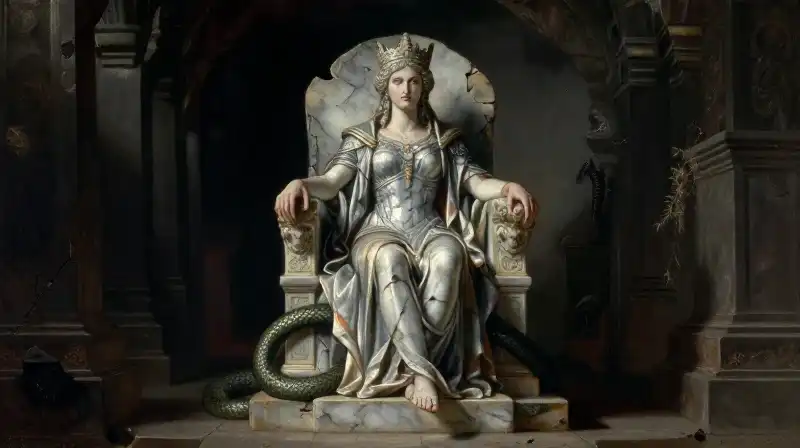
The earliest narratives surrounding Lamia often ground her in human, albeit elevated, circumstances. According to early accounts, she is variously identified as a beautiful queen of Libya, potentially the daughter of King Belus (1, 2, 3). Another foundational version posits her origins as a child of the sea-god Poseidon (2, 3). Her primary myth begins with a fateful encounter involving Zeus. When Lamia fell in the presence of Zeus, the jealousy of his wife, Hera, became the catalyst for her downward transformation (1, 2, 3). The nature of Hera’s punishment is a point of scholarly debate, emphasizing the ambiguity inherent in ancient traditions. Some accounts hold that she directly stole Lamia’s children (1, 2), while others assert that she personally killed them (1, 3). A less common, more psychologically acute variation suggests Hera compelled Lamia to eat her own children 1. This ensuing shame and overwhelming grief are universally believed to be the catalysts for Lamia’s monstrous change (2, 3), transforming her into a creature defined by distortion and consumption.
From Sorrow to Sin: The Monstrous Evolution
As Lamia’s figure circulated through Hellenistic and Roman culture, her manifestations shifted. In her earliest portrayals, she was often described as possessing specific, unsettling abilities. Some ancient accounts claim she had the power to remove and reinsert her eyes (1, 3)—a power some attributes to a curse of insomnia, while others suggest it was a gift from Zeus (1, 3). The creature’s appearance also saw variations. Initial traditions may have depicted her with a disfigured face (2, 3), but later literary works, such as Keats’ poem “Lamia,” influenced depictions to portray her as half-serpent and half-woman (1, 3). The serpentine quality, recognized as an analogue to part-snake beasts found in ancient myth, specifically ties her to the “Libyan myth” 1. During her phase as a “night-haunting spirit” or *daimon*, she served a clear social function in folklore: Lamia was often treated as a “bogeyman”—a terrifying force used to enforce obedience in children (1, 2, 3).
The Shift to Allegory: Seduction and the Sea
The evolution of Lamia’s character accelerated around the 1st century A.D., marking a distinct cultural reinterpretation. The focus shifted from tragedy and punishment to the themes of seduction, greed, and vampirism 1. In this later tradition, Lamia was redefined as a mesmerizing figure who lured young men with irresistible allure, only to consume their “fresh and pure flesh” or blood (1, 2, 3). This shift was mirrored by a change in her literal definition. The name Lamia itself is debated, but while some link it to serpentine qualities, the most direct Greek meaning translates to “large shark” (2, 3). This reinforces her ancient association with sea-monsters like Skylla and Akheilos (2, 3). The progression of the myth, therefore, is a fascinating cultural arc: moving from a purely regional, geographical force (the shark or the child-eater) to a sophisticated psychological allegory concerning predatory desire and consumption 1.
Comparative Folklore: Lamia and the Shades
To truly understand the scope of Lamia’s cultural presence, it is necessary to distinguish her from other mythical figures and terms that share a similar flavor of dread. One of the most common points of confusion is the comparison between Lamia and Lilith. While both are figures associated with female-led folklore and dangerous nighttime encounters, they originate from distinct cultural traditions. Lamia’s core myth is deeply rooted in classical Greek and Near Eastern mythology, focusing on transformation and consumption. Lilith, conversely, primarily emerges from Jewish tradition, often as a demonic figure representing rebellion against domestic authority. Furthermore, similar frightening entities were known by other names, such as *lamiai* or *mormolykeion*, suggesting that while Lamia is the most recognized iteration, the concept of the “creature of the night” or the “seductress monster” had broader regional variations (1, 2). The variations underscore the flexibility of these folk narratives to absorb local fears into a universal, frightening archetypal form.
The Enduring Significance of the Lamian Myth
The longevity of the Lamia myth across millennia is a testament to the power of the stories that shape community identity. She represents the uncomfortable intersection of beauty and inherent danger. She embodies the predatory nature of desire—how the most captivating allure can lead to the most profound consumption. Instead of merely defining the monster, examining Lamia allows us to see how different cultures process complex moral dilemmas: the agony of a divine punishment, the primal fear of being devoured, and the corrupting nature of unchecked appetite. She remains a powerful, if complex, cultural touchstone—a narrative reminder that in folklore, the darkest monsters often carry the most reflective mirrors of human nature.
References
Footnotes
Frequently Asked Questions
Are Lamia and Lilith the same?
No, Lamia and Lilith are not the same, as they originate from distinct cultural traditions. Lamias myth is rooted in classical Greek and Near Eastern mythology, focusing on transformation and consumption, while Lilith primarily emerges from Jewish tradition.
Related Articles