Domovoy: The Benevolent Protector of Slavic Homes and Myths

Introduction
The Domovoy—or Domowik—is more than a mere house spirit in Slavic mythology; it represents a profound cultural framework that links family stability, ancestral memory, and the physical space of the home. In the communities where these traditions thrive, the Domovoy is viewed as a tutelary deity whose influence often dictates the daily rhythm and fortunes of a kinship group 1. Far from being a “good” or “bad” entity in a binary sense, the spirit is a dynamic, sentient force that acts as the guardian of the domestic domain. It embodies the essential relationship between the inhabitants and their dwelling, offering a narrative where the health of the family is inseparable from the cleanliness and respect shown to the very walls that house them.
The Spirit of the Hearth: Meaning and Origins
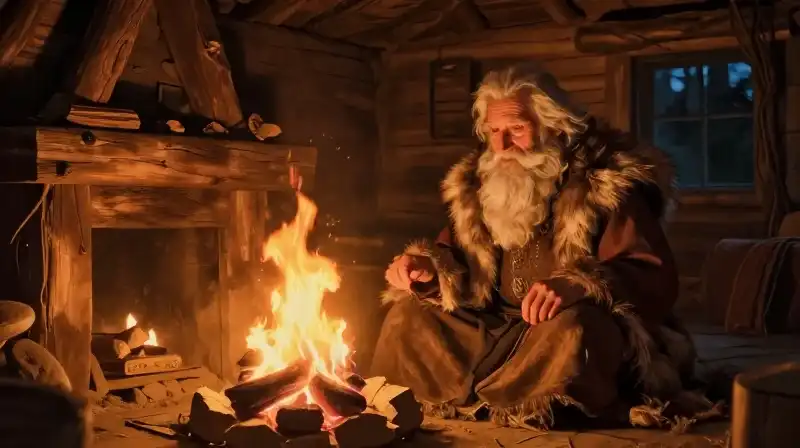
To understand the significance of the Domovoy, one must first look to the concept of the “abode” itself. Rooted in ancient Indo-European concepts tied to a “domain” or “homestead,” the Domovoy draws historical parallels to other venerated protective figures in neighboring cultures, such as the Roman Di Penates and the Slavic tradition of penates worship 1. Its primary cultural function is to safeguard the entire family unit—watching over the children, the livestock, and the collective joy and sorrow of the household (1, 2). The nature of this spiritual guardian is often fluid, which is key to understanding the complexity of the tradition. Unlike a static statue or a fixed divine entity, the Domovoy is capable of shifting its manifestation. It might appear to a family member as a wizened, grey-haired man, or it could present itself in animal form—such as a cat or a bear—or even as a shadowy projection of an ancestor who has passed (1, 2, 3). This fluid appearance contributes to the spirit’s mysterious and omnipresent role within the family’s daily life.
The Domestic Contract: Appeasing the Guardian
The survival of a household in traditional Slavic life often depended upon successfully maintaining a “domestic contract” with the Domovoy. This was a reciprocal relationship: the spirit provided protection, and the family was responsible for honoring the tradition. According to various practices, rituals were necessary to ensure the spirit’s favor and to prevent mischief. These rituals were highly specific and centered on domestic upkeep and small acts of generosity:
- Offering Provisions: Leaving small portions of leftovers or sacrificial offerings, such as a hen or the very first slice of bread, were common ways to acknowledge and appease the spirit (1, 2).
- Maintaining Order: Because the Domovoy’s mood was thought to be dictated by the state of the house, actively maintaining a clean and orderly environment was crucial 1.
- Honoring the Boundaries: Certain traditions involved specific symbolic gestures, such as burying small cloaks beneath the floorboards, reinforcing the spiritual connection between the inhabitant and the domestic space (1, 2).
When these conditions were met, the Domovoy functioned as a benevolent sentinel, diligently working to fend off external dangers like forest spirits or perceived threats, such as witches (1, 3).
A Dual Existence: Benevolence and Malice
Addressing the question of whether the Domovoy is “good or bad” requires an understanding of its conditional nature. The spirit is not intrinsically male or female in character; rather, its disposition is dictated by the conduct of the kin. If a family lives harmoniously, respects the sacred boundaries of their home, and performs their obligations, the Domovoy acts as a powerful protector (1, 3). Conversely, if the kin engage in poor behavior, neglect the house, or allow it to fall into disorder, the Domovoy can transform. It can become malicious, taking on a demonic aspect and actively causing trouble for the family (1, 3). This duality provides the necessary tension in the belief system: the spiritual welfare of the family is directly tied to their moral and domestic discipline.
The Broader Landscape: Ancestors and Regional Variations
The Domovoy does not exist in a vacuum; it is part of a much larger spiritual ecosystem that governs the domestic and agricultural realms. Specialized spirits exist to manage different aspects of a dwelling, such as the *Dvorovoy* for the courtyard or the *Bannik*, who rules the sacred and ritualistic space of the bathhouse (1, 2). This system provides a comprehensive map of the domestic spiritual universe. Furthermore, the Domovoy’s presence is often viewed through the lens of ancestor worship. In certain traditional practices, the spirit was believed to be the soul of a deceased family member, directly tying the Domovoy into the indigenous veneration of the departed 1. The culture of the Domovoy is also a mosaic of regional practices. The same concept manifests in various linguistic and geographic iterations, with names such as *Děd* in Czech or *Chozyain* in Russian. These local names reflect a diverse and deeply localized cultural adoption of the core concept of the protective household spirit 1. This localized practice ensures that the Domovoy remains a living part of the community’s unique heritage.
The Limits of the Tradition: Death, Mobility, and Debate
There are profound nuances that modern readers often mistake for simple folklore. One particularly sobering aspect of the Domovoy is that while generally protective, seeing the spirit could sometimes be interpreted as a dire sign. In some traditional accounts, a direct sighting of the Domovoy was regarded as an omen of imminent death 1. Another area of scholarly discussion surrounds the spirit’s “mobility.” Some traditions hold that the Domovoy is permanently bound to the physical structure of a specific house. Others posit that if the kinship group remains strongly attached and committed to the spirit, he will travel with the family, relocating to a new dwelling 1. Whether the spirit stays with the house or follows the family speaks to the core cultural valuation: is the family defined by their location, or by their ancestral commitment?
Synthesis: The Domestic Imperative
The Domovoy tradition is far more than a story of mythology; it is a powerful metaphor for the responsibility owed to the home and to the ancestors. In the contemporary world, where family units and physical homes are often transient, the Domovoy serves as a vital cultural reminder that our environments—both physical and social—are intertwined with our spiritual well-being. Whether you see it as a cosmic guardian, a familial ancestor, or simply the “patron” of the hearth, the Domovoy compels the observer to look beyond the surface of a building. It requires the occupant to engage in mindful maintenance, order, and respect. By honoring the spirit, the community engages in a practice of deep respect for its own history, space, and future.
References
Footnotes
Frequently Asked Questions
Is the Domovoy good or bad?
The Domovoy is not inherently good or bad, but rather a conditional guardian whose disposition is dictated by the kin. If the family respects the home and performs their obligations, the spirit acts as a powerful protector; however, neglect or poor behavior can cause it to transform and become malicious.
How do you appease a domovoi?
To appease the Domovoy, one must maintain a domestic contract by actively keeping the environment clean and orderly. Common rituals included offering provisions, such as leftovers or the first slice of bread, and honoring boundaries by burying small cloaks beneath the floorboards.
Is a Domovoy the same as a brownie?
The provided article does not mention the term brownie or compare the Domovoy to any other mythological figure.
What is the meaning of domovoi?
The Domovoy is a dynamic, sentient force in Slavic mythology that acts as the guardian of the domestic domain, linking family stability and ancestral memory to the physical space of the home. It functions as a tutelary deity whose influence safeguards the entire family unit and can represent the soul of a deceased family member.
How to Appease the Domovoy and Maintain the Domestic Contract
Offering Provisions
Leave small portions of leftovers or sacrificial offerings, such as a hen or the very first slice of bread, to acknowledge and appease the spirit.
Maintaining Order
Actively maintain a clean and orderly environment, as the Domovoy's mood is thought to be dictated by the state of the house.
Honoring Boundaries
Perform specific symbolic gestures, such as burying small cloaks beneath the floorboards, to reinforce the spiritual connection between the inhabitant and the domestic space.
Related Articles