
Pegasus: Myth, Lineage, and the Legacy of the Greek Winged Horse


Introduction
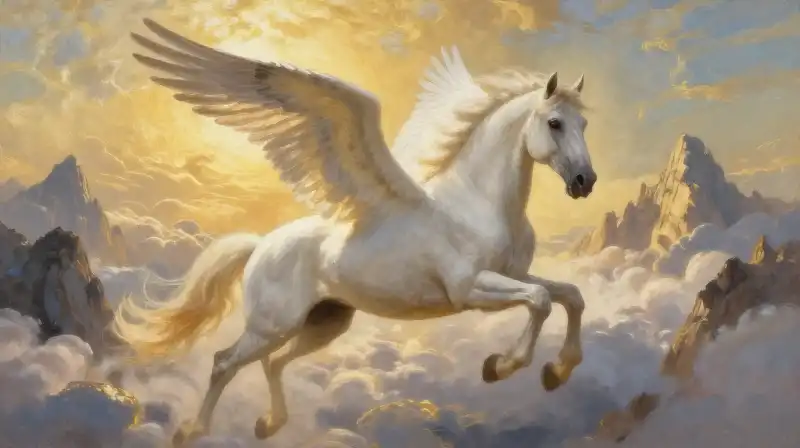
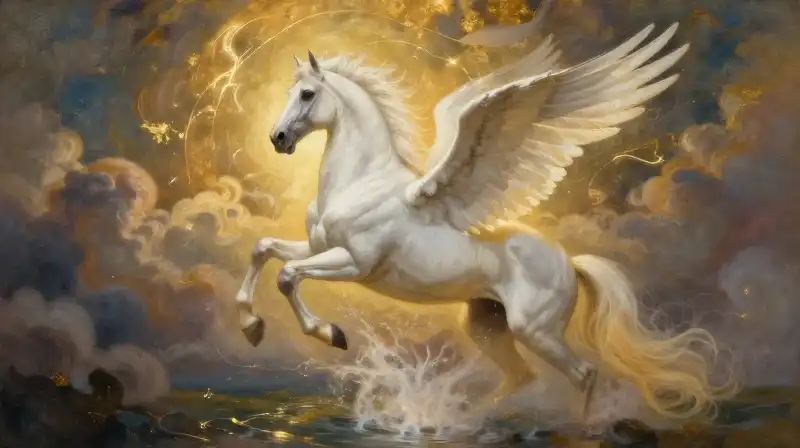
The winged horse, Pegasus, is far more than a mythological creature; it is a dynamic vessel of divine grace and boundless freedom that has shaped the cultural landscape of the ancient world and its modern descendants. Revered in Greek tradition, Pegasus emerged from the classical narratives as a powerful symbol of inspiration, the celestial, and the heroic. While the figure is commonly depicted as a majestic white stallion, the tradition speaks to a creature intrinsically linked to the peaks of Mount Olympus and the very essence of the Muses. To understand Pegasus is to delve into the cultural crossroads where myth, art, scholarship, and regional human history intersect, tracing how a divine lineage transformed into an enduring icon.
The Origins and Lineage of the Winged Horse
Pegasus’s genesis is woven deeply into the fabric of Greek folklore, connecting the creature to the most potent forces of the divine world. According to foundational accounts, Pegasus was conceived through a singular, dramatic event involving the goddess of serpents, Medusa, and the god Poseidon 1. In one of the regional variations of the myth, Pegasus was born directly from Medusa’s blood after she was beheaded by the hero Perseus. This powerful lineage, sired by Poseidon—who functioned as a horse-god—and foaled by Medusa, immediately imbued him with a unique status, linking him to both the sea and the foundational power of the Greek gods 1. The myth further details his pivotal role in the heroic age. Pegasus is famous for his association with Bellerophon, the celebrated hero who employed the winged horse to defeat the fearsome Chimera. This partnership cemented their place in the highest echelons of mythological hierarchy, ensuring their eventual connection to Mount Olympus 1. Furthermore, cultural variations persist regarding his physical form; while the iconic white stallion is standard, the legend’s true power lies in the fusion of his divine parentage and his astonishing ability to transcend the terrestrial realm.
Pegasus in Divine Lore: Inspiration and Power
The cultural significance of Pegasus extends far beyond his heroic exploits; his presence is inextricably linked to the concept of divine inspiration. He is credited with the creation of Hippocrene, a sacred spring located on Mount Helicon 1. This fountain holds profound significance because of its historical connection to the Mount Muses, suggesting that Pegasus is the conduit through which creative inspiration flows to the artists, poets, and thinkers of ancient Greece. Moreover, Pegasus is frequently associated with raw, potent divine power. His involvement in mythological service to Zeus included instances where he was tasked with carrying thunderbolts, a role that linked the winged horse not merely to flight, but to the symbols of storm and immense divine energy 1. This rich tapestry of attributes—inspiration, storm, and nobility—made Pegasus a powerful subject for the classical Greeks, influencing virtually every art form from pottery to coinage. The extensive iconography of Pegasus can be seen across ancient Greek pottery, elaborate Renaissance artworks, and even Roman bronze currency, demonstrating the universal appeal of the winged horse’s multifaceted symbolism 1.
The Debate Over Name and Species
Despite his pervasive presence in the myth, scholars continue to debate the precise nature of Pegasus. Was he merely a spectacularly winged animal, or was he something far more specific? While his name is used extensively in classical narratives, modern mythological analysis raises fascinating questions about his biological classification. Some etymologies suggest the name Pegasus derives from the Greek word for ‘spring’ (*pēgē*), referencing his origin at Hippocrene, while others propose a more contested Luwian link to the concept of lightning 1. More critically, some contemporary interpretations argue that Pegasus may not have been a representative species, but a singular demigod 1. This scholarly viewpoint, often discussed in online communities dedicated to mythology, suggests that the term *pterippus* is the generic Greek word for a winged horse, implying that Pegasus was a unique individual, a figure with a specific and singular divine destiny rather than a model for a class of creatures 1. This distinction between a generalized symbol and a specific, named deity adds a layer of nuance to understanding the depth of the tradition.
The Living Legacy: Modern Culture and Symbolism
The tradition of the winged horse has not remained confined to ancient ruins or dusty scrolls. In a remarkable testament to its endurance, Pegasus has evolved into a pervasive civic and symbolic motif across various cultures and eras. In ancient times, the winged horse served as a vital civic symbol, appearing on early Corinthian coinage, underscoring its importance in public life and commerce 1. This powerful symbolism persisted into Western cultural practices. Today, the figure of the winged horse continues to manifest in sophisticated heraldry, most notably appearing in British heraldry and the insignia of British World War II airborne troops 1. These modern incorporations demonstrate how the Greek tradition has been filtered through subsequent European history and repurposed to symbolize courage, transcendence, and aerial prowess—echoes of Pegasus’s original role as a conqueror of the sky and a vessel of inspiration.
Synthesis: The Enduring Meaning of the Winged Stallion
Pegasus endures because he embodies powerful cultural concepts: the marriage of wild power with divine guidance, the spark of creative inspiration, and the bridge between the mortal and the immortal worlds. Whether depicted on an ancient coin in Corinth, featured in Renaissance masters’ paintings, or appearing on the insignia of modern military forces, the winged horse represents a transcendent idea of freedom and elevated spirit. Understanding Pegasus requires looking past the simple definition of a winged horse; it requires appreciating the narrative—the journey from Medusa’s blood to the halls of Zeus—that established him as a living metaphor for the unreachable heights of human endeavor.
References
Footnotes
Frequently Asked Questions
Which winged horse of Greek mythology?
The winged horse of Greek mythology mentioned in the article is Pegasus.
Related Articles