
Traditional Día de los Muertos: Symbols, History, and Customs

Introduction
Día de los Muertos—or the Day of the Dead—is far more than a celebration of death; it is a profound act of cultural reunification. Across Mexico and Mexican diasporas, this tradition serves as a vital bridge, transforming the concept of finality into a festive reunion between the world of the living and the realm of the deceased 1. Unlike solemn days of mourning, this tradition encourages community gathering and exuberant remembrance. It is an ancestral way of acknowledging that while life moves forward, the connection to those who have passed remains unbroken.
The essence of Día de los Muertos lies in its refusal to separate memory from life. Through carefully constructed altars, the use of specific natural elements, and vibrant community practices, the living actively prepare the spiritual pathway for their ancestors to visit their homes and participate in the holiday. To understand this tradition is to understand a deeply held belief in the continuity of the spirit and the enduring power of family history.
The Alchemy of Memory: Mesoamerican Foundations and Syncretism
The richness of Día de los Muertos is rooted in its unique syncretism. It is a living testament to the complex evolution of Mexican culture, blending ancient, sophisticated Meso-American spiritual practices with later Spanish and European customs 1. This historical blending allowed the tradition to survive and adapt, creating a holiday that is simultaneously deeply rooted in indigenous cosmology and profoundly influenced by colonial history.
Ancient Mesoamerican beliefs held a view of the soul as cyclical, not simply ending upon death. This worldview is preserved in the modern tradition, which focuses on the passage and welcome of the spirit. When the tradition adopted Spanish influences, elements like religious iconography and the concept of formalized celebration were layered onto existing spiritual practices, resulting in a holiday that is both ancient and constantly evolving.
Navigating the Boundary: Spiritual Guides and Natural Elements
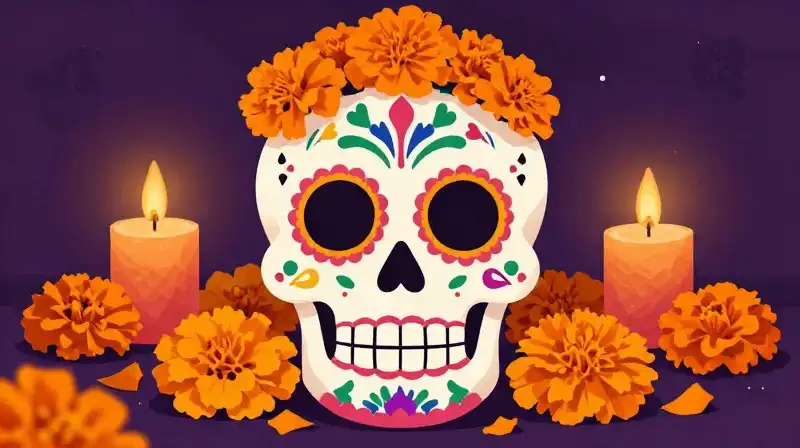
For the tradition to function, there must be a clear way for the spirits to navigate the transition from the supernatural back to the physical world. Specific elements serve as spiritual guides and directional markers. One crucial natural component is the *Cempasúchil*, or “Flor de Muerto.” Its pungent scent and vibrant color are believed to be powerful lures, acting as a fragrant roadmap that guides the spirits of the departed to their altars and graves 1.
Other symbols deal with the movement between realms. *Copal* incense, a practice dating back to ancient Mesoamerican times, is burned to purify the environment, marking the transition from the mundane world to the spiritual one 1. Furthermore, specific creatures and figures are invoked as guides. For instance, the ancient Mexican dog breed, the *Xoloitzcuintli*, was historically believed to lead the spirits across the river into the Underworld; today, this role is often represented by ceramic figures placed on altars 1.
The connection between the spiritual and the natural world is further highlighted by the migration of monarch butterflies. According to belief, these butterflies arrive in Mexico coinciding with November 1, acting as physical conduits for the visiting spirits of the departed 1.
The Offering: Symbolic Structure of the Ofrenda
The *ofrenda*, or offering altar, is the central physical expression of the celebration. It is not merely a collection of decorations; it is a meticulously designed, multi-layered map of the afterlife, structured to welcome the deceased. A central function of the ofrenda is to provide the ancestors with the necessary sustenance for their journey and their return 1.
The structure of the altar itself is deeply symbolic. Typically, an ofrenda features three levels, which represent the three cosmological realms: Heaven, Earth, and the Underworld 1. However, in more elaborate settings, the altar may feature up to seven levels, each carrying specific symbolic weight. The four essential elements placed on these altars symbolize the requirements of life and sustenance for the soul: water for purification, earth (provided through food) for nourishment, wind (represented by *papel picado* or perforated paper) for the spirit’s breath, and fire (candles) to illuminate the path 1.
The food items, such as the *Pan de Muerto*, are a key tradition. While recognized universally, the Pan’s placement and consumption vary significantly depending on regional customs across Mexico 1. The altar is a dynamic, personalized monument—a physical conversation between the living and the dead.
Beyond the Domestic Altar: Regional Expression and Social Meaning
While the *ofrenda* is a powerful intimate practice, the celebration is also a vibrant, communal affair, showcasing the incredible diversity within the tradition. Different regions of Mexico have developed unique customs that blend spiritual reverence with festive joy.
In states like Oaxaca, the celebration can take on a carnival-like energy through the *comparsa*. This event involves elaborate costumes, dancing, and public processions, emphasizing the celebratory aspect of death 1. In other areas, the practice of *tapete de arena* brings a different artistic dimension. These intricate sand sculptures, which can depict everything from themes of death played playfully to religious scenes, echo traditions found in older Spanish Catholic festivals, showing the layers of cultural influence 1.
Furthermore, the skeletal imagery of *calacas* (skeletal figures) and *La Catrina* offers a layer of social critique. La Catrina, specifically, is a satirical figure created in the 1900s to humorously critique the pretensions of upper-class women, mocking their obsession with vanity even in death 1. This tradition, while appearing lighthearted, is ultimately a commentary on the universality of fate, regardless of social standing.
The Living Meaning of the Tradition
What transcends the intricate symbolism and regional customs of Día de los Muertos is its singular philosophical stance: that death is not a termination, but a shift in relationship. By exchanging traditional mourning for heartfelt celebration, the holiday achieves something unique in the global calendar 1. It forces the living to engage directly with their heritage and their mortality.
The tradition ultimately asks the participants to honor the bond that never truly breaks. It is a powerful cultural mechanism that takes the fear and grief associated with loss and transforms it into a purposeful, loving acknowledgment of shared life. It is a practice built on the conviction that as long as the memory is kept alive on the altars and in the community, the connection remains eternal.
References
Footnotes
Frequently Asked Questions
What are the four elements of the ofrenda?
The four essential elements on the altars are water for purification, earth (through food) for nourishment, wind (represented by papel picado) for the spirits breath, and fire (candles) to illuminate the path. These elements symbolize the requirements of life and sustenance for the soul.
Related Articles