
The Myth of the Kraken: From Norse Lore to Giant Sea Monster

Introduction
The story of the Kraken—the colossal, tentacled leviathan of the deep—is more than just a thrilling tale of a sea monster; it is a powerful narrative woven into the very fabric of Scandinavian seafaring culture. It serves as a complex cultural archetype, embodying the immense, inscrutable power of the North Atlantic Ocean. To understand the myth of the Kraken is to understand the relationship between human ambition, the overwhelming power of the natural world, and the need to explain what lies beyond the horizon. This legend, which has captivated imaginations globally, has evolved from simple folk tales to a profound symbolic representation of the deep’s mystery.
The Seeds of a Legend: From Tool to Terror
While today the Kraken is universally recognized as a fearsome, giant cephalopod, its history reveals a fascinating linguistic journey. The term did not begin with an 18th-century popular description of a monster. In its earliest recorded usage, the Old Norse word *krake* actually referred to very practical, human objects: specifically, a malformed tree or a type of hook-based drag utilized by fishermen 1. This suggests that the “Kraken” was originally associated with crooked or powerful nautical tools rather than a beast. The transition from a description of equipment to a mythological creature was gradual. As the maritime culture grew, so did the imagination. In the 18th century, figures like Pontoppidan began popularizing the image of a gigantic, multi-limbed octopus, a powerful new visual template that defined the monster for the English-speaking world 1. Early historians suggest that the myth may have grown from the observational lens of sea-faring communities, who interpreted rare encounters with enormous, unfamiliar creatures as signs of divine or demonic forces 1.
The Ocean’s Reflection: Scientific Observations and Myth
The question of what animal the Kraken most closely resembles touches upon a long-running academic and cultural debate. While classical mythology presents it as a purely fantastical beast, many scholars suggest the legend may be rooted in genuine, though rare, encounters with enormous marine life (2, 1). The Giant Squid, which can attain lengths of up to 10 meters, is the primary biological candidate often cited 1. In a sense, the Kraken may function as a cultural amalgam of several real-world phenomena. The myth provides a symbolic vessel for the memory of massive creatures that washed ashore or were sighted in the murky depths. When people interpreted these rare, gigantic cephalopods—like the giant squid—through the cultural lens of Norse myth, the creature transcended its biological form. It became less of a specific species and more of an embodiment of the unknown power of the abyss.
The Cultural Weight: The Kraken as an Archetype of the North Atlantic
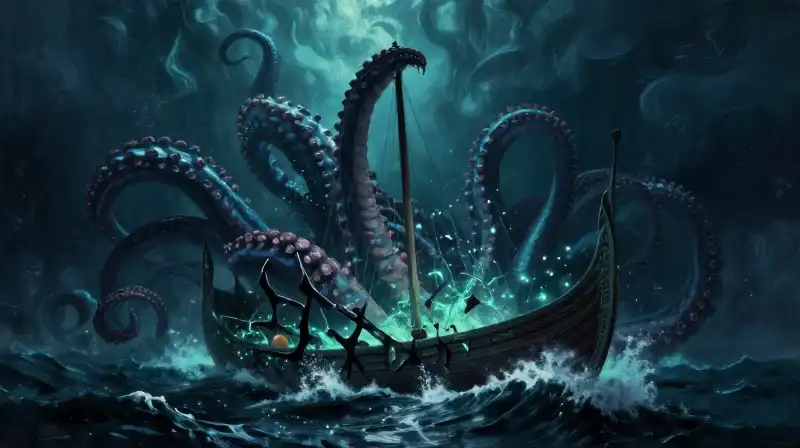
For the communities that live on and navigate the unforgiving seas of the North Atlantic, the Kraken was a living embodiment of their greatest challenges and fears. It represented the immense, untamable power of nature. Unlike abstract dangers, the Kraken was a tangible threat to survival, seen as a force capable of dragging entire ships and sailors into the darkness 1. This fear extended beyond the simple fear of sinking; it was a cultural acknowledgment of human fragility in the face of oceanic might. In local medieval lore, figures such as Hans Egede (1734) linked the monstrous sightings to existing local legends, such as the *hafgufa*, demonstrating how mythological narratives helped process environmental realities 1. The Kraken, therefore, became a symbol of both the immense wealth and the profound danger of the maritime world.
From Sea Lore to Global Taxonomy
As the myth gained traction and spread beyond its Scandinavian roots, the Kraken did not simply remain a piece of folklore; it achieved a surprising level of cultural ubiquity. The term evolved from a vague “sea monster” to a specific, recognizable icon—sometimes depicted with tentacles that reach an unbelievable mile in length—1. This global reach led to its use far beyond poetic description. The word *krake* began its transition into a formal taxonomic term, eventually being used in Swedish and German to give its name to the entire Cephalopod order, Octopoda 1. This transition highlights a unique cultural achievement: a terrifying legend of a beast became so powerful and pervasive that it influenced how people scientifically categorized the very creatures it was inspired by. Furthermore, regional variations exist; in some areas, synonyms for the beast, such as *horven* (“the horv”), have been noted, with some conjecture linking them to the action of a ‘harrow’ due to the swift, sweeping movement of certain inkfish 1.
The Enduring Mystery: A Phenomenon of Shared Imagination
The persistent global fascination with the Kraken can be viewed through the lens of “convergent evolution in myth form” 1. Like other ancient, terrifying ocean concepts such as Scylla and Charybdis, the Kraken represents a universal human desire to categorize and name the incomprehensible threats lurking in the dark waters. No matter the region, the idea of a massive, hidden force beneath the waves is a recurring cultural thread. The Kraken thus serves as a dynamic example of how culture processes nature. Whether stemming from a fisherman’s crooked drag, the sighting of a giant squid, or the simple fear of a tempest, the myth gives human shape and narrative purpose to the vast, dangerous unknown of the ocean. It reminds us that a tradition is not merely a story, but a mechanism by which a community understands its place in a powerful, and often unpredictable, world.
References
Footnotes
Frequently Asked Questions
What animal is closest to a Kraken?
The Giant Squid is cited as the primary biological candidate that the Kraken may closely resemble. This gigantic cephalopod can attain lengths of up to 10 meters.
How did the Kraken become a myth?
The term originated in Old Norse as a description of practical tools like fishing drags, but it became a myth as sea-faring communities interpreted rare sightings of enormous marine life, such as the giant squid, through the cultural lens of Norse myth. This transition involved popularizing visual templates in the 18th century and viewing these encounters as signs of powerful, unknown forces.
Related Articles