The Ennead: How the Nine Gods of Heliopolis Created the World

Introduction
To understand the ancient Egyptian worldview is to understand the rhythm of the cosmos, and nowhere is this cosmic rhythm better illustrated than in the Heliopolitan creation myth. At the heart of this tradition lies the Great Ennead, a pivotal group of nine deities that served as the foundational “family” responsible for bringing order out of the primordial void. This was not merely a collection of figures, but a theological blueprint for how the world functioned and how divinity was structured. Located in the city of Heliopolis, this tradition was centered around the cult of Atum, the sun god, and profoundly shaped the religious life of the Old Kingdom, surviving and influencing thought until the Ptolemaic period 1. The Ennead represents the complex interplay between solar power, natural forces, and the ultimate triumph of life over disorder.
The Genesis of Creation: From Atum’s Self-Making
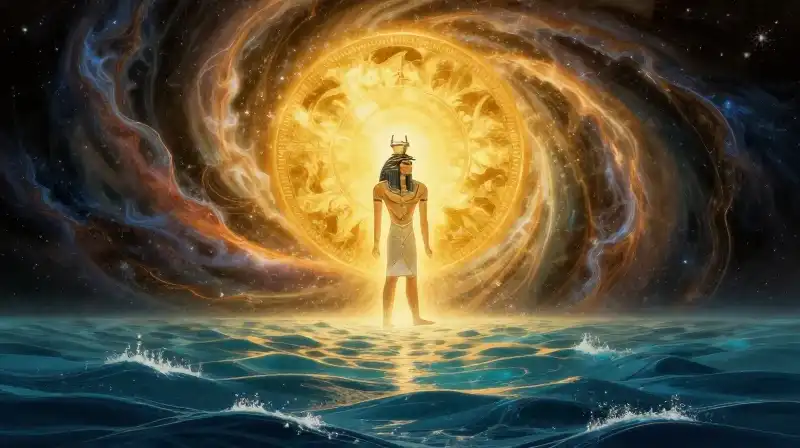
The Heliopolitan narrative begins with a solitary, primordial force known as Atum, who is often identified with the radiant sun god, Ra 1. In this framework, the act of creation is not one of external intervention, but of self-manifestation. Atum, embodying the fundamental life force of the early universe, produced air (*Shu*) and moisture (*Tefnut*). These elements, necessary precursors to land, subsequently fathered the physical world: the earth (*Geb*) and the nighttime sky (*Nut*) (1, 2). This initial generation sets the stage for the next critical stage of development—the formation of the “divine family.” The terrestrial and celestial parents then gave birth to the most recognizable figures of the Ennead: Osiris, Isis, Set, and Nephthys (1, 2). By integrating the creator into this subsequent family lineage, the cosmology established a stable, generational structure that mirrored the hierarchical order of the Egyptian world. Furthermore, within this myth, Osiris is situated as Atum’s great-grandson, thereby solidifying the ancestral link between the ultimate creative source and the kingship of the mortal realm 1.
The Dynamics of Order and Chaos
The most profound cultural lesson offered by the Ennead is the necessary balance between opposing forces. The mythological structure is not merely a list of deities; it is a theological representation of universal dynamic tension 1. The figures representing order, fertility, and kingship are largely consolidated in Osiris and Isis. Osiris embodies the cycle of death and rebirth—the vital cycle of the Nile and the agricultural seasons. Isis, the devoted mother and magician, represents cosmic order and the active force of life that defends that order. In stark counterpoint stand Set and Nephthys. While they are integral members of the family, they embody the forces of chaos, untamed nature, and conflict (1, 2). This division is essential to the Egyptian understanding of existence. The universe, in the Heliopolitan view, was not perfect but was a perpetual negotiation between the established order (Ma’at) and the persistent potential for destruction. This struggle between creation and entropy gave shape to the cultural anxieties and rituals of the people.
Beyond Heliopolis: Regional Variations and Historical Context
While the Great Ennead of Heliopolis is the most prominent grouping associated with the cult of Atum (or Ra-Horus of the Horizons), it is crucial to recognize that ancient Egypt featured multiple, sometimes overlapping, religious traditions across different regions and time periods 1. The cultural prevalence of the Heliopolitan Ennead did not preclude other local traditions. For instance, the theological schools in other cities developed alternative systems. For example, the Hermopolitan tradition utilized the Ogdoad, an eight-god model, and the Memphis theology presented its own distinct framework for world creation 1. The dominance of the Ennead suggests a purposeful effort to elevate the role of Atum and the sun cult, an idea scholars theorize might have been established by the powerful Heliopolitan priesthood to reinforce their theological authority 1. Furthermore, some Egyptologists question the traditional theories surrounding the precise development and eventual recovery of this specific Ennead structure after the prominence of the cult of Ra 1. This historical uncertainty reminds us that the myths we study are complex, evolving documents of human belief.
Cultural Endurance and Scholarly Understanding
The resonance of the Ennead extended far beyond the borders of Heliopolis. The Egyptian term *psḏt*—meaning “the Nine”—was so significant that it was adopted as a loanword into the Greek and Latin languages, eventually becoming the English word “ennead” 1. This indicates the profound, global linguistic and conceptual weight of this particular grouping of gods. Modern academic study views these varied creation narratives—Heliopolitan, Memphite, Hermopolitan—not as mutually exclusive competing myths, but as different perspectives on the same fundamental truths 1. The Egyptian tradition, therefore, suggests that the truth of creation lies in the convergence of these various stories. While the Heliopolitan Ennead remains the most prominent grouping in academic discourse, the broader tapestry of the divine is understood to be plural, reflecting a cultural embrace of diversity in religious expression (1, 2). The long-standing cultural significance of this solar family is evident in the continuous nature of the cult of Atum, which was maintained across eras, from the Old Kingdom deep into the Ptolemaic period 1. This enduring presence demonstrates how deeply the concepts of order, divine lineage, and cosmic negotiation permeated the culture and persisted across centuries.
Synthesis: The Meaning of Divine Family
To truly understand the Ennead is to see it not as a static list of names, but as the architectural plan for a universe built on balance. It is the story of how a singular, self-creating divine force—Atum—generated the physical world and organized it into a perpetual, complex family drama of creation and maintenance. By examining the tension between the disciplined order of Osiris and Isis and the raw power of Set, the Heliopolitan traditions give the reader a sophisticated understanding of the nature of reality: a place where life thrives only because it is constantly negotiating the powerful forces of chaos.
References
Footnotes
Frequently Asked Questions
Who are the 9 primeval gods?
The Heliopolitan Ennead originates with Atum, who produced air (Shu) and moisture (Tefnut), leading to the physical world of Geb and Nut. These parents subsequently gave birth to the next generation: Osiris, Isis, Set, and Nephthys.
Related Articles