Khonsu: The Ancient Egyptian God of the Moon and Protector

Introduction
In the vast tapestry of ancient Egyptian mythology, few figures as profoundly tied to the rhythms of daily life as Khonsu. He is a deity whose essence shifts with the lunar cycle, a celestial “traveler” whose movements across the night sky mirrored the passage of time itself. While he is primarily recognized as a moon god, understanding Khonsu requires looking past the mere definition of a celestial body. He was a potent symbol of life, fertility, protection, and even necessary destruction.
Khonsu, whose name literally translates to “traveler,” embodies the perceived movement of the moon across the heavens (1, 2). Far from being a purely passive observer of the stars, Khonsu played a vital role in the cultural life of the people, acting as a guide for those traveling under the cloak of darkness and as a harbinger of agricultural renewal. This article explores how the ancient Egyptians conceived of this divine protector and the complex, dual nature of his tradition.
The Traveler and His Iconic Forms
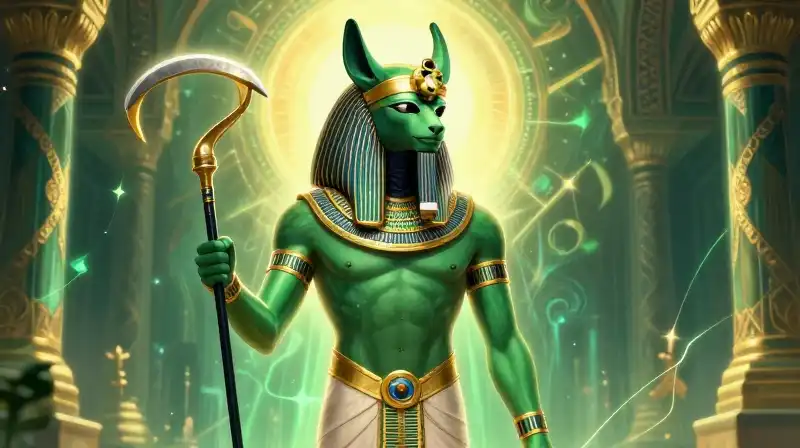
The iconography of Khonsu reflects the multifaceted nature of his power. He was not consistently depicted in one form, but rather adapted to his shifting divine roles 1. In his lunar aspects, he was often represented as a falcon wearing the moon-disk and crescent moon, or sometimes as a human child 1. When depicted as a human, he was often given green or blue skin, symbols frequently associated with growth and vitality 1.
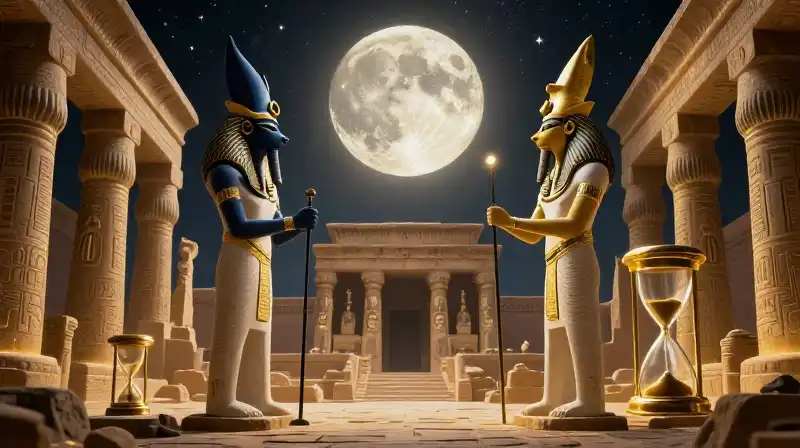
His symbolism included specific adornments that signaled his various powers: the *menat* necklace, a distinctive sidelock of hair, or emblems of childhood 1. Culturally, Khonsu was inextricably linked to the concept of time. Alongside the god Thoth, he served as a marker of calendrical time, linking the cosmic cycle to the terrestrial calendar 1.
A Protector of the Night Road
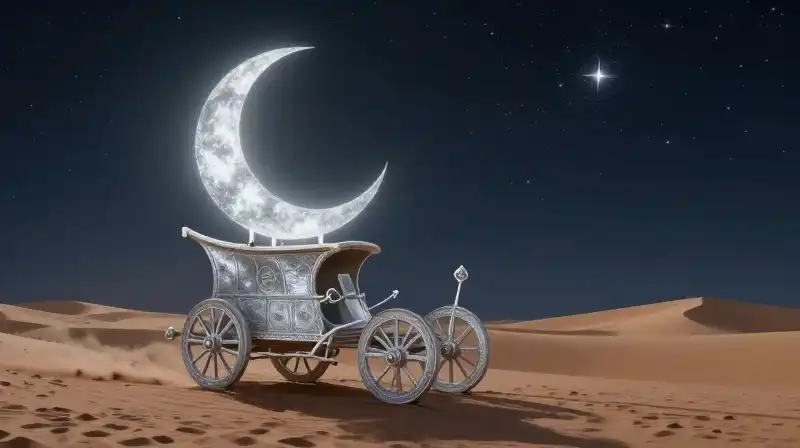
One of Khonsu’s most vital roles was that of the protector. Ancient Egyptians invoked his name to safeguard those who journeyed at night against the wild dangers of the desert and the unpredictable forces of the unknown (1, 2). He served as a spiritual “Pathfinder” and “Defender,” a figure invoked by travelers seeking safety under the cover of darkness (1, 2). His epithets, such as “Embracer” and “Pathfinder,” highlight this compassionate but powerful guardianship.
Beyond simple protection, his association with baboons, which in ancient Egypt held specific symbolic roles, further contextualized his domain as a watchman of the natural world 1. Thus, to the community that worshipped him, Khonsu was not just a symbol in a temple; he was a living presence ensuring the safe passage and continuity of life.
Cosmic Cycles and Fertility
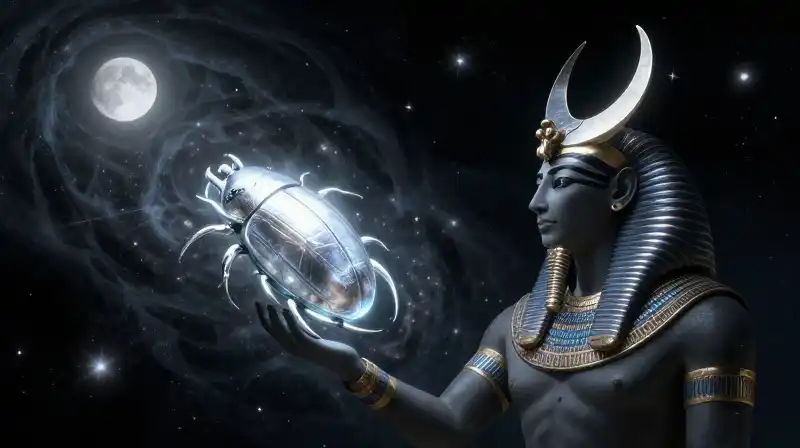
Khonsu’s attributes extended deeply into the cycles of nature and life itself. His lunar influence was tied intrinsically to the sacred concepts of conception and fertility (1, 2). It was a widely held cultural belief that the appearance of the crescent moon facilitated conception in women and significantly increased fertility in livestock (1, 2).
During the New Kingdom, the god’s influence became so dominant in the city of Thebes that it was believed Thebes itself served as a heaven housing both the sun (Amun-wer) and the moon (Khonsu), reflecting the depth of his cultural significance to the community 1. Mythologically, this cyclical nature was visible in his life narrative, which transitioned from a child to an old man, symbolizing the renewal of the lunar cycle and the arrival of spring 1. In some creation myths, Khonsu even appears as a great snake fertilizing the “Cosmic Egg,” reinforcing his role as an engine of genesis 1.
Duality: Protector and Destroyer
While often viewed through the lens of protective guidance, Khonsu’s tradition also possesses a dark, complex duality. His role was not always one of serene preservation. Early texts, such as the Cannibal Hymn, reveal a “butcher” aspect of the deity who performed acts of powerful extraction—taking the entrails of other gods to empower the deceased king 1. This contrasts sharply with his protective reputation, showcasing a tradition that valued the necessary balance between creation and necessary sacrifice.
In the context of the Underworld, Khonsu’s function shifted again. He was depicted as a “Wepwety” or “messenger,” involved in the critical process of destroying the heart, a ritual tied to the judgment of the deceased. This also led to him being equated with the concept of stealing magical powers from other divine figures 1. These narrative layers demonstrate that the Egyptian understanding of Khonsu was not monolithic; it was a tradition that acknowledged the full spectrum of life—from creation to ultimate dissolution.
Clarifying the Divine Narrative
Given the broad reach of modern cultural discussions, it is essential to clarify the historical context of Khonsu. Khonsu is strictly an ancient Egyptian deity; he is not a Greek god (r/mythology), nor is he the son of Ra (unless interpreted within specific, localized mythologies). His identity is rooted firmly in Egyptian cosmology and the mechanics of the moon (1, 2).
Furthermore, there are fascinating variations on his myth. One Ptolemaic legend portrays him as a young bull who matures into an old, castrated bull during the full moon, only to renew himself at the start of the next lunar cycle 1. In other narratives, his relationship with Nut, the sky goddess, involves a dispute where she tricks him during a game to extend the year, allowing her to conceive her children 1. These specific stories show how local traditions layered meaning onto the core lunar archetype.
The Enduring Meaning of Khonsu
To genuinely understand the tradition of Khonsu is to appreciate the deep cultural value placed on timing, transition, and the necessary duality of existence. Whether he is the guiding falcon or the fierce divine butcher, he represents a fundamental Egyptian truth: that life is a continuous, powerful cycle of creation and renewal, marked by the constant movement of celestial bodies and the profound changes within the self. He remains a powerful reminder of how ancient peoples read the stars not just as physical objects, but as divine forces that structure community, health, and destiny.
References
Footnotes
Frequently Asked Questions
Is Khonshu a real Egyptian god?
Khonsu is an ancient Egyptian deity whose identity is rooted firmly in Egyptian cosmology and the mechanics of the moon. He is strictly an Egyptian god and not a Greek god.
Is Khonshu a Greek god?
Khonsu is strictly an ancient Egyptian deity and is explicitly stated to not be a Greek god. His identity is rooted firmly in Egyptian cosmology and the mechanics of the moon.
Is Khonshu the son of Ra?
Khonsu is an ancient Egyptian deity, and he is not the son of Ra unless interpreted within specific, localized mythologies.
Related Articles